
Glamping is a fast-growing, high-ADR slice of outdoor hospitality — but demand is concentrated, not everywhere. Here is where projects pencil, and the discipline lenders require before they fund one.
Firm-wide engagement figures are distinct from project-specific findings and their stated source periods.
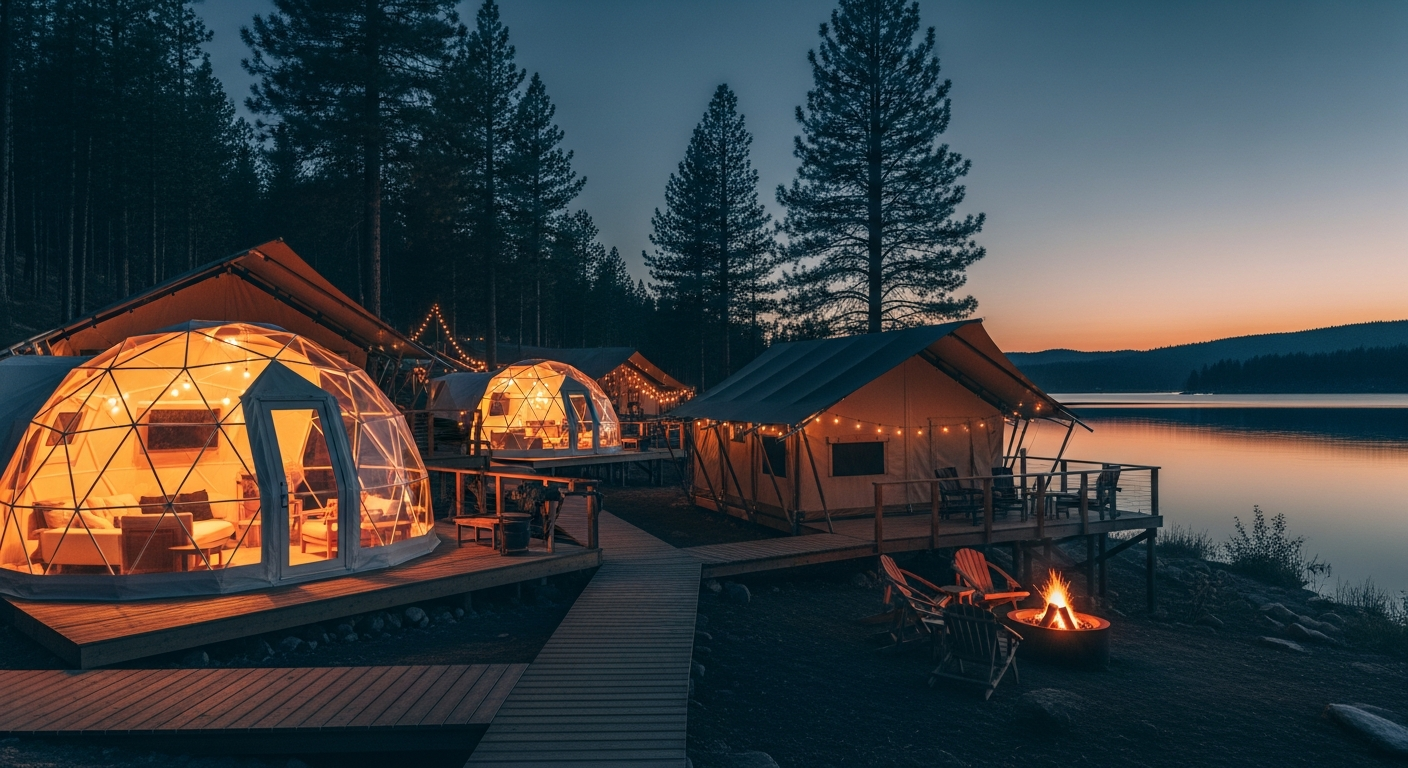
The glamping opportunity is widely misread as “nice tents anywhere in the woods.” It rarely underwrites that way. The best outdoor-hospitality assets are high-design, low-density lodging near proven demand generators — national and state parks, lakes, wine regions, ski towns, event destinations, and beaches — within a two-to-five-hour drive of a large metro. Glamping sits between camping, boutique lodging, RV parks, wellness retreats, and experiential hospitality, so a hotel market study provides relevant competitive-set discipline even though its unit economics also reflect camping. The demand base is real: KOA’s 2026 Camping & Outdoor Hospitality Report says more than 52 million North American households camped in 2025 — above pre-pandemic levels — generating a $66 billion economic footprint, and the U.S. Bureau of Economic Analysis reported that outdoor recreation accounted for $696.7 billion, or 2.4% of U.S. GDP, in 2024.
There is, however, no reliable national count of “unmet glamping demand” by county. The honest proxy is a blend — camping participation, sold-out campground behavior, park visitation, hotel ADR compression, short-term-rental supply, tourism growth, outdoor-recreation GDP, and search demand. For a developer or investor — and the lenders who finance them — that means the opportunity is real but concentrated, and it has to be underwritten market by market. The strongest thesis is usually a disciplined outdoor-hospitality platform, not raw-land luxury tents everywhere.
Glamping demand rests on five realities, and each one points toward high-design lodging near an existing draw rather than tents in an empty field.
Before any site-specific study, these are the zones where leisure demand, lodging scarcity, drive access, and monetization potential converge. Treat this as a screening list, not a recommendation to build — every market still requires its own feasibility work, and several carry serious land-cost, water, wildfire, or entitlement risk.
| # | Market zone | Why underserved / attractive | Best concept |
|---|---|---|---|
| 1 | Great Smoky Mountains outer ring — TN / NC | Most-visited national park ecosystem, huge drive-market access, family and wedding demand; the cabin market already proves willingness to pay. | Premium cabins, domes, treehouses, family and wellness lodging. |
| 2 | Moab / southeast Utah — UT / CO border | Arches and Canyonlands adventure demand and high ADR potential; land and permitting are the constraint. | Safari tents, luxury desert camps, dark-sky domes, adventure packages. |
| 3 | Yellowstone / Grand Teton gateway — WY / MT / ID | Huge seasonal visitation, constrained lodging, high rates, strong family and international travel. | Luxury tents/cabins, high-service seasonal resort, guided excursions. |
| 4 | Zion / Bryce / Grand Staircase corridor — UT | High park demand and road-trip traffic; premium lodging validated but node-specific gaps remain. | Design-forward cabins, domes, off-grid luxury, stargazing. |
| 5 | Adirondacks / Catskills / Hudson Valley — NY | Large NYC/Boston/Philadelphia drive market, high-income guests, wellness demand, strong fall foliage season. | Boutique cabins, saunas, forest and couples/wellness retreats. |
| 6 | Blue Ridge / Asheville / Boone / western NC | Strong drive access, outdoor culture, breweries, waterfalls, weddings, shoulder-season appeal. | Treehouses, cabins, wellness retreats, group and event lodging. |
| 7 | Ozarks — NW Arkansas / southern Missouri | Mountain biking, lakes, affordability, and regional drive demand from Dallas, KC, Tulsa, St. Louis, and Memphis. | Lake/mountain cabins, bike-focused glamping, family adventure. |
| 8 | Texas Hill Country | Massive Austin/San Antonio/Houston/Dallas drive market, wineries, rivers, and weddings — flood diligence is critical. | High-end cabins, vineyard glamping, wellness, couples. |
| 9 | Upper Great Lakes — Door County WI, UP Michigan, northern MN | Summer scarcity, lakes, dark skies, fall color, and relatively limited boutique outdoor lodging. | Seasonal cabins, A-frames, lake access, sauna / cold plunge. |
| 10 | Maine coast + inland lakes | Acadia pressure, coastal lodging scarcity, high summer ADRs, affluent Northeast demand. | Coastal cabins, canvas tents, wellness, food-forward retreats. |
| 11 | California secondary park gateways — Joshua Tree, Sequoia/Kings Canyon, eastern Sierra | High demand and premium ADR, but permitting, wildfire, water, and community resistance are major constraints. | Small luxury, design-led, low-water, fire-resilient projects. |
| 12 | Pacific Northwest — Columbia Gorge, Mt. Hood, Bend outskirts, Olympic Peninsula | Dense outdoor recreation, wine and food, hiking, biking, and water access; regulatory complexity varies. | Cabins, tiny homes, forest retreats, adventure + wellness. |
| 13 | Arizona high desert — Sedona overflow, Flagstaff, Grand Canyon gateways | High tourism, dark skies, desert scenery, and expensive hotels; water and county rules matter. | Domes, desert cabins, stargazing, guided adventure. |
| 14 | Colorado mountain-adjacent secondary towns | Ski-and-summer dual season and high hotel rates; entitlement and winterization costs are high. | Four-season cabins, hot tubs, retreat lodging. |
| 15 | Black Hills / Badlands — SD | National park and monument circuit, road trips, Sturgis events, and family tourism; less saturated than marquee western parks. | Seasonal cabins, safari tents, RV/glamping hybrid. |
The strongest first-wave markets combine demand with lower friction — the Ozarks and northwest Arkansas, less-saturated Great Smoky Mountains submarkets, the Adirondacks/Catskills/Hudson Valley, the Upper Great Lakes, and Texas Hill Country (with serious flood, water, and insurance diligence). Be more cautious with Moab, Zion, Joshua Tree, Yosemite gateways, and coastal California: the demand is excellent, but land cost, entitlement risk, water scarcity, wildfire exposure, and local resistance can destroy the economics.
The viable models are rarely raw-land tent camps. A feasibility study should test which of these the market and site can actually support, because each carries a different capital need, seasonality, and risk profile.
| Model | Best-fit markets | Why it works |
|---|---|---|
| Boutique cabin / dome retreat (12–30 units) | Catskills, Adirondacks, Blue Ridge, Ozarks, Upper Great Lakes, Hill Country | Four-season cabins and domes improve ADR, occupancy, financing, insurance, and comfort — more durable than seasonal canvas tents. |
| National-park gateway glamping (20–80 units) | Smokies, Moab, Zion/Bryce, Yellowstone/Teton, Grand Canyon, Black Hills, Acadia | Park visitation supplies demand, but the property needs a differentiated experience because gateway markets are getting competitive. |
| Wellness + nature retreat (10–40 units) | Hudson Valley, Asheville, OR/WA, Colorado, Sedona/Flagstaff, Maine | Wellness extends demand beyond peak season and lifts ADR — sauna, cold plunge, yoga, guided hikes, culinary, digital-detox. |
| Lake / river glamping | Ozarks, Great Lakes, TN, KY, ME, AR, AL, GA, TX | Water access drives family demand, summer occupancy, rentals, and events — but floodplain, evacuation, and insurance are core underwriting, not afterthoughts. |
| Farm / vineyard / agritourism (5–20 units) | Finger Lakes, Hudson Valley, VA, NC, Hill Country, OR wine country, MI, PA | Low density, experiential add-ons, weddings, food and wine, and shoulder-season programming. |
| Event-supported glamping | Music, wedding, motorsports, equestrian, festival, hunting/fishing markets | Events compress demand and support premium pricing — but the site still needs weekday or non-event demand to be financeable. |
The ranges below are underwriting brackets, not engineering bids. Glamping capex varies wildly because the product ranges from simple off-grid tents to luxury cabins with private bathrooms, HVAC, hot tubs, food and beverage, event space, and wellness amenities.
| Project type | Typical size | Capex (excl. land) | Notes |
|---|---|---|---|
| Micro glamping site | 3–8 units | $250K–$1.5M | Often owner-operated, lower infrastructure, shared bathhouse. |
| Boutique glamping retreat | 10–20 units | $1.5M–$5M | Strongest small-investor model; private baths raise cost materially. |
| Institutional-style resort | 20–50 units | $4M–$15M+ | Professional operations, amenities, staff housing, F&B, stronger brand. |
| Luxury destination resort | 50–100+ units | $15M–$50M+ | Requires destination demand, professional management, major infrastructure. |
One glamping feasibility source estimates that site development — roads, pads, utilities, landscaping, bathhouses, and common areas — often adds $15,000 to $40,000 per unit beyond the structure cost, and that a typical 20-to-30-unit resort may require $2 million to $10 million in development capital. The structure itself ranges widely by format:
| Accommodation type | Indicative installed cost | ADR potential | Comments |
|---|---|---|---|
| Bell tents | $5K–$20K / unit | Low–moderate | Lowest capex, seasonal, weaker weather resilience. |
| Safari tents | $25K–$90K / unit | Moderate–high | Strong “glamping” feel; bathrooms and HVAC drive cost. |
| Yurts / domes | $35K–$125K / unit | Moderate–high | Good visual identity; insulation and condensation matter. |
| Tiny cabins / A-frames | $75K–$250K / unit | High | More expensive but financeable and four-season capable. |
| Treehouses | $150K–$500K+ / unit | Very high | High ADR, high engineering and permitting complexity. |
| Luxury modular cabins | $125K–$350K+ / unit | High | Best for institutional-quality, four-season operations. |
The most common underwriting misses are the costs that live below the surface: septic capacity, well yield and water rights, stormwater and drainage, fire-access roads, road grade and snow removal, ADA compliance, bathhouse code, commercial-kitchen and food-service permitting, staff housing, insurance, wildfire and flood mitigation, utility-extension costs, and county resistance to short-term-rental or campground use. A feasibility study prices these in before land closes — not after.
Glamping revenue behaves more like boutique lodging than camping. The 2024 State of the Glamping Industry Report cited an average ADR near $227 a night, and reporting on the 2025 edition cited operators averaging about $251 a night. But a blended average does not underwrite a project — ADR, occupancy, and RevPAR vary sharply by tier:
| Project tier | ADR range | Stabilized occupancy | RevPAR range |
|---|---|---|---|
| Budget / rustic | $90–$175 | 35%–55% | $32–$96 |
| Mid-market glamping | $175–$275 | 40%–65% | $70–$179 |
| Premium boutique | $275–$450 | 45%–70% | $124–$315 |
| Luxury destination | $450–$900+ | 40%–65% | $180–$585 |
A 20-unit boutique project at a $275 ADR and 55% annual occupancy pencils to roughly $1.1 million in lodging revenue (20 units × 365 nights × 55% × $275), and packages, firewood, food and beverage, wellness, guided experiences, rentals, events, and retail can add another 10% to 35% on top. The expense side — housekeeping and laundry, guest services, maintenance and landscaping, utilities, OTA and platform fees, lodging taxes, property-management software, marketing and photography, pest control, insurance, replacement reserves, snow removal, and management compensation — is where the model either holds or breaks. The more “hotel-like” the experience becomes, the more the operation resembles boutique lodging than camping, and the more professional staffing and reserves it requires.
In our experience, a financeable glamping project shows at least eight of these ten traits:
Do not open with a 50-unit luxury tent resort at a marquee-park gateway. Prove the model first in a lower-friction, high-demand region, then replicate by regional cluster so labor, maintenance, marketing, and management are shared. The strongest risk-adjusted first market is northwest Arkansas and the Ozarks — Bentonville’s mountain-biking economy, lakes and scenery, attainable land, and a drive shed pulling from Dallas, Kansas City, Tulsa, Oklahoma City, St. Louis, Memphis, and Little Rock. Close behind: secondary Great Smoky Mountains nodes with real views, privacy, and access (not another generic cabin park); the Catskills, Hudson Valley, and Adirondacks for affluent NYC and Boston weekend and wellness demand; the Upper Great Lakes for summer scarcity and limited premium competition; and the Blue Ridge and western North Carolina for outdoor tourism, waterfalls, breweries, and weddings.
Texas Hill Country belongs on the list too — massive drive-market access and strong weekend demand — but only with heavy flood, water, heat, and insurance diligence and sites that are river-adjacent rather than floodplain-dependent. And often the best entry is not raw land at all: acquiring an older campground or RV park that already carries zoning and utilities, then adding 10 to 30 premium glamping units, is usually a lower-risk path than greenfield development.
These markets have excellent demand but carry risks that can quietly destroy the economics. A feasibility study exists to price exactly these risks before a sponsor commits capital.
Where glamping units sit inside a wider outdoor-hospitality program, they are modeled alongside the site inventory in the firm’s RV park, RV resort and campground feasibility studies, each on its own rate, occupancy and cost-to-serve.
| Market | Why demand is attractive | Why risk is high |
|---|---|---|
| Joshua Tree / Mojave | Strong design-tourism and desert demand. | Saturation pockets, water scarcity, STR backlash, heat, permitting. |
| Moab / Zion | Very high national-park demand. | Land cost, county resistance, water, competition, seasonality. |
| Yosemite gateways | Extremely strong demand. | Wildfire, evacuation, water, local opposition, high land cost. |
| Colorado resort towns | High ADR potential. | Land cost, labor housing, snow operations, entitlement difficulty. |
| Coastal California / Oregon | Premium pricing. | Coastal regulation, land scarcity, insurance, environmental review. |
| Florida nature / coastal glamping | Year-round demand. | Hurricanes, insurance, flood elevation, heat and humidity, land cost. |
For glamping, saturation is not the moment a market has “a lot of domes.” It is the point at which the next unit cannot earn a required return after marketing, labor, insurance, and replacement reserves.
A market is approaching saturation when:
Expand only when peak weekends are selling out 60 to 90 days in advance, annual occupancy exceeds 55% to 60%, shoulder-season occupancy is improving, direct bookings run 35% to 50% of reservations, repeat and referral bookings are growing, ADR can be raised without lowering occupancy, reviews hold consistently at 4.7+ stars, housekeeping and maintenance are scalable, and septic, water, and power capacity already supports the additional units.
The most feasible national prototype is not raw-land luxury tents everywhere. It is 15 to 30 premium cabins, domes, or tents on 20 to 80 acres within 15 to 30 minutes of a proven destination — with private bathrooms, HVAC, fire features, strong design, self-check-in, low food-service complexity, and expansion capacity built in from day one.
A feasible project should target an ADR of $225 to $375, stabilized occupancy of 50% to 65%, lodging revenue per unit of $40,000 to $85,000 a year, ancillary revenue of 10% to 25% of lodging revenue, development cost per key of $100,000 to $250,000 depending on format and infrastructure, direct bookings above 35% by year three, and a 25% to 45% EBITDA margin for well-run properties (lower with heavy amenities or a labor-intensive service model). The next-step discipline is to pick five target regions and score them by drive-market population, tourism demand, campground sellouts, hotel ADR, zoning friction, water and septic feasibility, and competitor quality; separate them into raw-land build, campground conversion, farm or vineyard partnership, and destination-resort opportunities; underwrite three formats — a 10-unit owner-operated site, a 25-unit boutique resort, and a 50-unit institutional resort — and never close on land until zoning, water, septic, fire access, and neighbor risk are validated.
Wert-Berater prepares independent, lender-grade feasibility studies for glamping resorts, cabin and dome retreats, RV-and-glamping hybrids, and campground conversions. Our fiduciary duty runs to the lender and agency, never to the borrower, so the demand case is built from evidence — drive-market population, park and tourism visitation, campground-sellout behavior, hotel ADR and short-term-rental supply, and comparable outdoor-lodging performance — rather than from a sponsor’s optimism. We define the trade area before counting demand, test ADR and occupancy by unit format instead of a single blended average, price the infrastructure and the hidden costs (septic, water, fire access, flood and wildfire mitigation, insurance) into the capital budget, and stress the pro forma for seasonality and a soft shoulder season. For SBA 7(a) or 504, USDA B&I, or conventional financing, the study is written to the standard the specific program requires.
President, Wert-Berater, Inc. — independent feasibility study consultants since 1998. 4,000+ engagements completed across all 50 states and internationally, evaluating $43.8 billion in project value for SBA, USDA, EB-5, conventional, and institutional financing decisions. Fiduciary duty runs to the lender and agency in every engagement.
+1 310-857-2443 ext. 800 · email · 1968 South Coast Hwy, Ste 2382, Laguna Beach, CA 92651 · 111 Town Square Pl Ste 1238 PMB 657834, Jersey City, NJ 07310 · 539 W. Commerce St #8486, Dallas, TX 75208 · 66 W Flagler Street, Suite 900, PMB 12704, Miami, FL 33130
Schedule a ConversationIndependent feasibility studies since 1998 — 4,000+ engagements, $43.8 billion in evaluated project value. Standard delivery in 10 to 15 business days. Fiduciary duty to the lender and agency.
Legal disclosure. Wert-Berater, Inc. offices are mailing addresses only. Following the COVID-19 pandemic the firm has elected to work remotely; its office locations receive mail and are not staffed for visitors or in-person meetings. Headquarters mailing address: 1968 South Coast Hwy, Ste 2382, Laguna Beach, CA 92651.
Wert-Berater, Inc. is an independent provider of feasibility studies and other related services. The firm does not provide financing or equity investment advice, and does not arrange, broker, or place debt or equity capital of any kind.
All appraisal assignments are performed by Bruce E. Jones, MAI, ASA-GC, BCA, CMEA, a member of the Appraisal Institute since 2006, a staff member of Wert-Berater, Inc. and owner of Special Purpose Realty Valuation.
Thousands of real estate, business, and machinery appraisal and litigation assignments.