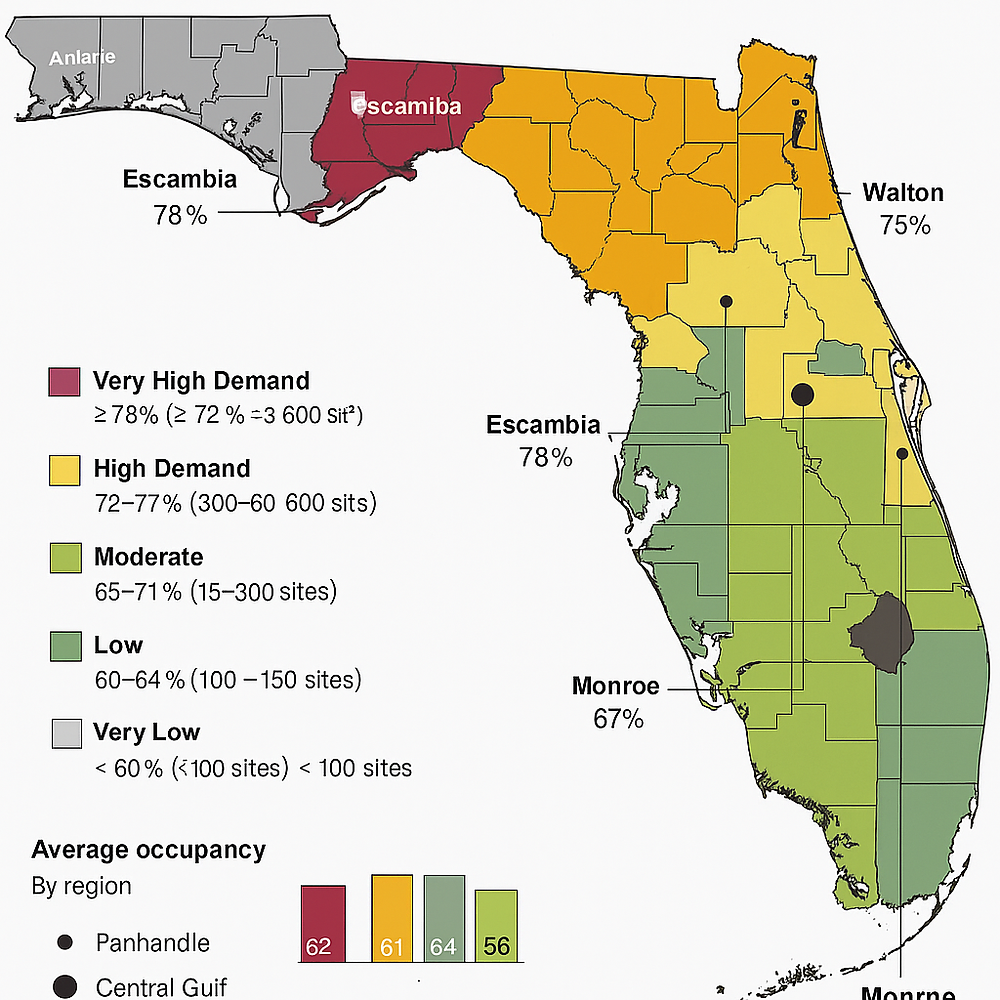
Florida vs Texas RV Park Market: 7 Powerful Insights for Smarter Investment (2025 Guide)
At a high level, the Florida vs Texas RV Park Market comparison is a trade-off:
Florida vs Texas RV Park Market: 7 Powerful Insights for Smarter Investment (2025 Guide)
Watch: a short overview — Florida vs Texas RV Park Market: 7 Powerful Insights for Smarter Investment (2025 Guide)
Executive Snapshot: Who Wins in 2025?
At a high level, the Florida vs Texas RV Park Market comparison is a trade-off:
Florida : Higher achievable ADRs and strong 2024 momentum (+7% occupancy YoY at FL parks; ADR up ~3% vs ~1% nationally), but higher land costs in many counties and coastal climate exposure. Woodall's Campground Magazine
Texas : Lower median rural $ per acre (mid-2024 median ~$4,702/ac statewide per TRERC via Texas Farm Credit), broad demand along I-35/I-10, and more entitlement latitude in many counties—often yielding lower cost per site and strong runway before full saturation in interior markets. Texas Farm Credit
Verdict: For yield-focused developers targeting cost-per-key discipline , Texas often pencils better. For premium ADR and winter seasonality plays, well-located Florida resorts can outperform—if you secure entitled land and price in resiliency capex (drainage, wind, insurance).
Florida benefits from heavy tourism, snowbird seasonality and continued in-migration; per statewide land market reporting, per-acre prices rose alongside migration in recent years—evidence of sustained demand (and cost). Saunders Land
Texas demand is diversified: energy metros, tech hubs (Austin), Gulf leisure, Hill Country road trips, and national/state parks—supporting resilient, drive-to camping. Rural land data and TRERC reporting suggest stable transaction activity through 4Q24, with regional variance in pricing. Texas Real Estate Research Center
Profitability Levers
ADR & Mix: Premium, pull-through, 50-amp full-hookup sites plus a handful of high-rate glamping units can lift blended ADR. Industry markers indicate camping/glamping ADRs rose the most YoY among accommodation types in 2024. Lodgify
Occupancy: Large operators reported ~99% blended MH/RV occupancy in late 2024 portfolios, signaling sticky demand for annual/seasonal and strong capture in mature parks. Quiver Quantitative
ADR & Occupancy Benchmarks
Florida 2024 snapshot: private parks +7% occupancy YoY ; ADR +3% (vs +1% U.S.). That’s a supportive backdrop for 2025 pricing power. Woodall's Campground Magazine
Typical Ranges (context): Basic public camping may sit in the $30s/night , destination RV resorts commonly $80–$220+ , glamping $250–$300+ depending on unit type and locale. INNOWAVE STUDIO
Land Cost per Site (Acquisition) Florida Land Math County-level spreads are wide; farmland reports show ~$20,400/ac averages in 2024 for large-tract transactions, with coastal counties far higher, and interior Panhandle often lower. Florida Politics
Florida’s land market note: rising per-acre prices and premiums for entitled or utility-served tracts—relevant when converting $/acre into $ per site . Saunders Land
Illustration: At 10 sites/acre (typical planning rule), a $25,000/ac parcel implies $2,500/site raw-land cost before soft/hard costs; at $60,000/ac coastal infill, it’s $6,000/site from land alone (ex-infrastructure). (Density source next section.)
Texas Land Math
Mid-2024 Texas median ~$4,702/ac statewide; interior submarkets often trade below that level, while Austin/DFW fringe trend higher. Texas Farm Credit
Converting to $/site at 10 sites/ac yields ~$470/site land basis at the state median, rising with density reductions or closer-in metros.
Local comps and zoning matter more than state medians. Treat these as directional markers and underwrite to specific parcels .
Construction Cost per Site (Hard + Soft)
Utilities (power/water/sewer/Wi-Fi): $5k–$25k per site typical.
Campsite (pads, hookups, landscaping): $20k–$50k+ per site depending on finishes.
Buildings (bathhouses, office/store, clubhouse): $250–$350+/sq ft .
Soft costs (design, engineering, permitting): 10–20% of total; add 10–20% contingency . Campground Consulting Group
Practical planning: ~8–10 sites/acre including roads and amenities per experienced designers; KOA guidance approximates ~10 sites/acre as a simple rule. Staves Consulting+1
Some operators push higher on transient-only layouts; many counties cap density. (Check local ordinance.) A conservative underwriting density 8–10 balances guest experience and drive lanes.
Amenities to Add (and to Avoid)
Must-Have / High-ROI (2025):
50-amp full-hookup at most sites; strong park-wide Wi-Fi ; pull-through sites for big rigs; shade/landscaping ; dog park ; laundry + clean bathhouse . KOA’s modernization themes and decade of growth reinforce connectivity and comfort as top drivers. Woodall's Campground Magazine
EV charging (Level 2): increasing share of campers own EVs; EV-friendly sites and/or communal chargers are becoming selection drivers. INNOWAVE STUDIO
Selective / Context-Dependent: Resort pool or splash pad : great ADR lift in family markets; high capex/Opex—fit only where ADR supports it. Campground Consulting Group
Avoid / Low-Use (for many sites):
Oversized, specialized amenities (e.g., underused mini-golf, large theaters) unless your comp-set proves demand and rate lift. Allocate capex toward site quality and connectivity first. Campground Consulting Group
Pipeline, Absorption & Stagnation Risks
Florida: 2024 data showed shorter booking windows and higher occupancies/ADRs—great for near-term absorption. But coastal insurance, storm-hardening, and higher land bases can push breakevens up; watch submarkets with heavy new resort openings. Woodall's Campground Magazine
Texas: Large land supply and favorable entitlement in many counties reduce barriers; absorption is supported by diversified, year-round road-trip demand. Portfolio operators reported ~99% blended occupancy (MH/RV) exiting 2024, and continued conversion of transient to annual sites—evidence of durable demand. Quiver Quantitative
Stagnation flags: occupancy softening, rising discounting, ADR growth below inflation, increasing negative reviews on Wi-Fi/power, and sustained increases in unsold weekend inventory.
When Do Markets Reach Saturation? (Scenario View)
Saturation depends on rate-sustainable demand per submarket (population + tourism) versus deliverable, entitled supply .
Florida (coastal metros & theme-park orbit): Base case: Saturation pockets in 2027–2029 where multiple luxury parks/glamping resorts cluster; interior corridors retain runway.
Risks: Insurance costs, hurricane seasons, infrastructure constraints. Saunders Land
Texas (I-35 corridor + Hill Country + Gulf): Base case: Wider runway; many counties can still absorb quality supply through 2029–2031 , particularly near secondary leisure nodes.
Risks: Extreme heat waves driving seasonal softness in July–Aug; localized entitlement limits; power-infrastructure upgrades. Texas Real Estate Research Center
These are planning scenarios , not forecasts. Always commission a parcel-level feasibility study.
Unit Economics Pro Forma (Illustrative Only)
Assumptions (both states): 120 sites; 10% premium pull-through; 10% glamping; density 9–10 sites/acre; basic pool, pickleball, dog park, fiber Wi-Fi; utilities to property line.
Implication: Texas often delivers lower cost per key and better DSCR cushions. Florida can produce higher peak ADR , particularly winter, if you win the right parcel and harden for climate.
Strategy Playbook by State
Florida – Build to Rate:
Target interior counties within 60–120 minutes of coasts/theme parks to balance land cost with demand.
Invest in drainage, wind-rated structures, and insurance model ; lean into pull-through FHU , resort-level Wi-Fi , and winter amenities (heated pool, activities). Saunders Land
Texas – Build to Yield:
Focus on I-35/I-10 feeders (day-trip leisure + events), Hill Country vistas, and lakes/rivers with lower land basis.
Differentiators: shade structures , water features , event pavilions , and EV charging , which is becoming a deciding amenity for a growing set of campers. INNOWAVE STUDIO
FAQs
Q1. What’s a realistic ADR for a new park in 2025? A: Many new, well-amenitized parks underwrite $80–$210 ADR for RV sites, with glamping $250–$300 depending on unit quality and brand. Local comps and seasonality dominate. INNOWAVE STUDIO
Q2. How many sites per acre should I plan? A: Underwrite 8–10 sites/acre including roads/amenities. This balances guest experience and maneuverability. Some locales allow more; verify zoning. Staves Consulting+1
Q3. What’s the average land cost per site? A: Convert $ per acre to $ per site using your target density. Example: Texas median $4,702/ac ≈ $470/site at 10 sites/ac ; Florida interior $20–15k/ac ≈ $2,000–$2,500/site . Site-specific comps will vary widely. Texas Farm Credit+1
Q4. What should I budget per site to build? A: As a rule: $20k–$30k (basic), $30k–$40k (mid), $40k–$80k+ (resort). Add 10–20% contingency. Campground Consulting Group
Q5. Which amenities move the needle most? A: 50-amp FHU , great Wi-Fi , pull-throughs , dog park , clean bathhouse , laundry —and EV charging is trending from “nice-to-have” to “expected” for a growing segment. Woodall's Campground Magazine+1
Q6. Is Florida saturated? A: Some coastal/theme-park submarkets are competitive, but 2024 data showed higher occupancy/ADR vs national peers. The where (parcel and entitlement) matters more than the state average. Woodall's Campground Magazine
Q7. Is Texas demand deep enough outside the metros? A: Yes in targeted corridors with natural draws and event calendars. Large operators’ 2024 occupancy and ongoing RV-to-annual conversions point to durable demand, but micro-market study is critical. Quiver Quantitative
RV Park Feasibility Study Consultants https://www.wert-berater.com/ Conclusion & Next Steps Bottom line for the Florida vs Texas RV Park Market:
Choose Florida if you can secure entitled land in resilient locations and build a rate-leading resort that monetizes winter peaks.
Choose Texas if your thesis is cost-per-key efficiency and steady, diversified demand , with room to expand across corridors not yet saturated.
Your diligence checklist:
3–5 parcel comps (sold + listed) within 12 months;
Texas land median ($/ac): TRERC via Texas Farm Credit (mid-2024). Texas Farm Credit
Florida land dynamics & rising per-acre pricing: 2024 Lay of the Land Report. Saunders Land
Construction cost ranges per site and line-items: Campground Consulting Group (2025). Campground Consulting Group
Portfolio occupancy and absorption signals: Sun Communities updates. Quiver Quantitative+1
ADR trend by accommodation (glamping up fastest): Lodgify Summer 2024. Lodgify
Typical density guidance: Staves Consulting; KOA “Own a KOA.” Staves Consulting+1
Typical ADR bands for camping/glamping: industry overview. INNOWAVE STUDIO
Donald Safranek, President, Wert-Berater, Inc. Feasibility Study Consultants 1968 South Coast Highway Suite 2382 Laguna Beach CA 92651 +1 310-857-2443 ext. 800 +1 888-661-4449 https://www.wert-berater.com/
President, Wert-Berater, Inc. — independent feasibility study consultants since 1998. More than 4,000 feasibility studies completed across all 50 states and internationally, evaluating $40.2 billion in project value for SBA, USDA, EB-5, conventional, and institutional financing decisions. Fiduciary duty runs to the lender and agency in every engagement.
+1 310-857-2443 ext. 800 · email · 1968 South Coast Hwy, Ste 2382, Laguna Beach, CA 92651 · 111 Town Square Pl Ste 1238 PMB 657834, Jersey City, NJ 07310 · 539 W. Commerce St #8486, Dallas, TX 75208 · 66 W Flagler Street, Suite 900, PMB 12704, Miami, FL 33130
Independent feasibility studies since 1998 — 4,000+ engagements, $40.2 billion in evaluated project value. Standard delivery in 10 to 15 business days. Fiduciary duty to the lender and agency.
Wert-Berater, Inc. · 1968 South Coast Hwy, Ste 2382, Laguna Beach, CA 92651 · 111 Town Square Pl Ste 1238 PMB 657834, Jersey City, NJ 07310 · 539 W. Commerce St #8486, Dallas, TX 75208 · 66 W Flagler Street, Suite 900, PMB 12704, Miami, FL 33130 · +1 310-857-2443 ext. 800 · email · Blog Index · Privacy · Terms · Site Map