
USDA financing does not fail on enthusiasm. It fails when the file cannot withstand review. If you are preparing a guaranteed loan, community facilities financing package, or another USDA-supported capital…
Financing a rural project? See our USDA feasibility study consultants service — built on the 7 CFR Part 5001 five-factor framework.
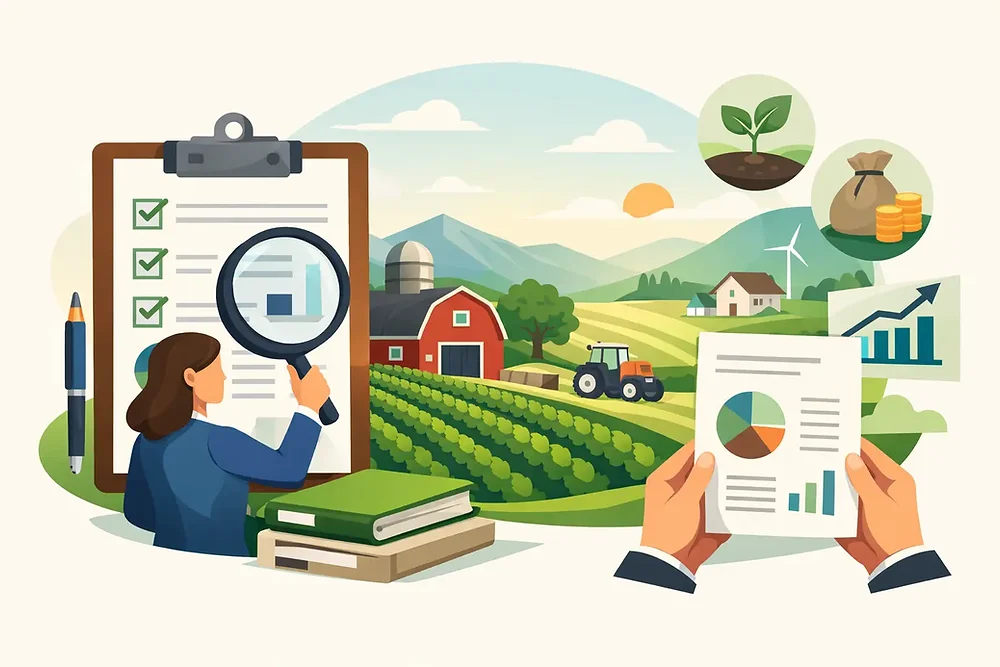
USDA financing does not fail on enthusiasm. It fails when the file cannot withstand review. If you are preparing a guaranteed loan, community facilities financing package, or another USDA-supported capital request, understanding how to document USDA project viability means presenting evidence that survives lender underwriting, agency scrutiny, and third-party review.
That standard is higher than many sponsors expect. USDA viability is not established by a polished narrative, a broker opinion, or management projections built to satisfy a desired outcome. It is established through independent, supportable analysis that shows the project can be built, operated, and financed on terms that are economically realistic. The question is not whether a sponsor believes in the project. The question is whether the record demonstrates a reasonable basis for approval.
In practical terms, viability means the project has a defensible path to construction or implementation, stable operations, debt service capacity, and enough resilience to handle ordinary business risk. The exact framing depends on the program and asset type, but the underlying test is consistent. Can the project perform as proposed without relying on unsupported assumptions or optimistic exceptions?
For that reason, a viability file has to connect market demand, development cost, capital structure, operating performance, and repayment ability. If one section is weak, the entire package can become vulnerable. A strong market study cannot cure an overstated revenue model. A detailed construction budget cannot offset thin debt coverage. Viability is cumulative.
The most reliable approach is to build the file as if it will be challenged by a skeptical underwriter. That means every major conclusion should trace back to evidence, methodology, and assumptions that can be explained without improvisation.
Start with the market case. USDA reviewers and participating lenders need to see that demand is real, measurable, and relevant to the project being financed. For a hospitality asset, that usually means documented demand drivers, competitive supply analysis, occupancy and rate positioning, and reasoned absorption or ramp-up assumptions. For manufacturing or processing projects, the focus may shift toward input availability, customer concentration, logistics, procurement channels, and pricing conditions. For community or infrastructure-related facilities, viability often depends on documented service need, user base stability, and realistic operating support.
The mistake many applicants make is confusing interest with demand. Expressions of support, anecdotal need, or sponsor confidence may have contextual value, but they do not substitute for market evidence. Viability documentation should show who the users or customers are, how many exist, what alternatives they have, what pricing the market supports, and how quickly the project can achieve stabilized operations.
The next requirement is cost realism. USDA project viability is weakened quickly when capital costs appear incomplete, inconsistent, or underdeveloped. Reviewers look for alignment among the development budget, contractor pricing or engineering support, soft cost assumptions, contingencies, equipment requirements, and timing. If the project includes specialized systems, imported equipment, unusual site conditions, or phased construction, those issues should be addressed explicitly. Omissions create more than budget risk. They create credibility risk.
Capital structure matters just as much. A file should clearly identify sources and uses, debt terms, sponsor equity, subordinate capital, grants if applicable, and any funding conditions that could affect closing or repayment. The more layered the capital stack, the more important it is to explain intercreditor relationships, disbursement timing, and whether the project can still proceed if one component is delayed or reduced. A capital plan that works only under perfect conditions is not a strong viability case.
This is where many USDA packages become promotional rather than analytical. Projections are necessary, but projections alone do not document viability. They must be grounded in a model that a lender and agency reviewer can follow from assumption to outcome.
Revenue assumptions should tie directly to market findings, operating history where available, contracts or letters of intent when relevant, pricing evidence, and realistic ramp-up periods. Expense assumptions should reflect actual operating conditions for the asset type and geography, not stripped-down placeholder percentages designed to improve margins. Labor, utilities, maintenance, insurance, transportation, management costs, replacement reserves, and working capital demands should be addressed with discipline.
Debt service coverage deserves particular care. USDA-supported transactions are often reviewed with an eye toward downside resilience, not just base-case sufficiency. If coverage appears acceptable only because projections assume immediate stabilization, unusually low expenses, or favorable pricing without support, the file will invite questions. In some cases, sensitivity analysis is necessary to show how the project performs under less favorable occupancy, volume, price, or cost conditions. That is not a sign of weakness. It is evidence of seriousness.
If you want to know how to document USDA project viability effectively, focus on independence. USDA review environments are not designed to reward sales material. They are designed to assess whether public-supported or agency-associated credit decisions rest on a credible factual basis.
That is why third-party feasibility analysis often carries outsized value. An independent report can evaluate market demand, test assumptions, assess comparable operations, review financial reasonableness, and identify weaknesses before they become approval obstacles. It also creates a cleaner record for lenders and agency personnel who must justify their decisions internally.
There is a practical point here. A sponsor-prepared package may be detailed and sincere, but if it appears advocacy-driven, reviewers may apply greater skepticism. Independent, lender-grade work signals that the project has been examined rather than merely presented. For larger or more complex transactions, that distinction can materially affect how the file is received.
Most weak files do not fail because the concept is impossible. They fail because key links in the record are missing or overstated.
One common problem is assumption drift. The market section may imply one pace of absorption while the financial model assumes a faster ramp-up. The construction budget may reflect one scope while the operating plan assumes a broader launch condition. The debt request may fit one total project cost while the uses schedule implies another. Even small inconsistencies can erode confidence because they suggest the package was assembled rather than underwritten.
Another issue is unsupported management execution. USDA reviewers may accept startup or turnaround risk when it is properly addressed, but not when it is ignored. If the project depends on specialized operating expertise, supply-chain discipline, regulatory compliance, or complex tenanting, the record should address who will execute, what experience they bring, and what controls are in place. Viability is partly economic, but it is also operational.
A third weakness is treating compliance as separate from feasibility. For USDA-backed projects, regulatory, environmental, permitting, and program eligibility issues often affect timing, cost, and risk. If those factors are unresolved, they belong in the viability analysis. A project is not truly viable merely because demand exists. It must also be financeable and executable within the applicable framework.
Lenders and agency reviewers are not asking whether the project could work in a favorable scenario. They are asking whether the credit decision is defensible based on the record. That is a different standard, and it should shape how the package is prepared.
A defensible file usually shows four things clearly. First, there is a measurable economic need or market opportunity. Second, the project scope and cost are realistic. Third, projected operations can support the capital structure on reasonable assumptions. Fourth, the analysis has been prepared with enough independence and rigor to survive review.
For serious projects, especially those above conventional small-business scale, that generally requires more than a borrower narrative and spreadsheet. It requires institutionally credible documentation built for underwriting . That is the standard firms such as Wert-Berater, Inc. have long applied in lender-grade and regulation-compliant feasibility work.
The strongest USDA packages do not try to sound persuasive. They try to be verifiable. If your documentation can withstand a careful reader who has no incentive to approve the transaction, you are much closer to proving viability than most applicants ever get.

President, Wert-Berater, Inc. — independent feasibility study consultants since 1998. More than 4,000 feasibility studies completed across all 50 states and internationally, evaluating $40.2 billion in project value for SBA, USDA, EB-5, conventional, and institutional financing decisions. Fiduciary duty runs to the lender and agency in every engagement.
+1 310-857-2443 ext. 800 · email · 1968 South Coast Hwy, Ste 2382, Laguna Beach, CA 92651 · 111 Town Square Pl Ste 1238 PMB 657834, Jersey City, NJ 07310 · 539 W. Commerce St #8486, Dallas, TX 75208 · 66 W Flagler Street, Suite 900, PMB 12704, Miami, FL 33130
Schedule a ConversationIndependent feasibility studies since 1998 — 4,000+ engagements, $40.2 billion in evaluated project value. Standard delivery in 10 to 15 business days. Fiduciary duty to the lender and agency.