
Wert-Berater prepared an independent SBA 504 feasibility study for a proposed 120-key, new-construction, upper-midscale all-suite hotel in Montgomery County, Alabama, with a total project cost of approximately $21.9 million. The analysis evaluated economic, market, technical, financial, and management feasibility against SBA SOP 50 10 8 standards, producing a determination of Feasible — Subject to Stated Conditions following a mid-engagement capital-structure revision. Stabilized Year-3 operating DSCR reached 1.365x under the revised structure, passing the SBA 1.15x minimum, conditioned on independent equity verification, a recorded land transfer, an executed management agreement, and guarantor financial statements.
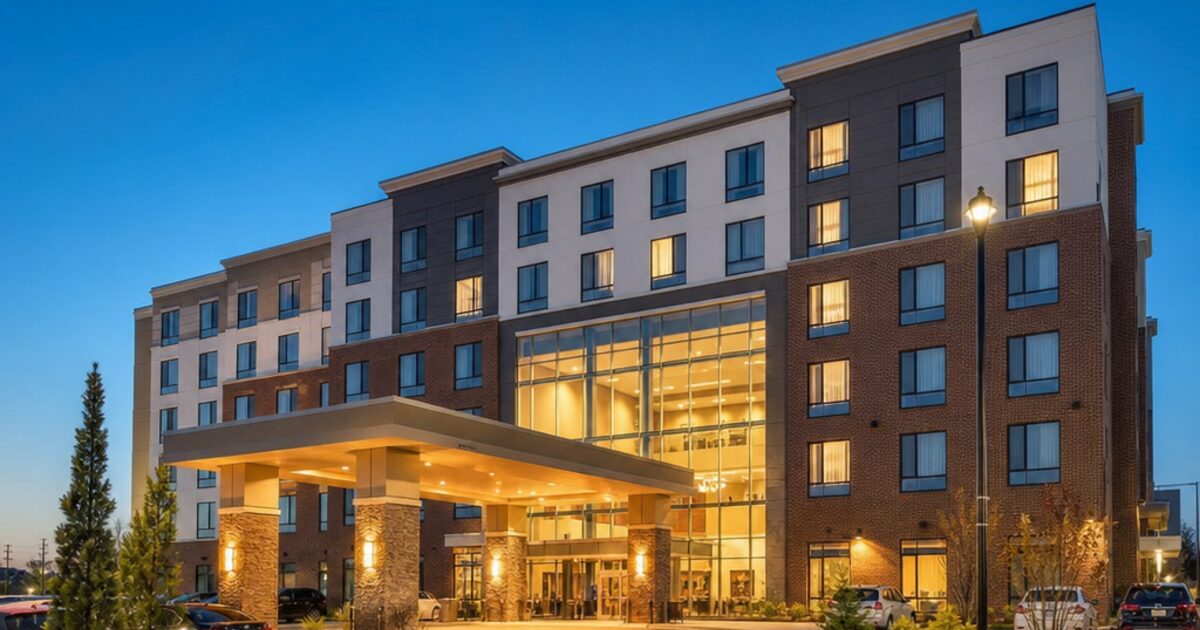
Wert-Berater, Inc. was engaged by the participating lender to deliver an independent feasibility study in support of an SBA 504 new-construction loan for a proposed 120-key, upper-midscale, all-suite hotel in Montgomery County, Alabama. The intended users were the lender, the participating certified development company, and the U.S. Small Business Administration, each of which retains sole responsibility for its own credit and eligibility determinations under SBA SOP 50 10 8. Total project cost under the revised capital structure was approximately $21.9 million, financed through a permanent first-lien bank loan (50.0 percent), an SBA 504 debenture (22.1 percent), and a borrower equity injection (27.9 percent).
The project involves a five-story, approximately 75,700-square-foot building on a 3.3-acre site within an established eastern-corridor retail and hospitality submarket near a major interstate interchange. The all-suite format — studio and one-bedroom suites with in-room kitchen facilities — is designed to serve both conventional transient demand and the extended-stay segment from a single property, without the operating cost of a full-service hotel. Construction was to be governed by a guaranteed-maximum-price contract with a regional general contractor experienced in comparable hotel projects.
Montgomery is the capital of Alabama and the seat of Montgomery County. Its metropolitan employment base is diversified and substantially non-discretionary: a major Air Force installation with approximately 12,000 employees, a state-government employment base exceeding 10,000 positions, and a growing advanced-manufacturing sector anchored by a large automotive assembly plant and its regional supplier network. These generators produce the multi-night and extended-stay travel patterns — legislative, temporary-duty, training, vendor, and relocation travel — for which the all-suite format is specifically suited, and they are comparatively insulated from the discretionary-travel cycle.
The competitive set of six existing properties in the eastern submarket recorded a three-year achieved trend of 78.5 percent occupancy at a trailing average daily rate of approximately $143.80, the strongest single piece of demand evidence in the record. The independent appraisal's stabilized assumptions of 78.0 percent occupancy and a $154.00 average daily rate sit modestly below the set's achieved occupancy and carry an approximately 7 percent rate premium attributable to new all-suite product — a defensible, conservative positioning. A significant supply event — more than 200 new same-tier rooms entering the submarket after the trend data window closed — was identified as the study's central market risk and was carried as a supply-monitoring condition rather than resolved by assumption.
The financial model was constructed in a companion Excel workbook with every figure formula-linked to a master Assumptions tab and every input tagged to a citable source document, so no result is hardcoded and the complete evidentiary pedigree of each assumption is visible to the underwriter. Revenue was built from a ground-up occupancy-and-rate ramp referencing the independent appraisal's stabilized figures across a three-year stabilization period, with operating margins drawn line-by-line from the appraisal's income-capitalization schedule. The borrower's own projections were retained as a separately named alternative scenario tested on the actual executed financing terms rather than the borrower's own internally inconsistent financing arithmetic.
Under a mid-engagement capital-structure revision, the permanent bank loan was reduced to approximately 50 percent of project cost, enlarging the equity share to approximately 27.9 percent and cutting annual debt service materially. On the appraisal's stabilized assumptions, the revised structure produced a Year-3 operating DSCR of 1.365x — passing the SBA 1.15x standard with approximately $237,000 of EBITDA cushion — while the 1.00x global floor held in every post-ramp modeled year. Seven of ten projected years cleared the operating standard; two step-up years following the transition to full amortization fell modestly short at 1.101x and 1.137x, each curable by any single conventional structuring lever: an equity paydown, amortization extension from 240 to 300 months, the permanent rate at the contractual floor, a documented land transfer eliminating the estimated ground-rent line, or a 3.4 percent revenue increase.
Stress testing encompassed revenue sensitivity at five-percent increments through plus and minus fifteen percent, parallel operating-expense sensitivity, interest-rate shocks of 50 to 300 basis points applied across both facilities, a compound downside scenario, a construction-delay stress, break-even analysis in both occupancy and rate terms, and a 500-trial Monte Carlo simulation randomizing the four principal uncertainties jointly. The simulation produced a mean Year-3 DSCR of 1.320x, a roughly 21 percent probability of missing the operating standard, and a roughly 7 percent probability of falling below the global floor — with the failing tail concentrated in supply-adjusted occupancy draws, the reason the supply-monitoring condition survived the revision. Valuation was developed through discounted cash flow analysis at an 11.0 percent discount rate and 2.5 percent terminal growth, supplemented by a levered-returns analysis, Altman Z-Score test, liquidation-value analysis, and Wert-Berater's proprietary five-factor weighted rating.
Wert-Berater's overall study-level determination was Feasible — Subject to Stated Conditions. The economic and market fundamentals were each independently supported; the construction program was credible under a guaranteed-maximum-price contract with a qualified regional contractor; the operating platform was substantive, anchored by the lead sponsor's direct same-market branded-hotel experience; and the revised financial structure passed the SBA operating standard at stabilization. The determination was conditioned on six Critical items: independent verification of the equity injection and its in-kind land component by an independent appraisal; the recorded land-transfer deed conveying site control; the executed management agreement between the borrowing and operating entities; guarantor personal financial statements enabling the global coverage computation; the ground-rent amount if the transfer did not close; and revised binding lender and certified development company authorization terms evidencing the July 22, 2026 capital structure. No unconditional determination was issued while any Critical condition remained open, consistent with the firm's standing practice on all engagements.
SBA SOP 50 10 8 requires an independent feasibility study for hotel and other special-purpose new-construction projects financed through the 504 program. The study must evaluate economic, market, technical, financial, and management feasibility and demonstrate that projected operating cash flow will service debt at or above the SBA's 1.15x operating and 1.00x global debt-service coverage minimums. The intended users are the lender, the certified development company, and the SBA itself.
For a proposed, not-yet-operating property, stabilized occupancy and ADR are typically anchored to an independent MAI appraisal's income-capitalization assumptions, corroborated by the competitive set's achieved trend data drawn from industry sources. The feasibility analyst tests those assumptions against realized submarket performance, reviews the demand generators supporting each segment, and retains the borrower's own projections as a separately tested alternative scenario rather than adopting them as the base case.
This determination means the project's economic, market, technical, financial, and management fundamentals are each supported by the evidentiary record, and the base-case financial model passes the governing debt-service coverage standard at stabilization, but the unconditional determination is withheld because named, verifiable items — typically equity verification, site control documentation, executed operating agreements, and guarantor financial statements — remain open. The determination will be upgraded to unconditional only as those conditions resolve favorably and the record is complete.
Hotels are classified as special-purpose properties under SBA guidelines because they have limited alternative use and their value is closely tied to ongoing operations and brand affiliation. SBA SOP 50 10 8 contemplates higher equity injection percentages for new-construction, special-purpose projects to provide a larger first-loss cushion against construction-cost overruns, ramp-period cash flow deficits, and collateral recovery risk in liquidation scenarios.

President, Wert-Berater, Inc. — independent feasibility study consultants since 1998. 4,000+ engagements completed across all 50 states and internationally, evaluating $43.8 billion in project value for SBA, USDA, EB-5, conventional, and institutional financing decisions. Fiduciary duty runs to the lender and agency in every engagement.
+1 310-857-2443 ext. 800 · email · 1968 South Coast Hwy, Ste 2382, Laguna Beach, CA 92651 · 111 Town Square Pl Ste 1238 PMB 657834, Jersey City, NJ 07310 · 539 W. Commerce St #8486, Dallas, TX 75208 · 66 W Flagler Street, Suite 900, PMB 12704, Miami, FL 33130
Schedule a ConversationIndependent feasibility studies since 1998 — 4,000+ engagements, $43.8 billion in evaluated project value. Standard delivery in 10 to 15 business days. Fiduciary duty to the lender and agency.
Legal disclosure. Wert-Berater, Inc. offices are mailing addresses only. Following the COVID-19 pandemic the firm has elected to work remotely; its office locations receive mail and are not staffed for visitors or in-person meetings. Headquarters mailing address: 1968 South Coast Hwy, Ste 2382, Laguna Beach, CA 92651.
Wert-Berater, Inc. is an independent provider of feasibility studies and other related services. The firm does not provide financing or equity investment advice, and does not arrange, broker, or place debt or equity capital of any kind.
All appraisal assignments are performed by Bruce E. Jones, MAI, ASA-GC, BCA, CMEA, a member of the Appraisal Institute since 2006, a staff member of Wert-Berater, Inc. and owner of Special Purpose Realty Valuation.
Thousands of real estate, business, and machinery appraisal and litigation assignments.