
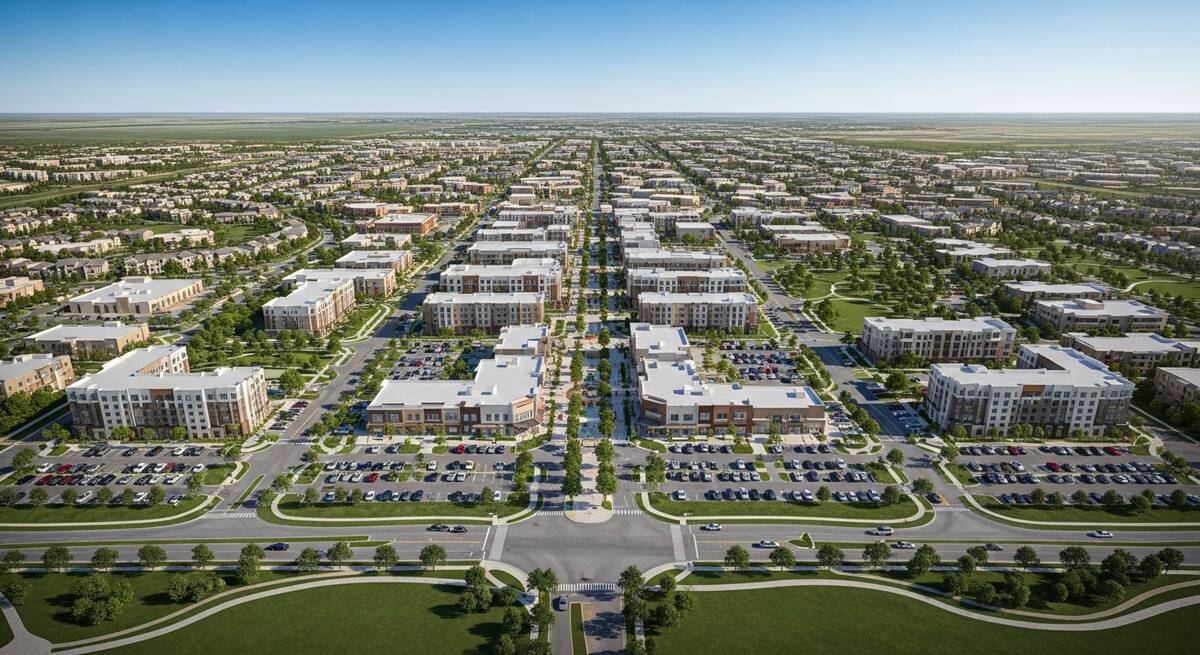
In 2017, the City of Laredo, Texas planned a large, phased community development program — roughly 17,000 residential units, about 500,000 square feet of commercial, and ancillary uses, valued at approximately $5.3 billion. Here is how an independent feasibility study tested demand, absorption, and phasing across the whole plan.
Firm-wide engagement figures are distinct from project-specific findings and their stated source periods.
In 2017, the City of Laredo, Texas set out to plan one of the largest community development programs in its history — a phased, master-planned expansion combining roughly 17,000 residential units, about 500,000 square feet of commercial development, and a range of ancillary uses, with a total program value of approximately $5.3 billion. Before committing to a plan of that scale, the City needed independent confirmation that the market could actually absorb it, and in what order. Wert-Berater served as the independent feasibility consultant on that question.
This case study explains, in general terms, how we approached the feasibility of a citywide community development plan: why demand has to be tested use by use, how absorption drives phasing over a multi-year horizon, and what public and private stakeholders look for before backing a multi-billion-dollar program.
A community development plan of this size is not one project — it is a portfolio of residential, commercial, and civic components that share infrastructure, a market, and a decades-long absorption calendar. Laredo is a fast-growing border city and one of the busiest inland ports on the U.S.–Mexico frontier, which shapes both its housing demand and its commercial base. The program brought together approximately 17,000 residential units across a range of housing types, roughly 500,000 square feet of commercial development, and ancillary uses supporting the residential and commercial core.
Each of those components has its own buyer or tenant, its own cost, and its own timing. A pace that works for entry-level housing says nothing about when neighborhood retail will pencil. The core analytical problem was therefore sequencing: how much of each use the market can absorb, in what order, and at what point the supporting commercial and civic uses become viable.
The foundation of the plan is housing, so the feasibility analysis started there. Seventeen thousand units delivered all at once would overwhelm any single market; delivered in step with household formation, they can anchor an entire district. We examined demand by product type — entry-level and move-up for-sale housing, rental apartments, and other residential formats — and tied the deliverable pace to realistic, locally grounded growth rather than to the plan’s ambitions. Sizing the residential program correctly is what makes everything downstream of it financeable.
Commercial space follows population. Roughly 500,000 square feet of retail, service, and related commercial uses only performs once nearby rooftops and daytime population exist to support it. The study evaluated the commercial program by category and timed it to the residential absorption ahead of it, so that stores, services, and employment uses come online when there is demand to fill them — rather than sitting vacant while the district fills in.
Ancillary uses — civic, institutional, and public-realm components, along with the roads, utilities, and shared infrastructure that make development possible — generate little standalone value but are essential to the program. Like structured parking in a dense redevelopment, these are costs carried ahead of the revenue they enable. A credible feasibility analysis makes that explicit, allocating infrastructure and ancillary costs to the phases and uses that benefit from them rather than burying them in a single blended number.
Because demand and absorption differ by use and by timing, the study treated phasing as part of feasibility, not an afterthought. The program was structured so that infrastructure and faster-absorbing residential lead — establishing the district and its rooftops — before demand-sensitive commercial and later-stage components are brought online.
| Program component | What the feasibility test isolates | Why it drives phasing |
|---|---|---|
| Residential (for-sale & rental) | Supportable absorption by product type and price point | Leads the program; establishes rooftops and early revenue |
| Commercial & retail | Rent-supported demand net of vacancy and tenant risk | Follows rooftops; timed to daytime population |
| Ancillary & civic uses | Service demand tied to the residential and commercial base | Sized to the district they serve |
| Infrastructure & shared systems | Cost carried by the uses it enables, not a standalone return | Front-loaded; allocated across phases |
A city, a lender, or an institutional partner backing a multi-billion-dollar, multi-year program is really asking four questions. Is there real, durable demand for each use in this market? Do the costs — including infrastructure carried well ahead of revenue — leave a supportable program under realistic assumptions? Does the phasing protect stakeholders if any single component absorbs slowly? And are the later, demand-sensitive uses treated conservatively rather than assumed into the returns? Answering those questions use by use, with demand and absorption analysis behind the answers, is what makes a plan of this scale credible.
Our approach to large, mixed-use community development plans is consistent whether the client is a municipality, a master developer, or an institutional partner. We define the market and demand for each proposed use independently, test supportable absorption use by use, allocate infrastructure and ancillary costs to the phases that benefit, build phasing and absorption into the conclusion, and stress-test the demand-sensitive components under downside scenarios. Fiduciary duty in every engagement runs to the lender and applicable agency — which is why the conclusions hold up under review.
President, Wert-Berater, Inc. — independent feasibility study consultants since 1998. 4,000+ engagements completed across all 50 states and internationally, evaluating $43.8 billion in project value for SBA, USDA, EB-5, conventional, and institutional financing decisions. Fiduciary duty runs to the lender and agency in every engagement.
+1 310-857-2443 ext. 800 · email · 1968 South Coast Hwy, Ste 2382, Laguna Beach, CA 92651 · 111 Town Square Pl Ste 1238 PMB 657834, Jersey City, NJ 07310 · 539 W. Commerce St #8486, Dallas, TX 75208 · 66 W Flagler Street, Suite 900, PMB 12704, Miami, FL 33130
Schedule a ConversationIndependent feasibility studies since 1998 — 4,000+ engagements, $43.8 billion in evaluated project value. Standard delivery in 10 to 15 business days. Fiduciary duty to the lender and agency.
Legal disclosure. Wert-Berater, Inc. offices are mailing addresses only. Following the COVID-19 pandemic the firm has elected to work remotely; its office locations receive mail and are not staffed for visitors or in-person meetings. Headquarters mailing address: 1968 South Coast Hwy, Ste 2382, Laguna Beach, CA 92651.
Wert-Berater, Inc. is an independent provider of feasibility studies and other related services. The firm does not provide financing or equity investment advice, and does not arrange, broker, or place debt or equity capital of any kind.
All appraisal assignments are performed by Bruce E. Jones, MAI, ASA-GC, BCA, CMEA, a member of the Appraisal Institute since 2006, a staff member of Wert-Berater, Inc. and owner of Special Purpose Realty Valuation.
Thousands of real estate, business, and machinery appraisal and litigation assignments.