
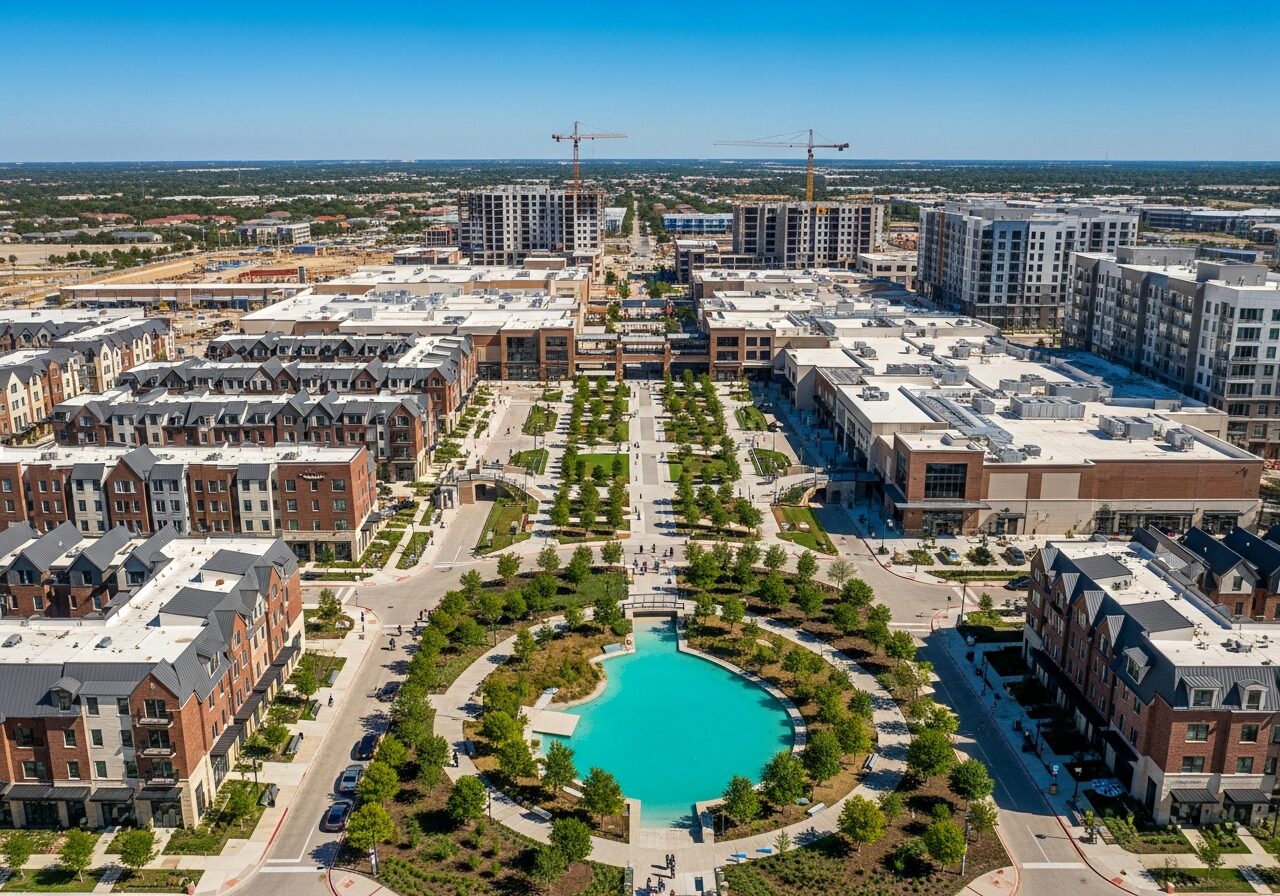
An approximately $1 billion redevelopment turned a 37-year-old, 100-acre regional shopping mall in Plano, Texas into a phased mixed-use district. Here is how an independent feasibility study — anchored by land residual analysis of every parcel under every proposed use — supported the plan. Party names are withheld.
Firm-wide engagement figures are distinct from project-specific findings and their stated source periods.
When a 37-year-old, 100-acre enclosed regional mall in Plano, Texas was slated for a roughly $1 billion redevelopment into a phased mixed-use district, the sponsor and its capital partners needed more than a market study. They needed to know whether a single master plan — combining for-sale homes, rental apartments, an open-air retail and dining atrium carved from the old mall, a hotel, senior living, structured parking, and large public open space — could be financed, phased, and priced parcel by parcel. Wert-Berater served as the independent feasibility consultant on that question. Party names are withheld consistent with the confidential nature of the engagement.
This case study explains, in general terms, how we approached a billion-dollar adaptive reuse: why the highest and best use had to be resolved one parcel at a time, how land residual analysis isolates what each parcel can actually support, and what a lender looks for before committing to a plan that will not be fully built for years.
Adaptive reuse of a dead or dying mall is not a single project — it is several projects sharing one balance sheet, one set of shared infrastructure, and one absorption calendar. On this site the program included brownstone-style for-sale townhomes, a 412-unit apartment block, an open-air retail and restaurant promenade repurposed from the enclosed structure, a 200-room hotel, a senior-living community, a 2,000-space structured (underground) parking system, and a public realm built around an 8-acre park, a crystal lagoon, and roughly 1.6 miles of trails.
Each of those uses has its own buyer or tenant, its own construction cost, its own risk profile, and its own timing. A number that works for townhomes in year one says nothing about whether the hotel pencils in year five. The core analytical problem was therefore allocation: which use belongs on which parcel, in what order, at what supportable land value.
Highest and best use is the use that is legally permissible, physically possible, financially feasible, and maximally productive. On a 100-acre redevelopment, that test cannot be answered for the site as a whole — frontage, visibility, access, structured-parking economics, and adjacency to the park or the retail core make one parcel worth far more as apartments and the next worth more as for-sale product or hospitality. Resolving highest and best use parcel by parcel is what turns a conceptual master plan into a financeable one.
Redevelopment decisions of this kind rest on trade-area and competitive-node evidence, which custom retail market reports assemble for any county, submarket or drive-time market.
The tool for that allocation is land residual analysis. In simple terms, the residual method starts from the projected completed value of what could be built on a parcel, then subtracts everything it costs to get there — hard and soft construction costs, financing, and a required developer profit — and treats what is left over as the value the land itself can support. Run the same parcel under a different use and you get a different residual. The use that produces the highest supportable land value, subject to the master plan and the market, is the one that belongs there.
For this engagement we prepared land residual valuations for each parcel across all proposed uses. Testing residential, multifamily, retail, hospitality, senior-living, and structured-parking scenarios on each parcel produced a parcel-by-parcel basis for the three decisions the sponsor and its lenders cared about most: what to build where, in what sequence to build it, and what each parcel should be priced at if sold or contributed to a builder.
| Proposed use | What the residual test isolates | Why it drives phasing |
|---|---|---|
| For-sale townhomes / brownstones | Supportable lot value after build cost, sales pace, and builder profit | Fastest absorption; funds early infrastructure and proves the district |
| Rental apartments | Residual land value from stabilized net operating income and exit | Mid-phase cash flow; sized to lease-up depth |
| Open-air retail & dining | Rent-supported value net of tenant-improvement and vacancy risk | Follows rooftops; timed after the residential base is in place |
| Hotel | Value from projected occupancy, ADR, and RevPAR less operating risk | Later phase; depends on the district becoming a destination |
| Senior living | Residual from care-model revenue and absorption | Later phase; demand- and staffing-sensitive |
| Structured / underground parking | Cost carried by adjacent uses, not a standalone residual | Front-loaded shared cost that must be allocated across parcels |
The last row is the one sponsors most often underestimate. Structured parking and shared infrastructure generate little or no standalone land value; they are costs that must be carried ahead of the revenue they enable. A residual framework makes that explicit by charging those costs against the parcels and phases that benefit from them, rather than letting them disappear into a single blended number.
Because residual values differ by use and by timing, the study treated phasing as part of feasibility, not an afterthought. The plan was staged so that faster-absorbing residential and the enabling infrastructure came first — establishing the district and generating early cash flow — before higher-risk retail, hotel, and senior-living components were brought online in later phases. Retail and dining, for example, are far more financeable once nearby rooftops and daytime population already exist.
A lender or institutional partner underwriting a billion-dollar, multi-year redevelopment is really asking four questions. Is there real, durable demand for each use in this submarket? Do the costs — including adaptive reuse of an aging structure and expensive structured parking — leave a supportable land basis under realistic assumptions? Does the phasing protect the capital stack if any single component absorbs slowly? And are the later, riskier uses treated conservatively rather than propping up the returns? Answering those questions parcel by parcel, with residual analysis behind the answers, is what makes a plan bankable.
Our approach to complex, mixed-use and adaptive-reuse projects is consistent whether the site is a former mall, a big-box corridor, or a downtown block. We define the market and demand for each proposed use independently, prepare land residual valuations parcel by parcel across every proposed use, allocate shared infrastructure and parking to the parcels and phases that benefit, build phasing and absorption into the conclusion, and stress-test the later-stage components under downside scenarios. Fiduciary duty in every engagement runs to the lender and applicable agency — not to the borrower — which is why the conclusions hold up under underwriting review.
President, Wert-Berater, Inc. — independent feasibility study consultants since 1998. 4,000+ engagements completed across all 50 states and internationally, evaluating $43.8 billion in project value for SBA, USDA, EB-5, conventional, and institutional financing decisions. Fiduciary duty runs to the lender and agency in every engagement.
+1 310-857-2443 ext. 800 · email · 1968 South Coast Hwy, Ste 2382, Laguna Beach, CA 92651 · 111 Town Square Pl Ste 1238 PMB 657834, Jersey City, NJ 07310 · 539 W. Commerce St #8486, Dallas, TX 75208 · 66 W Flagler Street, Suite 900, PMB 12704, Miami, FL 33130
Schedule a ConversationIndependent feasibility studies since 1998 — 4,000+ engagements, $43.8 billion in evaluated project value. Standard delivery in 10 to 15 business days. Fiduciary duty to the lender and agency.
Legal disclosure. Wert-Berater, Inc. offices are mailing addresses only. Following the COVID-19 pandemic the firm has elected to work remotely; its office locations receive mail and are not staffed for visitors or in-person meetings. Headquarters mailing address: 1968 South Coast Hwy, Ste 2382, Laguna Beach, CA 92651.
Wert-Berater, Inc. is an independent provider of feasibility studies and other related services. The firm does not provide financing or equity investment advice, and does not arrange, broker, or place debt or equity capital of any kind.
All appraisal assignments are performed by Bruce E. Jones, MAI, ASA-GC, BCA, CMEA, a member of the Appraisal Institute since 2006, a staff member of Wert-Berater, Inc. and owner of Special Purpose Realty Valuation.
Thousands of real estate, business, and machinery appraisal and litigation assignments.