
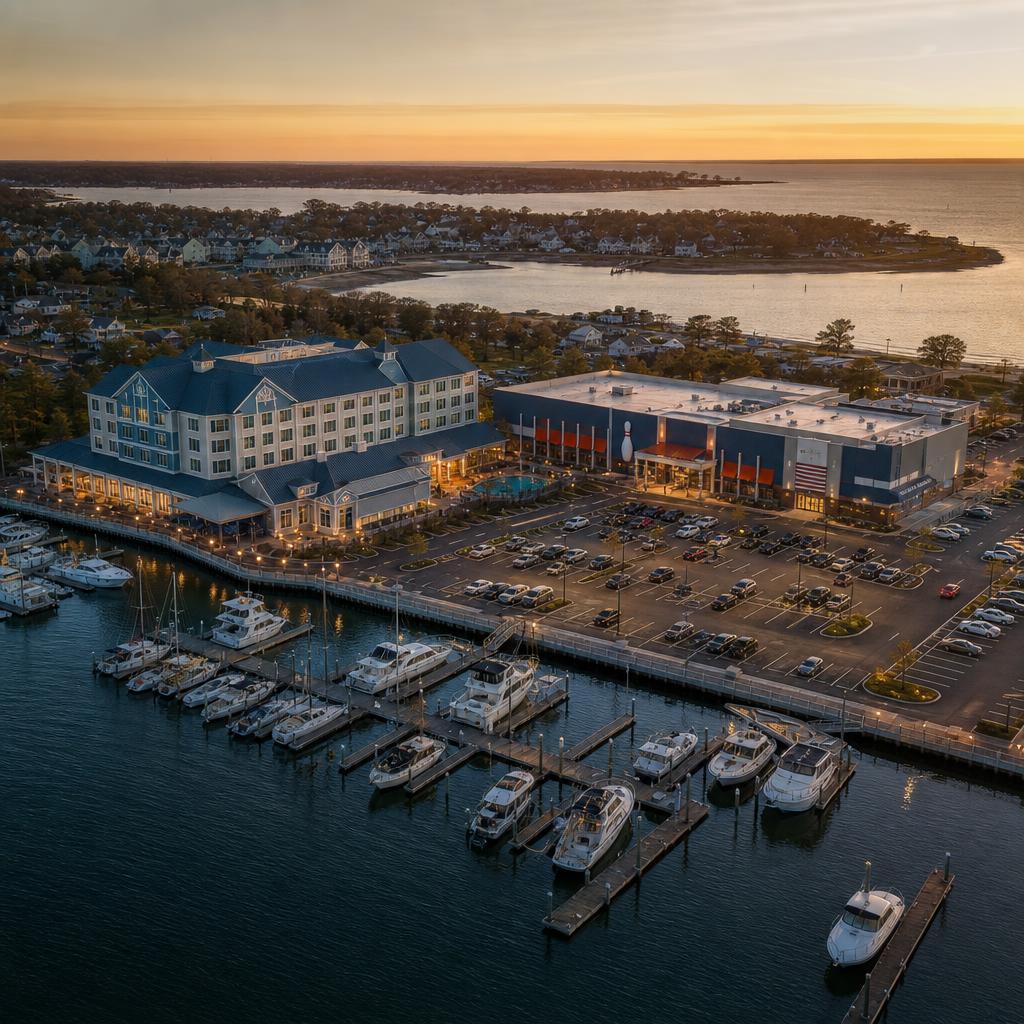
Value derived from the integrated performance of the real estate, the business operating within it, and the tangible personal property — the assignments where conventional real estate methodology alone is insufficient.
Wert-Berater appraises special-purpose and going-concern real estate — assets whose value is derived from the integrated performance of the real estate, the business operating within it, and the tangible personal property that makes it run. For these properties the central question is rarely just “what is the real estate worth.” It is how much of the total value belongs to the real estate, how much to the business enterprise, and how much to the machinery and equipment — and whether those components have been allocated correctly under USPAP. That allocation is exactly where conventional, single-discipline appraisal falls short, and exactly what we are built to deliver.
Going-concern value developed and then allocated across the real estate, the business enterprise, and machinery & equipment — a single reconciled opinion rather than three disconnected ones.
Quantifying how much of total value is attributable to the real estate versus the business operating within it, with a defensible, USPAP-consistent methodology.
Valuation of operating and mission-specific properties — from hotels and entertainment venues to special-purpose plants and institutional facilities — where the business and the real estate are inseparable.
Contested or non-obvious HBU analysis for assemblages, transitional uses, and special-purpose assets with limited comparable evidence.
Full-service hotels and resorts, where going-concern value, FF&E, and business enterprise value must be properly segregated from the underlying real estate.
Restaurants, banquet and event venues, golf and country clubs, wineries, marinas, and family-entertainment centers — operating businesses with significant intangible and personal-property components.
Special-purpose plants where machinery, equipment, and process improvements are inseparable from the real estate’s productive value.
Healthcare, senior-living, educational, and other mission-built properties whose value reflects an operating use rather than a generic alternative.

Wert-Berater’s Senior Valuation Advisor holds the MAI designation from the Appraisal Institute, where he has been a member since 2006, and the ASA-GC (Going Concern) designation from the American Society of Appraisers — one of the few credentials specifically focused on complex valuation assignments involving business enterprise value. He is also a Business Certified Appraiser (BCA) and a Certified Machinery/Equipment Appraiser (CMEA), allowing the firm to deliver a fully integrated valuation across every component of value in a single, reconciled analysis.
In real estate since 1987, he specializes in special-purpose, operational property — hotels, restaurants, gas stations, car washes, funeral homes, and the many other property types that sell as a combination of real estate, an intangible business value component, and tangible non-real-estate assets. He maintains Certified General real estate appraiser licenses in New Jersey, New York, Pennsylvania, Maryland, and Virginia, and has appraised in at least 25 states. The ASA Going-Concern specialty is designed for appraisers who regularly appraise complex commercial real estate with a business component and who understand when — and when not — to allocate or segregate the value components and analyze their effect on value as USPAP requires. The BCA and CMEA designations are each recognized by the U.S. Small Business Administration as a “Qualified Source” for business and equipment appraisals.
Bruce E. Jones, MAI, ASA-GC, BCA, CMEA serves as Wert-Berater’s Senior Valuation Advisor, a staff member of the firm who is also owner of Special Purpose Realty Valuation. Availability for any specific assignment is confirmed in writing and is subject to a conflicts check and a signed engagement.
Special Purpose Realty Valuation — 402 Birmingham Avenue, Manchester, NJ 08759 · (732) 374-9064. That is Mr. Jones’s own firm; it is not a Wert-Berater, Inc. office.
Our work emphasizes credible, well-supported, and defensible valuation conclusions, particularly in assignments where conventional real estate methodologies alone are insufficient. Experience across multiple appraisal disciplines — real estate appraisal, business valuation, and machinery & equipment appraisal — allows us to bring interdisciplinary expertise to the most complex assignments. That integrated competency is crucial for collateral underwriting, as well as in many litigation scenarios and property-tax appeals, where the allocation between real property, business enterprise value, and equipment is the question that most disputes turn on.
Lender-ready opinions for financing of special-purpose and going-concern assets, with the real estate, business, and equipment value components clearly segregated for credit and committee review.
Defensible conclusions that withstand sophisticated cross-examination in disputes turning on the allocation between real property, business value, and personal property.
Appraisals that isolate the real estate’s assessable value from non-taxable intangible and personal-property components.
Purchase-price allocations and value opinions for acquisitions, partnership matters, and reporting where each component of value must be supported independently.
Each engagement begins with a focused understanding of the property, the interest being appraised, and the purpose and intended use of the opinion, followed by targeted research and structured analysis. Where an assignment calls for it, the real estate, business-enterprise, and machinery & equipment components are valued under the appropriate standards and then reconciled into a single, internally consistent conclusion. Opinions are developed to USPAP standards, with clear scope definition and well-supported conclusions designed to withstand scrutiny in underwriting, financial reporting, mediation, arbitration, or court proceedings.
Where an assignment needs current primary market evidence rather than stale secondary data, a custom market report can be commissioned alongside the appraisal — or on its own, before a property is even identified. Operating and special-purpose assets are covered by our gas station, convenience store and truck stop market analysis and our hospital and ASC market research; for special-purpose plants and owner-occupied facilities, see our industrial and warehouse market reports. A market report analyses the market; it is not an appraisal and does not constitute an opinion of value.
For conventional income-producing property — office, industrial, multifamily and retail — where value does not depend on an operating business, see Commercial Real Estate Appraisal.
A going-concern engagement cannot be structured like a conventional income-property study. The real estate, the personal property installed within it, and the operating business are economically inseparable, so the analysis must treat them as a single productive unit before it can allocate value among the components. For a lender or reviewing agency, that means the deliverable set is materially broader than a standard feasibility study.
Every model is a fully linked Excel workbook with no hardcoded values, published to a secure client portal where a reviewer can stress any input and watch the coverage ratios recalculate in real time.
Demand for a going-concern property is not derived from a generic regional absorption rate. It is derived from the specific population of customers, patients, guests, or processors that the operating business can realistically capture, and from the competitive supply that is already serving or will soon serve that same population. The construction of that analysis differs by asset type but follows a consistent discipline.
For hospitality and entertainment assets, primary data sources include state lodging-tax filings, convention and visitors bureau occupancy reports, franchise performance disclosure documents, and direct rate surveys of identified competitive properties. Supply-pipeline work draws on building-permit records, brand-development announcements, and zoning-board agendas to identify projects under construction or in entitlement.
For healthcare and institutional facilities, licensing registries maintained by state health departments establish the existing licensed-bed or licensed-unit inventory. Certificate-of-need filings, where the state requires them, reveal approved but not yet operational supply. Demographic and utilization data from state health planning agencies anchor the demand side.
For manufacturing, processing, and energy-related special-purpose assets, offtake agreements, utility interconnection queues, commodity forward curves published by exchange operators, and trade-association capacity surveys provide the throughput and pricing framework. No single source is treated as authoritative; the analysis triangulates across at least two independent data streams for every material assumption, and each source is cited in the narrative so a reviewer can locate and verify it independently.
In a going-concern model, a small movement in one or two operating assumptions can shift debt-service coverage from compliant to deficient. Identifying those assumptions early — and testing each one rigorously — is the core analytical obligation of the engagement. For most special-purpose and going-concern asset types, four inputs carry the majority of the sensitivity.
SBA, USDA, and conventional lenders each bring a distinct analytical lens to going-concern collateral, but they share a common concern: the value of the collateral is contingent on continued successful operation, so the underwriting of the business and the underwriting of the real estate cannot be separated.
Under SBA SOP 50 10 8, the minimum operating coverage is 1.15x and the global coverage standard applies to all affiliated obligations of the borrower. For a going-concern property, the agency expects the feasibility study to demonstrate that the business component — not merely the real estate — generates sufficient cash flow to service the proposed debt. The allocation schedule matters because SBA collateral policy distinguishes between real property liens and personal-property liens, and the component values determine which lien positions are available.
USDA Business & Industry and Community Facilities programs require that the analysis conform to RD Staff Instruction 5001. For special-purpose assets in rural markets, the demand analysis must address the limited depth of the local competitive set and the sensitivity of projections to a single large employer or anchor institution whose presence drives utilization.
Conventional lenders typically require 1.20x coverage and are particularly focused on the going-concern's dependence on a franchise agreement, management contract, or operating license that does not run with the land. If the license or franchise is not assumable by a successor operator, the lender's recovery in a distressed scenario may be limited to the real estate value in an alternative use — which for a true special-purpose improvement may be substantially below going-concern value. The study addresses this explicitly in the highest-and-best-use section and the statement of conditions.
The engagement begins with a fixed fee quoted in writing within one business day of receiving a complete project description. The fee does not vary with the outcome of the analysis, and no portion of it is contingent on a finding that supports loan approval. That structure is not incidental: fiduciary duty runs to the lender and the reviewing agency, and a contingent fee would compromise that duty.
Standard delivery is ten to fifteen business days from the date a complete data room is received. A complete data room for a going-concern engagement typically includes three years of historical operating statements, a current rent roll or license inventory, the franchise or management agreement if one exists, the proposed loan term sheet, and any existing appraisal or prior feasibility study. Incomplete submissions restart the clock; the engagement letter specifies exactly what is required so there is no ambiguity.
Rush delivery is available and is quoted at the time of engagement. The timeline commitment is binding, not aspirational.
Upon delivery, the bound narrative report, the ten-year pro forma, and the sensitivity and stress-test schedules are published to a secure client portal. The financial model remains live: a reviewer at the lender or the agency can change any input — occupancy, rate, expense ratio, interest rate — and the coverage ratios, debt-service calculations, and ratio benchmarks recalculate immediately. No hardcoded values exist in the workbook. This architecture allows a credit officer to conduct independent scenario analysis without requesting a revised report, which compresses the lender's internal review timeline and reduces back-and-forth between the credit desk and the analyst.
A standard real estate appraisal values the physical asset — land and improvements — as if vacant or leased at market rent. A going-concern appraisal values the integrated operating enterprise, then allocates that total value among real property, personal property, and business intangibles. For lenders, the distinction matters because the collateral position and recovery analysis depend on which component carries the value.
Special-purpose improvements have few or no alternative uses, so value is almost entirely dependent on the continuation of a specific operating concept, license, or franchise. If the business fails or the license is revoked, the lender cannot rely on re-leasing to a comparable tenant to recover collateral value. The underwriting must therefore stress both the operating assumptions and the alternative-use scenario simultaneously, which requires a broader analytical scope than a standard income-property study.
The fee is fixed and quoted in writing within one business day of receiving a complete project description. It does not vary with the outcome and is not contingent on any finding. Because scope varies significantly by asset type — a limited-service hotel differs from a skilled-nursing facility or an ethanol plant — the firm prices each engagement individually rather than publishing a schedule.
Standard delivery is ten to fifteen business days from receipt of a complete data room. Rush delivery is available and is quoted at the time of engagement. The clock starts when all required documents are received; the engagement letter specifies exactly what constitutes a complete submission so there is no ambiguity about when the timeline begins.
The allocation methodology compares the going-concern value conclusion against the value of the real property in its next-best alternative use and the depreciated replacement cost of the personal property. The residual, after deducting supportable real-property and personal-property values, represents intangible business value. Each step is documented in the report with the market evidence and reasoning, because SBA and USDA reviewers examine the allocation to determine available collateral positions.
SBA SOP 50 10 8 and USDA RD Staff Instruction 5001 each specify when an appraisal, a feasibility study, or both are required, and those requirements vary by loan amount, collateral type, and program. Wert-Berater prepares feasibility studies and performs appraisals, and the two are separate engagements with separate deliverables. Appraisal assignments are developed to USPAP standards and are accepted subject to scope, appraiser availability, applicable state licensing requirements, a conflicts check and a signed engagement. Sponsors should confirm with their lender which deliverable satisfies the program requirement before engaging any analyst.
Tell us about the property and the purpose of the appraisal — financing, a workout, a tax appeal, litigation, or financial reporting. We’ll confirm scope, fee, and timing — and whether the assignment calls for an integrated real-estate, business, and equipment opinion — by email or phone within one business day.
Sign in to your live portal to open your model, review your study, and track performance against the original projections — 24/7.
Sign in to your portal →Legal disclosure. Wert-Berater, Inc. offices are mailing addresses only. Following the COVID-19 pandemic the firm has elected to work remotely; its office locations receive mail and are not staffed for visitors or in-person meetings. Headquarters mailing address: 1968 South Coast Hwy, Ste 2382, Laguna Beach, CA 92651.
Wert-Berater, Inc. is an independent provider of feasibility studies and other related services. The firm does not provide financing or equity investment advice, and does not arrange, broker, or place debt or equity capital of any kind.
All appraisal assignments are performed by Bruce E. Jones, MAI, ASA-GC, BCA, CMEA, a member of the Appraisal Institute since 2006, a staff member of Wert-Berater, Inc. and owner of Special Purpose Realty Valuation.