
Borrowers applying for an SBA 7(a) loan, SBA 504 loan, or CDC-assisted financing need more than a basic business plan. A lender-ready SBA loan feasibility study can help evaluate market demand, financial projections, repayment ability, site feasibility, management capacity, and compliance considerations. For start-ups, franchises, acquisitions, real estate projects, and expansion loans, the business plan and feasibility study can be an investment worth its weight in gold.
Working on an SBA-backed project? See our SBA feasibility study consultants service — SOP 50 10 compliant, fixed-fee, delivered in 10–15 business days.
Firm-wide engagement figures are distinct from project-specific findings and their stated source periods.
For many small business borrowers, the SBA loan application process feels like a paperwork exercise. It is not. A good SBA loan package is a repayment story, a compliance file, a risk analysis, and a lender confidence tool all at once.
A business plan is not interchangeable with valuation or independent feasibility analysis; see SBA documentation distinctions under SOP 8.1.
Whether a borrower is applying for an SBA 7(a) loan, a 504 loan through a Certified Development Company, or a project involving real estate, equipment, business acquisition, franchise development, or start-up operations, the quality of the business plan and feasibility study can materially affect how the lender views the deal.
The SBA 7(a) loan program is the SBA’s primary business loan program and can be used for purposes such as acquiring, refinancing, or improving real estate and buildings, working capital, equipment, supplies, business ownership changes, and multiple-purpose loans. The maximum 7(a) loan amount is generally $5 million.
The SBA 504 loan program is designed for long-term, fixed-rate financing for major fixed assets that promote business growth and job creation. These loans are delivered through Certified Development Companies, or CDCs, which are SBA-certified and regulated community-based nonprofit partners. The 504 program can provide long-term financing for eligible fixed-asset projects, often involving real estate, construction, expansion, modernization, or major equipment.
The key point for borrowers is simple: the lender is not just asking whether the business idea sounds good. The lender is asking whether the project is eligible, properly documented, financially supportable, compliant with SBA requirements, and likely to repay under realistic operating conditions.
That is where a professional business plan and independent feasibility study become an investment — not an expense.
A basic business plan may explain what the borrower wants to do. A lender-ready SBA business plan must explain why the business should work, how the borrower will execute, how loan proceeds will be used, and how the debt will be repaid.
For SBA lending, this matters because the lender must document the credit decision. The business plan should not be a marketing brochure. It should support the underwriting file.
A strong SBA business plan should generally address:
For a simple operating business with strong historical cash flow, the lender may rely heavily on tax returns and financial statements. But for start-ups, acquisitions, franchises, construction projects, special-purpose properties, projections-heavy deals, or businesses with limited operating history, the business plan alone may not be enough.
That is where the feasibility study becomes critical.
A business plan is usually borrower-facing. It tells the story of the business.
A feasibility study is lender-facing. It tests the story.
SBA loan programs require lenders and CDCs to evaluate eligibility, repayment ability, use of proceeds, borrower contribution, collateral, management capacity, and other program-specific requirements under SOP 50 10. While the exact documentation required depends on the loan type, project facts, lender policy, and SBA program rules, feasibility analysis is especially important when the lender must rely on future performance rather than a long record of proven historical cash flow.
| Dimension | Business plan | Feasibility study |
|---|---|---|
| Audience | Borrower-facing — tells the story | Lender-facing — tests the story |
| Author | The borrower (or their advisor) | An independent third-party consultant |
| Question answered | “Here is what we intend to do” | “Here is whether the project is economically, market, technical, financial, and management feasible — and here are the risks” |
| Projections | Presents the borrower’s assumptions | Benchmarks, stress-tests, and independently validates the assumptions |
| Role in the file | Explains the credit request | Supports the underwriting and compliance documentation |
A comprehensive feasibility study asks harder questions:
One of the biggest mistakes borrowers make is assuming that a high traffic count proves demand.
It does not.
Traffic counts are useful, but they are only one input. A high-traffic road can still produce a weak business if access is poor, turning movements are limited, nearby competitors are stronger, the site lacks visibility, the trade area is overbuilt, the concept is wrong, or the borrower’s cost structure is too aggressive.
For example, in a gas station, restaurant, hotel, car wash, retail center, daycare, self-storage facility, or medical office project, traffic counts help estimate exposure. But feasibility depends on much more than exposure.
A complete study should also consider:
Traffic count is the starting line. It is not the finish line.
A recently completed Wert-Berater feasibility study illustrates the difference between a simple market narrative and a lender-grade feasibility analysis.
The study did not merely conclude that a site had traffic exposure or that the franchise brand was strong. It tested the project across multiple feasibility dimensions, including economic feasibility, market feasibility, technical feasibility, financial feasibility, management feasibility, risk assessment, and stress testing.
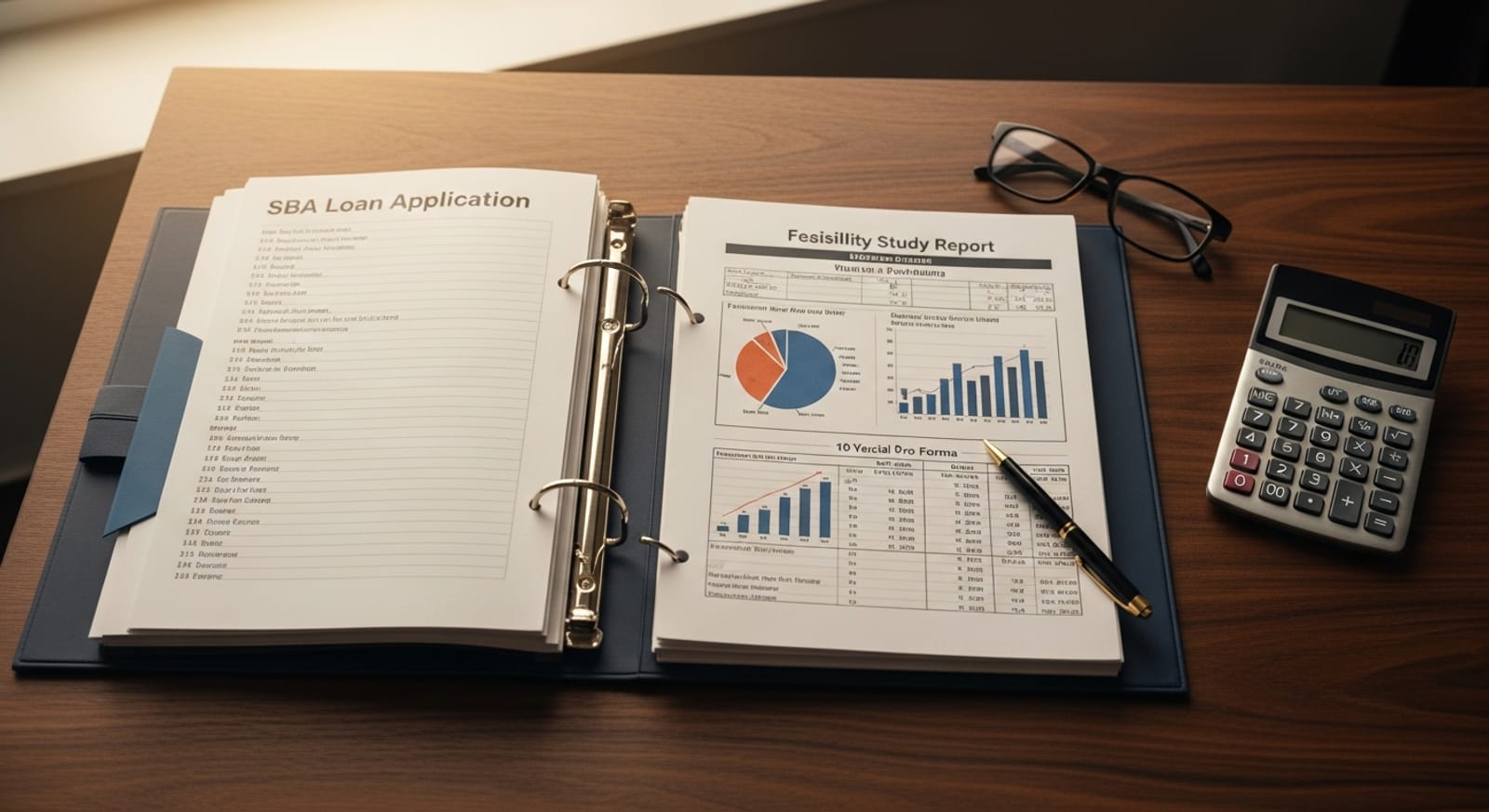
The report included a detailed financial model, a 10-year pro forma, debt-service coverage analysis, sensitivity testing, interest-rate stress testing, recession calibration, Monte Carlo simulation, market capture analysis, competitive review, operating expense benchmarking, franchise-risk review, and an independent feasibility determination.
That level of analysis matters because lenders and SBA program participants are not simply funding optimism. They are evaluating repayment ability, project viability, borrower execution capacity, and compliance documentation.
In the recently completed study, Wert-Berater evaluated factors such as market area demand, competitive supply, capture rate, franchise strength, foodservice and ancillary revenue contribution, product margin assumptions, operating expense structure, debt service coverage ratio, standalone versus portfolio performance, labor market risk, construction and technical feasibility, zoning and site constraints, management risk, and stress-case performance.
This is exactly why a feasibility study can be worth its weight in gold. It helps identify whether the project is truly financeable before the borrower, lender, CDC, or investor relies on projections that may not hold up under scrutiny.
SBA 7(a) loans are flexible. They may be used for working capital, real estate, equipment, refinancing, acquisition, ownership changes, and other business purposes. That flexibility is powerful, but it also means each loan package must tell a clear and supportable story.
A 7(a) borrower should be prepared to show:
For SBA 7(a) loans, the business plan and feasibility study should connect directly to the loan request. If the plan says the borrower needs money for equipment, buildout, working capital, franchise fees, inventory, or acquisition costs, the budget, sources and uses, projections, and supporting documents should all reconcile. We cover the projection-based underwriting standard in depth in our SBA 7(a) Feasibility Study Guide.
A weak package creates avoidable questions. A strong package reduces uncertainty.
The SBA 504 program is different from 7(a). It is focused on fixed assets, economic development, and job creation or public policy goals. The borrower typically works with a bank or private lender and a Certified Development Company.
Because 504 loans often involve real estate, construction, equipment, or expansion projects, feasibility becomes especially important. CDCs help package, process, close, and service 504 loans, and they play an important role in supporting economic development, job creation, business growth, expansion, and modernization.
For 504 projects, the feasibility study can help answer questions such as:
For CDCs and lenders, a well-supported feasibility study can also help establish that the file was analyzed with discipline, that risks were identified, and that the credit decision was not based on unsupported borrower projections. Our SBA 504 Feasibility Study Guide covers what CDCs and lenders require in detail.
Borrowers sometimes resist the cost of a professional business plan or feasibility study because they view it as another closing expense. That is the wrong lens.
The real cost is not the study. The real cost is moving forward with a weak or incomplete loan package.
A poor application can lead to delayed underwriting, repeated lender questions, unclear use-of-proceeds documentation, unsupported projections, weak debt-service analysis, compliance concerns, credit committee resistance, SBA eligibility issues, CDC packaging problems, higher perceived lender risk, loan denial, worse terms, a failed closing, or post-closing servicing issues.
Even worse, a borrower may obtain financing for a project that was never truly feasible. In that case, the absence of proper analysis becomes far more expensive than the cost of the feasibility study.
A good feasibility study can save money by identifying problems before closing. It can also protect the borrower from overborrowing, undercapitalizing, choosing the wrong site, underestimating costs, or relying on unrealistic revenue assumptions.
Before submitting an SBA application, borrowers should ask several practical questions.
The borrower should be able to explain the exact amount requested and the specific use of funds. A lender-ready package should include a detailed sources-and-uses schedule, cost estimates, working capital assumptions, equity injection documentation, and supporting invoices or bids where applicable.
Projections should not be built to “make the loan work.” They should be built from defensible assumptions.
For a gas station, that may include gallons sold, fuel margin, inside sales, foodservice sales, payroll, utilities, insurance, credit-card fees, maintenance, rent, franchise fees, and inventory turns. For a hotel, it may include occupancy, ADR, RevPAR, franchise fees, payroll, reserves, property taxes, insurance, and seasonality. For a restaurant, it may include seat count, ticket average, turns, labor, food cost, delivery fees, rent, and marketing.
Every industry has its own operating logic. A feasibility study translates that logic into a model a lender can review.
Many borrowers focus on acquisition price, construction cost, or equipment cost and underestimate working capital. Working capital is often the difference between a business surviving the ramp-up period and running out of cash before stabilization.
SBA lenders care about repayment. Repayment depends heavily on execution. Borrowers should document industry experience, franchise training, key employees, outside advisors, operating systems, and contingency plans. If the borrower lacks direct experience, the plan should explain how the gap will be mitigated. This is the heart of management feasibility.
Borrowers often say a market is underserved because “there is nothing like this nearby.” That may be true, but it is not enough. A feasibility study should quantify market demand, define the trade area, identify competitors, estimate capture rates, benchmark pricing, and test whether the business can survive under conservative assumptions — the discipline of a proper market feasibility analysis.
For real estate-heavy businesses, site feasibility is critical. A good study should examine zoning, access, parking, utilities, signage, environmental risk, construction timeline, and local approvals. A site can be financially attractive on paper but technically flawed in practice.
SBA-backed lending is not just commercial underwriting. It also involves program rules, eligibility, documentation, and post-closing accountability. The borrower’s business plan and feasibility study should support a clean, consistent record. The numbers in the plan, projections, sources and uses, cost estimates, lender credit memo, and SBA forms should tell the same story.
A business plan and feasibility study can provide value in four major ways.
A lender does not want unsupported optimism. A lender wants evidence, assumptions, risk analysis, and repayment support.
A complete package can help reduce back-and-forth questions, missing information, and underwriting uncertainty.
A feasibility study may reveal that the site is weak, the construction budget is low, the revenue assumptions are aggressive, the working capital reserve is inadequate, or the debt structure is too tight. Finding those issues before closing is valuable.
The borrower benefits from independent analysis too. A feasibility study can prevent a borrower from taking on debt for a project that is not ready, not properly capitalized, or not likely to perform.
Wert-Berater provides independent feasibility studies, business plans, market studies, and financial feasibility analyses for SBA borrowers, lenders, CDCs, developers, and franchise operators who need more than a basic business plan.
A comprehensive Wert-Berater feasibility study is designed to evaluate whether a proposed project is supportable across the major feasibility dimensions:
A recently completed Wert-Berater feasibility study demonstrates the level of rigor that can be applied to a project. Rather than relying on traffic counts alone, the study combined market demand, competition, capture rate, franchise economics, operating expense benchmarks, 10-year projections, DSCR analysis, stress testing, Monte Carlo simulation, management risk review, and technical feasibility considerations.
That is the difference between a document that merely describes a project and a study that tests whether the project can work.
Yes. A business plan helps explain the business model, use of loan proceeds, management experience, market opportunity, financial projections, and repayment strategy. For start-ups, acquisitions, franchises, and expansion projects, a lender-ready business plan can be especially important.
An SBA loan feasibility study is an independent analysis that evaluates whether a proposed business or project is economically, market, technical, financial, and management feasible. It helps lenders, CDCs, and borrowers assess risk before financing.
Requirements vary by project, lender, CDC, and SBA program rules. Even when not explicitly required, a feasibility study can help support repayment analysis, project viability, financial projections, and compliance documentation.
Traffic counts only show exposure. A complete feasibility study also considers access, competition, trade area demand, capture rates, pricing, operating costs, management ability, site constraints, debt service coverage, and sensitivity testing.
A feasibility study can help borrowers identify risks, strengthen the loan application, support financial projections, reduce lender questions, and determine whether the project is properly capitalized before closing.
An SBA loan business plan should include the borrower background, ownership structure, business concept, use of proceeds, market analysis, competitive review, management experience, financial projections, repayment strategy, and risk mitigation plan.
Borrowers applying for SBA 7(a), 504, or CDC-assisted financing should treat the business plan and feasibility study as core parts of the loan strategy.
The business plan explains the vision. The feasibility study tests the vision. Together, they help the lender understand the project, evaluate repayment capacity, document the credit file, and assess compliance with SBA program expectations.
For borrowers, this work can be worth its weight in gold because it can improve the quality of the application, reduce uncertainty, identify hidden risks, and support a more disciplined financing process.
In SBA lending, the best applications do not simply ask for money. They prove the project deserves capital.

President, Wert-Berater, Inc. — independent feasibility study consultants since 1998. 4,000+ engagements completed across all 50 states and internationally, evaluating $43.8 billion in project value for SBA, USDA, EB-5, conventional, and institutional financing decisions. Fiduciary duty runs to the lender and agency in every engagement.
+1 310-857-2443 ext. 800 · email · 1968 South Coast Hwy, Ste 2382, Laguna Beach, CA 92651 · 111 Town Square Pl Ste 1238 PMB 657834, Jersey City, NJ 07310 · 539 W. Commerce St #8486, Dallas, TX 75208 · 66 W Flagler Street, Suite 900, PMB 12704, Miami, FL 33130
Schedule a ConversationIndependent feasibility studies since 1998 — 4,000+ engagements, $43.8 billion in evaluated project value. Standard turnaround two weeks; RUSH delivery in 7 business days at additional cost. Fiduciary duty to the lender and agency.
Legal disclosure. Wert-Berater, Inc. offices are mailing addresses only. Following the COVID-19 pandemic the firm has elected to work remotely; its office locations receive mail and are not staffed for visitors or in-person meetings. Headquarters mailing address: 1968 South Coast Hwy, Ste 2382, Laguna Beach, CA 92651.
Wert-Berater, Inc. is an independent provider of feasibility studies and other related services. The firm does not provide financing or equity investment advice, and does not arrange, broker, or place debt or equity capital of any kind.
All appraisal assignments are performed by Bruce E. Jones, MAI, ASA-GC, BCA, CMEA, a member of the Appraisal Institute since 2006, a staff member of Wert-Berater, Inc. and owner of Special Purpose Realty Valuation.
Thousands of real estate, business, and machinery appraisal and litigation assignments.