
ADR, occupancy, and the ramp: hospitality underwriting is a three-variable problem where the third variable defaults the most loans.
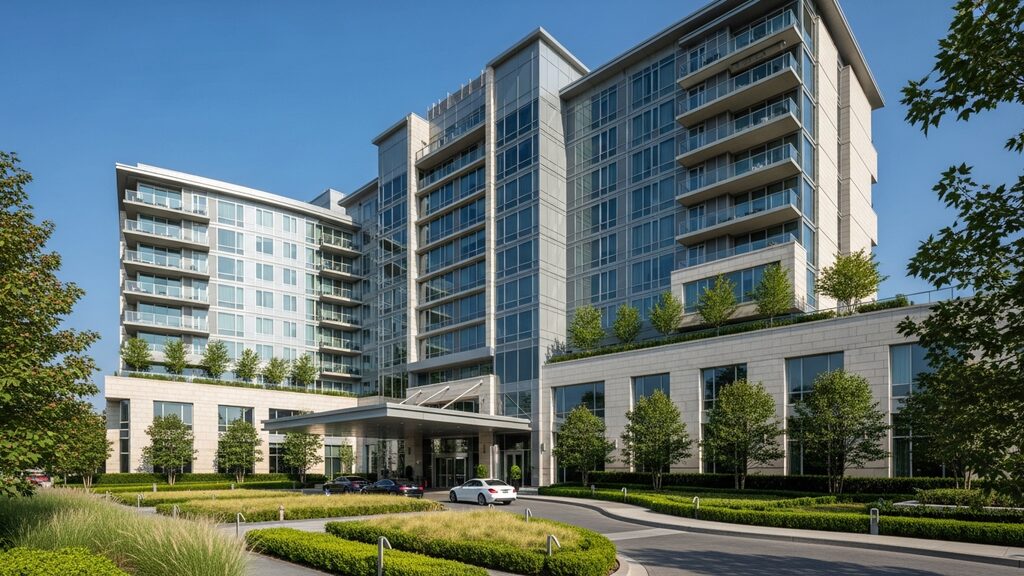
Hotel pro formas live on two headline numbers — average daily rate and occupancy — but the credits fail on the third: the ramp. A new flag opens into a market that takes two to four seasons to learn it exists, while debt service starts at the first draw’s conversion. The study’s central exhibit is therefore the stabilization curve, benchmarked against actual openings in comparable markets, with year-one and year-two coverage reported against the program minimums rather than blended away.
Demand segmentation does the analytical work: transient leisure, corporate, group, and extended-stay demand each have their own generators, seasonality, and rate tolerance, and the subject’s capture is built segment by segment from the demand drivers actually present — the highway interchange, the hospital, the university, the lake. Special-purpose treatment under SOP 50 10 8 applies in full, and the FF&E reserve is non-negotiable in our models: lodging assets consume their furnishings on a schedule the coverage math must respect.
The firm’s hospitality record runs from boutique concepts — a $9,300,000 Hudson River marina-lodging redevelopment whose floating units priced from a national comparable set — to flagged limited-service projects, each with segmentation-built demand, penetration benchmarked against the competitive set, and the renovation-cycle reserves the asset class requires.
Where a specific property has to be tested against these standards rather than discussed in general, that work is performed by an independent hotel feasibility study consultant engaged by the lender, with the determination and any conditions stated on the record.
Lodging demand follows the penetration (fair-share) methodology standardized across hospitality underwriting. Definition: the competitive set’s aggregate room-night demand is measured, the subject’s proportionate share is computed from room count, and a penetration index expresses performance against that share. Purpose: to express every occupancy claim as a ratio against observed market reality rather than a free-standing assertion. Application: define the set; obtain its occupancy and ADR history; segment demand into transient, corporate, group, and extended-stay; and project the subject segment by segment.
The mathematics: market room-nights = set rooms × 365 × set occupancy; fair share = subject rooms ÷ total set rooms; penetration index = subject occupancy ÷ set occupancy × 100. A 90-room subject in a 1,000-room set holds a 9.0 percent fair share; projecting it at 105 penetration in year three means claiming 5 percent more than proportionate capture, and the study must name the advantages — product age, brand distribution, location — that justify each point above 100. Revenue follows as RevPAR = occupancy × ADR, with ADR positioned against the set’s actual rates. The rationale: the index renders optimism visible and measurable — a new entrant claiming 115 penetration against newer product has stated a falsifiable proposition, which is exactly what underwriting requires of a forecast.
Hospitality files carry the most polished optimism in our practice. The recurring flags: penetration indexes above 100 against a competitive set that includes newer product; ADR positioning at the top of the set with no product justification; ramp curves of a single season when the comparable openings in the market took three; and FF&E reserves at token percentages on pro formas that need every point of margin. Demand studies that lean on a single generator — the hospital, the plant, the venue — without testing what happens when that generator’s travel policy changes. And brand assumptions misapplied: system-average RevPAR claimed for a location the brand itself would classify differently.
On the construction side, the flag is the budget that prices the building but not the opening: pre-opening payroll, marketing, and the operating-shortfall reserve the first two seasons will consume.
Mitigation in hospitality is mostly calibration. We rebuild penetration from the set’s actual occupancy and the subject’s genuine advantages, then work with the sponsor on what closes the gap the honest number opens: a flag with stronger distribution, a revised room count, an extended interest-only period sized to the documented ramp. Where the demand base is concentrated, we quantify the concentration and the determination conditions on diversification evidence — corporate agreements, group commitments — or the structure carries reserves against it. The conversation we have with sponsors is direct: the study’s stress cases are the negotiation with the lender done in advance, and a project structured to survive them closes faster than one defended around them.
Commission the market work before the brand decision, not after — the set’s gaps should choose the flag. Build the ramp into the capital stack: two seasons of operating shortfall funded at closing converts the most common hospitality failure mode into a planned line item. Treat the FF&E reserve as untouchable; the refinance lender at year seven will inspect what it bought. Anchor every ADR claim to a named comparable. And bring the demand evidence forward — corporate rate agreements and group letters convert your projections from hope to pipeline in the underwriter’s reading.
The trends shaping hotel underwriting now: extended-stay and select-service product continues to take share of new construction because its labor model survives wage inflation that full-service cannot; underwriters know it and price the difference. Alternative lodging has permanently widened the competitive frame in leisure markets — studies that exclude short-term-rental supply from the set are incomplete. And labor itself has become a stress case: housekeeping and front-desk wage trajectories belong in the sensitivity tables alongside occupancy, because the margin compression of the past cycle came from the expense side as much as the revenue side.
Engagements are typically initiated by the borrower, with lender or CDC confirmation obtained before work begins — institutions apply differing rules, so sponsors should confirm the required path with their lending contact — and are delivered in 10 to 15 business days from complete project data, and built to the program framework that governs the credit — SBA SOP 50 10 8 coverage minimums of 1.15x operating and 1.00x global, the 37-factor structure of USDA 7 CFR Part 5001, or the 1.20x convention of conventional credit policy — with a ten-year pro forma, sensitivity at ±5/10/15 percent, rate stress to +3.0 percent, and Monte Carlo analysis as standard equipment.

President, Wert-Berater, Inc. — independent feasibility study consultants since 1998. 4,000+ engagements completed across all 50 states and internationally, evaluating $41.2 billion in project value for SBA, USDA, EB-5, conventional, and institutional financing decisions. Fiduciary duty runs to the lender and agency in every engagement.
+1 310-857-2443 ext. 800 · email · 1968 South Coast Hwy, Ste 2382, Laguna Beach, CA 92651 · 111 Town Square Pl Ste 1238 PMB 657834, Jersey City, NJ 07310 · 539 W. Commerce St #8486, Dallas, TX 75208 · 66 W Flagler Street, Suite 900, PMB 12704, Miami, FL 33130
Schedule a ConversationIndependent feasibility studies since 1998 — 4,000+ engagements, $41.2 billion in evaluated project value. Standard delivery in 10 to 15 business days. Fiduciary duty to the lender and agency.
Legal disclosure. Wert-Berater, Inc. offices are mailing addresses only. Following the COVID-19 pandemic the firm has elected to work remotely; its office locations receive mail and are not staffed for visitors or in-person meetings. Headquarters mailing address: 1968 South Coast Hwy, Ste 2382, Laguna Beach, CA 92651.
Wert-Berater, Inc. is an independent provider of feasibility studies and other related services. The firm does not provide financing or equity investment advice, and does not arrange, broker, or place debt or equity capital of any kind.
All appraisal assignments are performed by Bruce E. Jones, MAI, ASA-GC, BCA, CMEA, a member of the Appraisal Institute since 2006, a staff member of Wert-Berater, Inc. and owner of Special Purpose Realty Valuation.