
The affordable-housing asset institutional capital discovered: pad rental economics with infrastructure-age risk underneath.
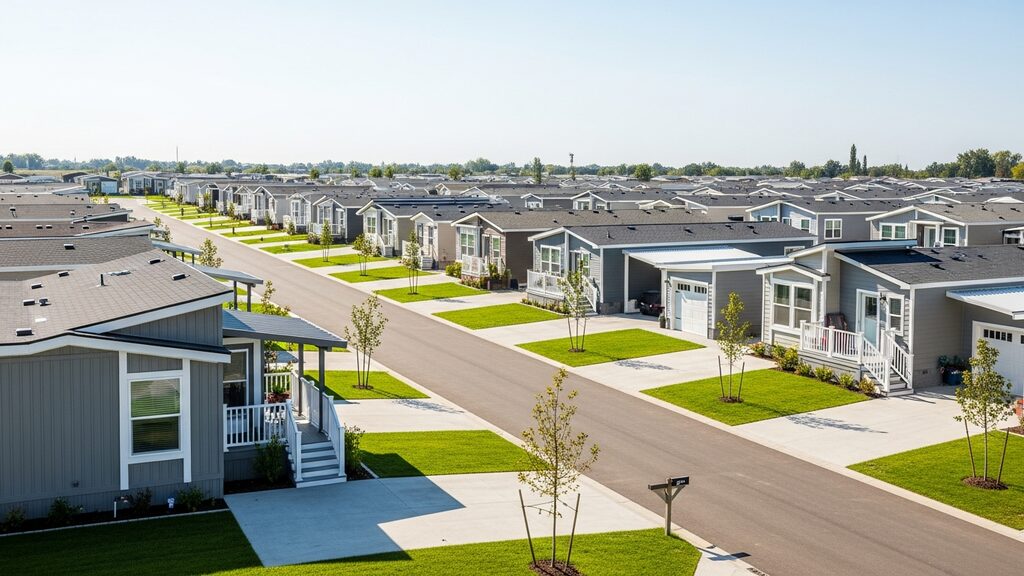
Manufactured housing communities run the most stable operating model in residential real estate — residents own the homes, the community rents the pads, and the cost of moving a home makes tenancy durably sticky. The demand case writes itself from affordability arithmetic: pad rent plus home payment against the local cost of the cheapest site-built alternative, with the gap quantified from Census housing-cost data. The risks live elsewhere.
Infrastructure is the honest underwriting question for acquisitions: decades-old private water, sewer, and electrical systems carry replacement cycles the trailing financials never show, and the technical review’s job is to convert the systems’ age into a reserve schedule the coverage math must absorb. For ground-up communities the constraint is entitlement — zoning receptivity to new MHC supply is the scarcest input in the category — which the study treats as the gating condition it is.
Community-level competition and rent evidence can be commissioned on its own as a manufactured housing community market report covering site counts, occupancy, lot rents, concessions and nearby development.
Our community-housing work applies the same rigor as the firm’s RV-resort practice — the categories share pad economics, utility infrastructure, and small-operator management risk — with rent-positioning benchmarked against the regulated and market alternatives the resident actually faces, and expansion-pad potential analyzed as upside rather than counted in the base case.
Engagements are typically initiated by the borrower, with lender or CDC confirmation obtained before work begins — institutions apply differing rules, so sponsors should confirm the required path with their lending contact — and are delivered in 10 to 15 business days from complete project data, and built to the program framework that governs the credit — SBA SOP 50 10 8 coverage minimums of 1.15x operating and 1.00x global, the 37-factor structure of USDA 7 CFR Part 5001, or the 1.20x convention of conventional credit policy — with a ten-year pro forma, sensitivity at ±5/10/15 percent, rate stress to +3.0 percent, and Monte Carlo analysis as standard equipment.

President, Wert-Berater, Inc. — independent feasibility study consultants since 1998. 4,000+ engagements completed across all 50 states and internationally, evaluating $41.2 billion in project value for SBA, USDA, EB-5, conventional, and institutional financing decisions. Fiduciary duty runs to the lender and agency in every engagement.
+1 310-857-2443 ext. 800 · email · 1968 South Coast Hwy, Ste 2382, Laguna Beach, CA 92651 · 111 Town Square Pl Ste 1238 PMB 657834, Jersey City, NJ 07310 · 539 W. Commerce St #8486, Dallas, TX 75208 · 66 W Flagler Street, Suite 900, PMB 12704, Miami, FL 33130
Schedule a ConversationIndependent feasibility studies since 1998 — 4,000+ engagements, $41.2 billion in evaluated project value. Standard delivery in 10 to 15 business days. Fiduciary duty to the lender and agency.
Legal disclosure. Wert-Berater, Inc. offices are mailing addresses only. Following the COVID-19 pandemic the firm has elected to work remotely; its office locations receive mail and are not staffed for visitors or in-person meetings. Headquarters mailing address: 1968 South Coast Hwy, Ste 2382, Laguna Beach, CA 92651.
Wert-Berater, Inc. is an independent provider of feasibility studies and other related services. The firm does not provide financing or equity investment advice, and does not arrange, broker, or place debt or equity capital of any kind.
All appraisal assignments are performed by Bruce E. Jones, MAI, ASA-GC, BCA, CMEA, a member of the Appraisal Institute since 2006, a staff member of Wert-Berater, Inc. and owner of Special Purpose Realty Valuation.