
Participation growth is real; local revenue models are unproven. Early-cycle recreation is exactly what independent analysis exists for.
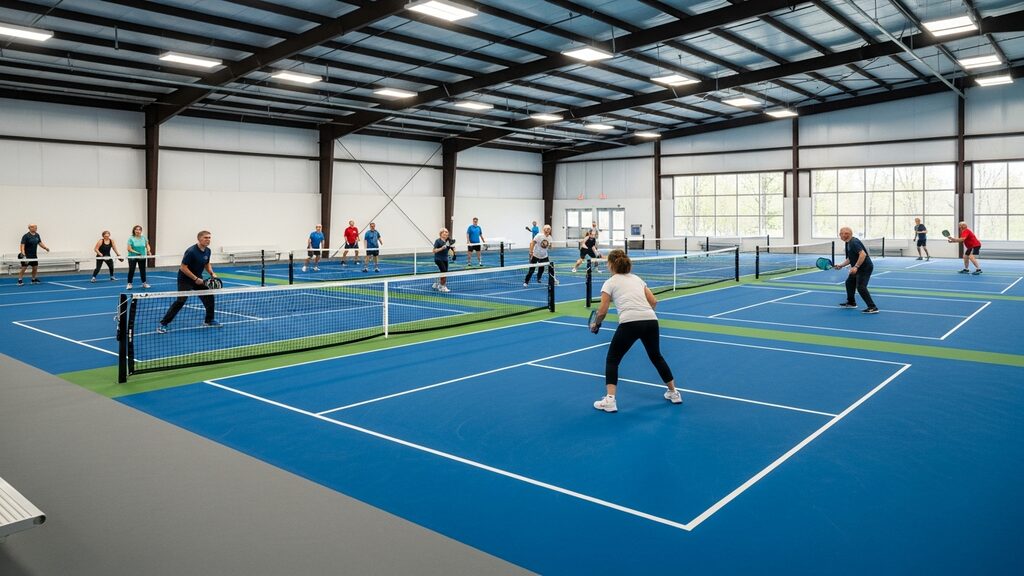
Pickleball’s participation curve is the steepest in American recreation, and capital has followed it into dedicated club formats — courts plus social, food and beverage, leagues and lessons. The underwriting tension is honest on both sides: explosive category growth against a local revenue model with few mature comparables. The study’s job is to hold both truths — modeling membership, programming, and social spend on conservative ramps benchmarked against the operating clubs that preceded the subject market, while crediting the demand evidence that is genuinely there.
Sports facilities of every kind share the structure: a membership-and-programming revenue stack (leagues, lessons, court time, events, F&B) over a high fixed-cost base, where utilization rate is the capture-rate equivalent and the prime-time/off-peak split decides whether the courts earn around the clock or eight hours a day. Multi-sport and tournament-capable formats add a destination component — room nights and economic impact — that strengthens community-financing cases. Wert-Berater works these formats as an independent sports facility feasibility study consultant, building sellable court-hours by daypart rather than applying one blended occupancy across every operating hour.
The firm’s recreation record includes two dedicated pickleball club engagements — a Texas SBA 7(a)/504 clubhouse-social concept at $4,840,000 with year-one coverage of 1.97x and a GM-hire condition, and an $18,040,063 northeastern pickleball park — alongside larger sports-complex work to $115,000,000, each with the social-revenue line underwritten as its own margin driver rather than an afterthought.
Engagements are typically initiated by the borrower, with lender or CDC confirmation obtained before work begins — institutions apply differing rules, so sponsors should confirm the required path with their lending contact — and are delivered in 10 to 15 business days from complete project data, and built to the program framework that governs the credit — SBA SOP 50 10 8 coverage minimums of 1.15x operating and 1.00x global, the 37-factor structure of USDA 7 CFR Part 5001, or the 1.20x convention of conventional credit policy — with a ten-year pro forma, sensitivity at ±5/10/15 percent, rate stress to +3.0 percent, and Monte Carlo analysis as standard equipment.
President, Wert-Berater, Inc. — independent feasibility study consultants since 1998. 4,000+ engagements completed across all 50 states and internationally, evaluating $41.2 billion in project value for SBA, USDA, EB-5, conventional, and institutional financing decisions. Fiduciary duty runs to the lender and agency in every engagement.
+1 310-857-2443 ext. 800 · email · 1968 South Coast Hwy, Ste 2382, Laguna Beach, CA 92651 · 111 Town Square Pl Ste 1238 PMB 657834, Jersey City, NJ 07310 · 539 W. Commerce St #8486, Dallas, TX 75208 · 66 W Flagler Street, Suite 900, PMB 12704, Miami, FL 33130
Schedule a ConversationIndependent feasibility studies since 1998 — 4,000+ engagements, $41.2 billion in evaluated project value. Standard delivery in 10 to 15 business days. Fiduciary duty to the lender and agency.
Legal disclosure. Wert-Berater, Inc. offices are mailing addresses only. Following the COVID-19 pandemic the firm has elected to work remotely; its office locations receive mail and are not staffed for visitors or in-person meetings. Headquarters mailing address: 1968 South Coast Hwy, Ste 2382, Laguna Beach, CA 92651.
Wert-Berater, Inc. is an independent provider of feasibility studies and other related services. The firm does not provide financing or equity investment advice, and does not arrange, broker, or place debt or equity capital of any kind.
All appraisal assignments are performed by Bruce E. Jones, MAI, ASA-GC, BCA, CMEA, a member of the Appraisal Institute since 2006, a staff member of Wert-Berater, Inc. and owner of Special Purpose Realty Valuation.