
Membership economics made the category a lender favorite — and saturation is now the question every committee asks first.
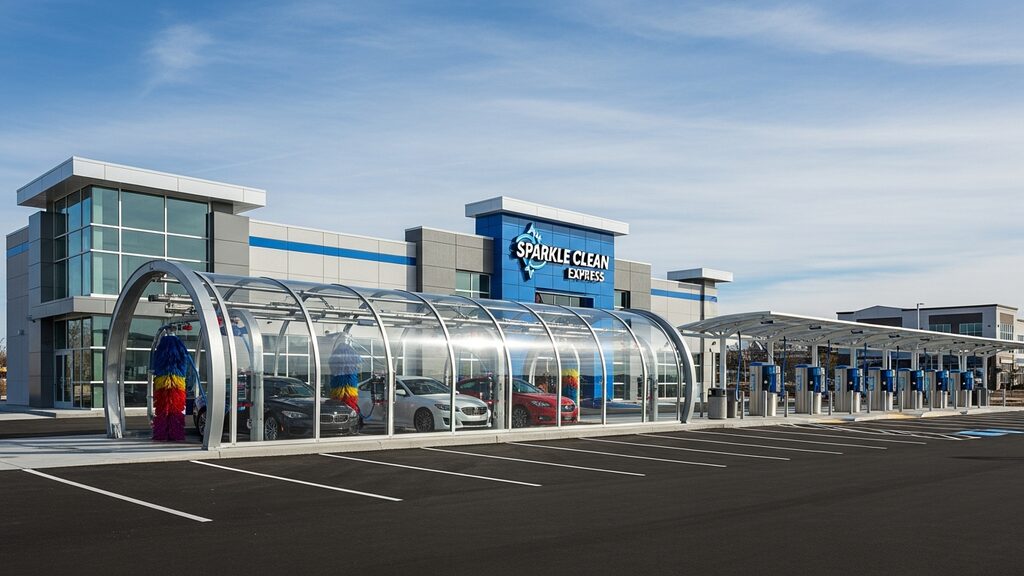
The express tunnel model converted car washing from weather-dependent retail into subscription revenue, and lenders noticed: predictable monthly receipts, low labor, strong margins at volume. The model’s strength is also its risk — membership economics are superb until a competitor opens inside the drive-time ring and the market splits. Underwriting now begins with saturation: tunnels per capita in the trade area against benchmark markets, with the permitted pipeline counted as built.
What follows is a walk through the analysis itself — how demand, capture, membership economics, and coverage are actually assembled. Readers who need the engagement rather than the methodology will find scope, deliverables, fees, and turnaround on our car wash feasibility study consultant page.
Site economics decide the rest. Arterial traffic counts, signalized access, stacking depth, and visibility govern volume; the membership penetration curve governs how fast volume converts to recurring revenue. Our pro formas hold penetration below mature-comparable levels and model the ramp month by month, because the first eighteen months — fixed costs fully loaded, membership base building — are where coverage actually binds. Entitlement status gets equal weight: California jurisdictions in particular make the conditional use permit the project’s longest-lead item.
Recent practice includes a $7,480,000 SBA 504 express tunnel in Alhambra, California — $3,225,000 bank first, SBA debenture, $1,289,000 equity on 25-year fixed amortizations, underwritten with drawings and CUP approvals in the evaluated record — and a Chino highest-and-best-use engagement that concluded a branded tunnel plus ground-lease pad as the maximally productive use at $9,300,000 of development cost against an indicated stabilized value of approximately $19,375,000.
Express car wash demand rests on two accepted methods applied in sequence: fair-share capture analysis for wash volume and membership penetration modeling for revenue mix. Fair share is defined as the subject’s proportionate claim on trade-area demand based on capacity: fair share = subject capacity ÷ total competitive capacity at stabilization, with the pipeline counted as built. Demand itself derives from the vehicle base: annual washes = registered vehicles in the drive-time ring × wash frequency, with frequency benchmarked from industry survey data and climate-adjusted.
The subject’s volume is then captured washes = trade-area washes × fair share × positional adjustment, where the adjustment — bounded and justified item by item — reflects access, visibility, and product superiority against the set. Membership penetration converts volume to recurring revenue: members at stabilization = captured unique customers × conversion rate, with conversion benchmarked from operating comparables, never vendor literature, and churn netted monthly. The rationale: fair share disciplines optimism by anchoring the claim to capacity arithmetic anyone can verify, and any departure above fair share carries an explicit burden of proof — which is precisely the posture a credit committee needs the market study to take.
Express-tunnel files fail on saturation arithmetic more than anything else: the study that counts existing tunnels but not the three permitted ones, or draws the trade ring generously enough to dilute them. Membership assumptions are the second cluster — penetration curves lifted from mature markets onto a ring that already has two subscription programs competing for the same washes, and churn rates from operator marketing rather than operating statements. We also flag construction budgets quoting equipment without site reality — the retaining wall, the water-reclaim mandate, the utility upgrades — and pro formas with no rate war modeled, when the observable pattern in contested rings is exactly that: the incumbent cuts the unlimited price the month the new tunnel opens.
Entitlement optimism rounds out the list. The conditional use permit described as routine in a jurisdiction that has begun resisting wash approvals is not a schedule item; it is the project’s survival question.
Our mitigation work in this category is usually structural. Where saturation is real but not disqualifying, we model the contested-market case — lower penetration, a discounted unlimited price — and identify the membership base at which coverage still clears; the lender then sizes the facility or the reserves to that case, not the brochure case. Where the budget under-scopes site work, the value-engineering conversation happens before commitment: our recent practice includes a corridor analysis that relocated the concept entirely when the numbers favored a different configuration. Where the CUP is uncertain, the determination conditions on it explicitly, and the sponsor gets a finding they can take to the planning process rather than a study that pretends the question is settled.
Pick the site like the credit depends on it, because it does: signalized arterial access, real stacking depth, and visibility beat interior pads at any price. Secure the CUP — or document its path — before ordering the appraisal. Bring operating evidence to the membership assumptions: if you operate elsewhere, your own penetration and churn data is the strongest exhibit in the file. Model the first eighteen months at monthly resolution and fund the ramp; the tunnels that fail rarely fail at stabilization. And resist the temptation to assume premium pricing and premium volume simultaneously — pick the position the competitive set permits.
Three trends now govern the category’s underwriting. Institutional consolidation has professionalized competition: new entrants increasingly face platform operators with subscription pricing power and site-selection science. Water regulation is tightening — reclaim requirements and drought-era scrutiny are budget lines, not footnotes, in much of the West. And the membership model itself is maturing: the easy-penetration era in virgin markets is closing, so underwriting has shifted from whether subscriptions work to whether this ring has subscription capacity left. Studies that still treat membership as a novelty premium are dating themselves.
Engagements are typically initiated by the borrower, with lender or CDC confirmation obtained before work begins — institutions apply differing rules, so sponsors should confirm the required path with their lending contact — and are delivered in 10 to 15 business days from complete project data, and built to the program framework that governs the credit — SBA SOP 50 10 8 coverage minimums of 1.15x operating and 1.00x global, the 37-factor structure of USDA 7 CFR Part 5001, or the 1.20x convention of conventional credit policy — with a ten-year pro forma, sensitivity at ±5/10/15 percent, rate stress to +3.0 percent, and Monte Carlo analysis as standard equipment.
President, Wert-Berater, Inc. — independent feasibility study consultants since 1998. 4,000+ engagements completed across all 50 states and internationally, evaluating $41.2 billion in project value for SBA, USDA, EB-5, conventional, and institutional financing decisions. Fiduciary duty runs to the lender and agency in every engagement.
+1 310-857-2443 ext. 800 · email · 1968 South Coast Hwy, Ste 2382, Laguna Beach, CA 92651 · 111 Town Square Pl Ste 1238 PMB 657834, Jersey City, NJ 07310 · 539 W. Commerce St #8486, Dallas, TX 75208 · 66 W Flagler Street, Suite 900, PMB 12704, Miami, FL 33130
Schedule a ConversationIndependent feasibility studies since 1998 — 4,000+ engagements, $41.2 billion in evaluated project value. Standard delivery in 10 to 15 business days. Fiduciary duty to the lender and agency.
Legal disclosure. Wert-Berater, Inc. offices are mailing addresses only. Following the COVID-19 pandemic the firm has elected to work remotely; its office locations receive mail and are not staffed for visitors or in-person meetings. Headquarters mailing address: 1968 South Coast Hwy, Ste 2382, Laguna Beach, CA 92651.
Wert-Berater, Inc. is an independent provider of feasibility studies and other related services. The firm does not provide financing or equity investment advice, and does not arrange, broker, or place debt or equity capital of any kind.
All appraisal assignments are performed by Bruce E. Jones, MAI, ASA-GC, BCA, CMEA, a member of the Appraisal Institute since 2006, a staff member of Wert-Berater, Inc. and owner of Special Purpose Realty Valuation.