
Enplanements drive it, ride-share erodes it, and price-versus-shuttle-time decides who wins it: off-airport parking is derived-demand underwriting.
Paid-parking demand is modeled on comparable logic for freight, where hours-of-service rules drive overnight stops; see our truck stop feasibility study consultant page.
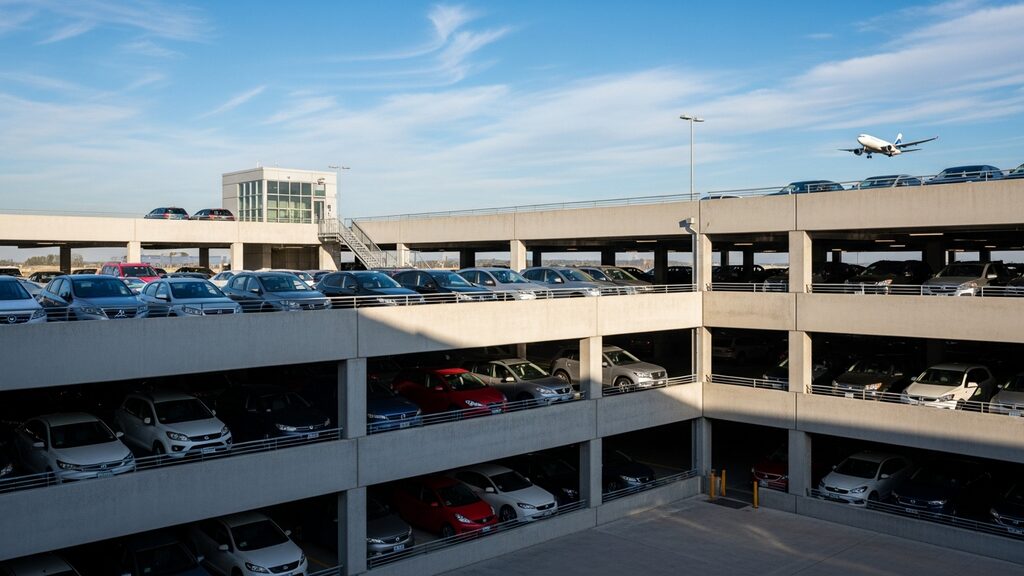
Off-airport parking demand derives entirely from the airport it serves: enplanement trends, the origin-passenger share that actually parks, and the on-airport garage’s capacity and pricing set the market’s size and ceiling. The competitive analysis is a capacity census — land area, stall counts, and density across the existing off-airport set — locating the subject’s proposed capacity inside the observed market rather than beside it. Ride-share substitution is the structural risk and gets stressed explicitly: the pro forma must survive penetration rates above today’s.
The operating model is yield management: daily and economy tiers, online pre-booking’s share and its channel costs, shuttle frequency as both expense line and competitive weapon. Ramp matters — parking facilities build occupancy as travelers discover them — so monthly cash-flow modeling carries the early period, and the lender’s comfort on initial operating risk is built from exactly that resolution.
A recent $4,600,000 engagement serving George Bush Intercontinental applied the full battery — competitor land-area/capacity/density table, zoning and regulatory review, construction-cost validation, monthly operating summaries, discounted cash flow, and sensitivity — structured precisely for the question committees ask of parking assets: how long is the ramp, and what does coverage look like during it.
Engagements are typically initiated by the borrower, with lender or CDC confirmation obtained before work begins — institutions apply differing rules, so sponsors should confirm the required path with their lending contact — and are delivered in 10 to 15 business days from complete project data, and built to the program framework that governs the credit — SBA SOP 50 10 8 coverage minimums of 1.15x operating and 1.00x global, the 37-factor structure of USDA 7 CFR Part 5001, or the 1.20x convention of conventional credit policy — with a ten-year pro forma, sensitivity at ±5/10/15 percent, rate stress to +3.0 percent, and Monte Carlo analysis as standard equipment.

President, Wert-Berater, Inc. — independent feasibility study consultants since 1998. 4,000+ engagements completed across all 50 states and internationally, evaluating $41.2 billion in project value for SBA, USDA, EB-5, conventional, and institutional financing decisions. Fiduciary duty runs to the lender and agency in every engagement.
+1 310-857-2443 ext. 800 · email · 1968 South Coast Hwy, Ste 2382, Laguna Beach, CA 92651 · 111 Town Square Pl Ste 1238 PMB 657834, Jersey City, NJ 07310 · 539 W. Commerce St #8486, Dallas, TX 75208 · 66 W Flagler Street, Suite 900, PMB 12704, Miami, FL 33130
Schedule a ConversationIndependent feasibility studies since 1998 — 4,000+ engagements, $41.2 billion in evaluated project value. Standard delivery in 10 to 15 business days. Fiduciary duty to the lender and agency.
Legal disclosure. Wert-Berater, Inc. offices are mailing addresses only. Following the COVID-19 pandemic the firm has elected to work remotely; its office locations receive mail and are not staffed for visitors or in-person meetings. Headquarters mailing address: 1968 South Coast Hwy, Ste 2382, Laguna Beach, CA 92651.
Wert-Berater, Inc. is an independent provider of feasibility studies and other related services. The firm does not provide financing or equity investment advice, and does not arrange, broker, or place debt or equity capital of any kind.
All appraisal assignments are performed by Bruce E. Jones, MAI, ASA-GC, BCA, CMEA, a member of the Appraisal Institute since 2006, a staff member of Wert-Berater, Inc. and owner of Special Purpose Realty Valuation.