
Physician demand is durable; physician real estate preferences are specific. The product has to match how practices actually occupy.
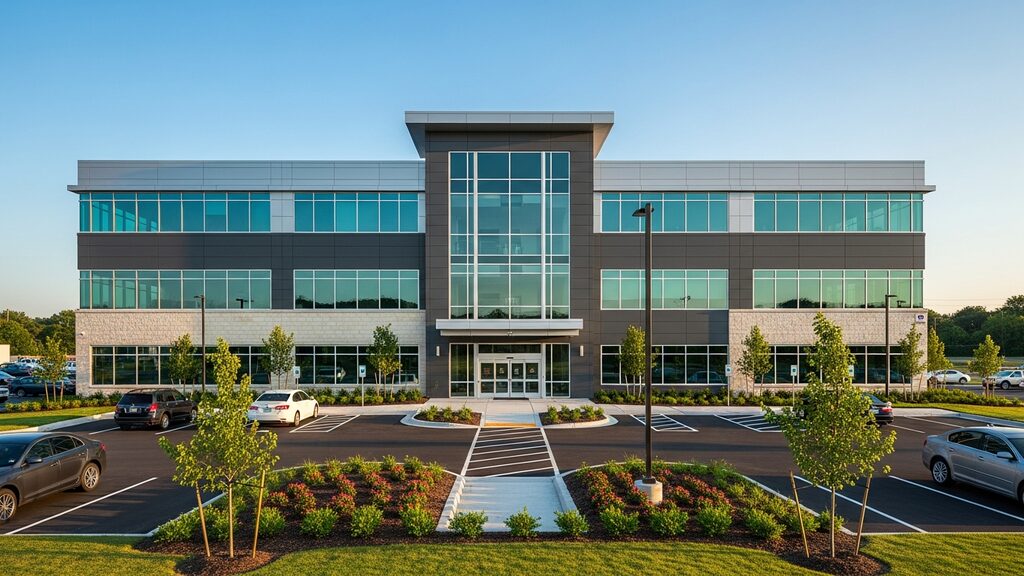
Medical office demand tracks the most reliable curves in the economy — population aging and outpatient migration — but the product decision carries the project: consolidated multi-tenant MOB space and decentralized campus formats serve different practice economics. Specialties weighing identity, signage, parking at the door, and the option to own frequently prefer building-scale product over suite-scale space, and tenant-demand evidence — letters of intent, oversubscription, specialty mix — is the study’s strongest exhibit when it exists.
The health-system landscape defines the competitive frame: hospital-adjacent versus retail-convenient locations, system-employed versus independent physicians, and the referral geography that decides where practices can actually move. Reimbursement-driven specialties bring credit-quality tenancy with reimbursement-policy exposure, which the analysis prices rather than ignores.
A recent $38,900,000 engagement covered a 12.18-acre medical village — sixty-eight thousand square feet across nineteen buildings of 3,500 to 4,920 square feet, oversubscribed at study date, with a hybrid lease-and-sale absorption strategy and pad-consolidation flexibility engineered into the utility design. Its value-engineering pass cut total project cost by nearly 8 percent — the kind of finding independent technical review exists to produce.
Engagements are typically initiated by the borrower, with lender or CDC confirmation obtained before work begins — institutions apply differing rules, so sponsors should confirm the required path with their lending contact — and are delivered in 10 to 15 business days from complete project data, and built to the program framework that governs the credit — SBA SOP 50 10 8 coverage minimums of 1.15x operating and 1.00x global, the 37-factor structure of USDA 7 CFR Part 5001, or the 1.20x convention of conventional credit policy — with a ten-year pro forma, sensitivity at ±5/10/15 percent, rate stress to +3.0 percent, and Monte Carlo analysis as standard equipment.

President, Wert-Berater, Inc. — independent feasibility study consultants since 1998. 4,000+ engagements completed across all 50 states and internationally, evaluating $41.2 billion in project value for SBA, USDA, EB-5, conventional, and institutional financing decisions. Fiduciary duty runs to the lender and agency in every engagement.
+1 310-857-2443 ext. 800 · email · 1968 South Coast Hwy, Ste 2382, Laguna Beach, CA 92651 · 111 Town Square Pl Ste 1238 PMB 657834, Jersey City, NJ 07310 · 539 W. Commerce St #8486, Dallas, TX 75208 · 66 W Flagler Street, Suite 900, PMB 12704, Miami, FL 33130
Schedule a ConversationIndependent feasibility studies since 1998 — 4,000+ engagements, $41.2 billion in evaluated project value. Standard delivery in 10 to 15 business days. Fiduciary duty to the lender and agency.
Legal disclosure. Wert-Berater, Inc. offices are mailing addresses only. Following the COVID-19 pandemic the firm has elected to work remotely; its office locations receive mail and are not staffed for visitors or in-person meetings. Headquarters mailing address: 1968 South Coast Hwy, Ste 2382, Laguna Beach, CA 92651.
Wert-Berater, Inc. is an independent provider of feasibility studies and other related services. The firm does not provide financing or equity investment advice, and does not arrange, broker, or place debt or equity capital of any kind.
All appraisal assignments are performed by Bruce E. Jones, MAI, ASA-GC, BCA, CMEA, a member of the Appraisal Institute since 2006, a staff member of Wert-Berater, Inc. and owner of Special Purpose Realty Valuation.