
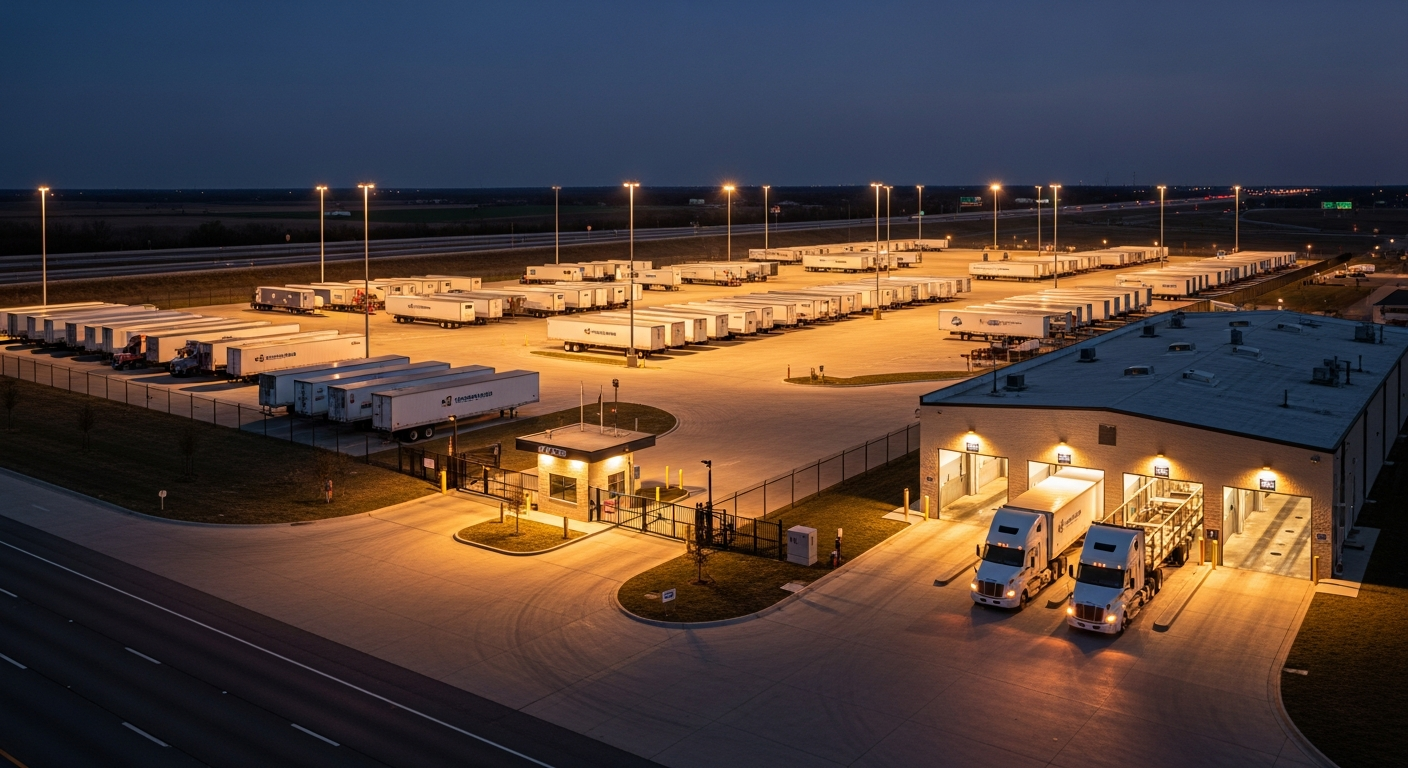
Secure truck parking is a documented national infrastructure gap, and truck wash demand rides the same freight corridors. Here is where the two pencil together — and the discipline lenders require before they fund one.
Firm-wide engagement figures are distinct from project-specific findings and their stated source periods.
Truck parking is one of the few real-estate shortages that federal agencies describe in plain language. The Federal Highway Administration treats inadequate truck parking as a national safety problem: when a driver cannot find a legal, safe place to rest, the choice is to keep driving fatigued or to park on a shoulder, a ramp, or a vacant lot. FHWA expects demand to keep outrunning supply as freight volume and e-commerce grow. For developers — and the lenders who finance them — that is the definition of a financeable gap, provided the specific site actually captures the demand.
The gap is national, but the value is not evenly distributed. The strongest private opportunities cluster where several pressures collide at once: hours-of-service rest timing, warehouse and distribution density, port and intermodal freight, land scarcity, and parking enforcement. Truck wash demand tends to ride the same corridors, which is why the most defensible projects underwrite parking and wash together rather than as two separate bets.
The demand is persistent and measurable. In the 2018–2019 Jason’s Law survey, 98% of participating drivers reported difficulty finding safe parking and 75% said it happened at least weekly — with the worst window running 4 p.m. to 5 a.m., Monday through Thursday, and the hardest months October through February. Drivers most often named Georgia, Illinois, New Jersey, New York, and Pennsylvania as shortage states, with new or worsening pressure reported along the I-95 corridor and the Pacific corridors.
Supply has not kept pace. Public estimates — which may be dated — put national capacity near 313,000 spaces as of the 2019 update: roughly 40,000 public rest-area spaces and about 273,000 private truck-stop spaces, a total that grew only modestly from 2014 to 2019 while driver pain stayed severe. Turning that shortage into a bankable project is the work of a truck parking feasibility study, which tests whether drivers and fleets at one specific site will pay the proposed rate rather than take a free alternative — a question no national shortage figure answers. The demand base underneath those numbers is enormous. Trucks moved 11.27 billion tons of freight in 2024 — about 72.7% of U.S. freight by weight — generating roughly $906 billion in industry revenue and employing some 3.58 million professional drivers.
The federal response confirms the gap rather than closing it. USDOT has announced more than $275 million in truck-parking grant funding, including $180 million for Florida’s I-4 corridor to add 917 spaces across Volusia, Seminole, and Osceola Counties, and has cited that roughly 40% of truckers spend more than an hour a day searching for parking. Public money is real, but it is concentrated — which is precisely why site-level feasibility, not national averages, decides whether a private project pencils.
Truck wash demand is less transparent than parking. There is no reliable national figure for unmet wash demand by market, so it has to be sized by proxy: truck counts, nearby truck stops, food-grade and reefer corridors, fleet terminals, port drayage, winter road-salt exposure, agriculture, livestock, and tanker traffic — all measured against the distance to the nearest competitor. Blue Beacon, the category leader, reports operating more than 115 wash locations nationally, mostly at travel plazas and usually open around the clock. That is enough to show the market is national, yet sparse relative to the scale of freight movement.
The strongest wash sites are not simply high-traffic. They are places where a driver already has a reason to stop — fuel, food, rest, parking, a scale, a shower, a washout, or fleet service. Express-wash operators explicitly recommend siting near major-brand truck stops where 24-hour two-way truck counts are highest. That overlap is the whole argument for combining parking and wash: parking creates the dwell time, and the wash converts it into a higher-margin transaction. A commercial truck wash feasibility study sizes that conversion from corridor fleet counts, food-grade and reefer activity, and the drive time to the nearest competing wash, precisely because no national unmet-demand figure exists to size it from.
On a first pass — before any site-specific study — these are the strongest preliminary targets for a combined secure-parking-plus-wash concept. Treat this as a screening list, not a recommendation to build: each node still requires its own feasibility work.
| # | Market node | Why it is underserved | Best concept |
|---|---|---|---|
| 1 | Joliet / Elwood / Minooka, IL — I-80, I-55, I-57, I-294 | Chicago region is a cited shortage area; massive intermodal, warehousing, rail, and cross-country freight. | Secure paid parking + washout + fleet contracts. |
| 2 | Lehigh Valley / Allentown–Bethlehem–Easton, PA — I-78 / I-476 / I-80 | PA, NJ, and NY are driver-cited shortage states; land scarcity near NYC creates high willingness to pay. | High-security reservation parking, smaller footprint, premium monthly stalls. |
| 3 | Atlanta outer ring, GA — I-75 south (Locust Grove/Jackson), I-85 NE, I-20 | Georgia is among the most-cited shortage states; a freight crossroad with warehouse sprawl and congestion. | 150–250 spaces + wash + tire/light maintenance. |
| 4 | Central Florida — Lakeland / Polk County / I-4, plus I-75 connectors | USDOT is funding 917 spaces on I-4, proving unmet demand — but public capacity may absorb part of the gap. | Build quickly, or target adjacent premium demand before grant supply opens. |
| 5 | Inland Empire, CA — Ontario / Fontana / Rialto / I-10 / I-15 / SR-60 | Pacific corridors and California are shortage areas; port-linked freight and warehouse density are extreme. | Premium high-rate parking, fleet contracts, washout — difficult permitting. |
| 6 | Savannah, GA / Pooler — I-16 / I-95 | Port growth, drayage, warehousing, and I-95 corridor shortage signals. | Drayage parking + washout + chassis/trailer service. |
| 7 | Carlisle / Harrisburg, PA and Hagerstown, MD — I-81 / I-76 / I-70 | I-81 is a major Northeast freight spine; PA is driver-cited; severe overnight pressure near warehouses. | Large secure overnight lot + washout + drop-lot partnerships. |
| 8 | DFW south — Wilmer / Hutchins / Lancaster / I-20 / I-35E / I-45 | Massive distribution growth, cheaper land than coastal markets, strong fleet density. | 200+ spaces, fleet-focused wash, monthly contracts. |
| 9 | Memphis / West Memphis — I-40 / I-55 / rail-intermodal | Cross-country interchange, intermodal, logistics hub, and long-haul rest timing. | Parking + truck wash + reefer/trailer washout. |
| 10 | San Antonio / New Braunfels / Austin corridor — I-35 / I-10 | Texas freight density, cross-border freight, and corridor growth; grants already recognize Texas need. | Large-format parking with phased expansion. |
Our read of a first-wave strategy is to pair one “premium scarcity” market with one “scalable land” market. The scarcity market — eastern Pennsylvania and the PA–NJ edge, or Joliet/Elwood, Illinois — justifies higher paid rates because alternatives are limited, freight density is high, and official shortage signals are strong. The scalable-land market — Atlanta’s outer ring, south DFW, or Memphis/West Memphis — offers better land economics and enough volume to build a 150- to 300-space prototype with wash and fleet contracts.
The discipline is to avoid starting in the most expensive market without an anchor. The Inland Empire may be one of the most underserved markets in the country, but entitlement risk, land cost, stormwater, and community opposition can erase the return unless a fleet, port operator, or logistics customer pre-commits. Central Florida is attractive, but a private project there has to be timed around the grant-funded public supply now entering the I-4 corridor.
The ranges below are underwriting brackets, not engineering bids. Heavy truck parking costs more per stall than car parking because stall size, pavement depth, turning radii, drainage, lighting, and load-bearing requirements are all more demanding; technology — access control, license-plate recognition, payment, and app access — typically adds 5% to 15% to a base surface lot.
| Project type | Typical land need | Capex range | Notes |
|---|---|---|---|
| Basic secured truck parking | 5–15 acres | $1.5M–$6M + land | Gravel or heavy-duty paved, lighting, fencing, cameras, gate; restrooms optional. |
| Institutional-grade paid truck parking | 10–25 acres | $5M–$18M incl. exurban land | 100–250 spaces, paved, drainage, stormwater, security, office, restrooms, app access. |
| Truck parking + wash / washout | 15–35 acres | $10M–$35M+ | Highest feasibility when both wash and parking demand are strong. |
| Full travel-center-style project | 25–60 acres | $25M–$80M+ | Fuel, C-store, restaurant, showers, parking, wash, repair — harder but defensible. |
A standard surface parking stall is often quoted at $3,000–$6,000 per car space, or $4,000–$8,000 with access control, LPR, and integrated payment technology — and truck stalls run materially higher for the reasons above. For the wash component, express-wash guidance puts initial cost near $1.5M to $2.5M depending on location, acreage, bay count, and equipment, with roughly five acres for a strong layout (some operators work with about 2.5). The light end of vendor quotes tends to understate a full institutional-grade facility once land, stormwater, utilities, and multi-bay design are included.
A private parking project generally needs one or more of these revenue structures to work. The most bankable cash flow comes from monthly and fleet contracts — not transient drivers alone. A 150-space secure lot can perform once stabilized paid occupancy reaches roughly 65% to 80%, with stronger returns in land-constrained markets.
| Parking revenue stream | Typical range |
|---|---|
| Overnight parking | $15–$35 / night |
| Reserved premium parking | $20–$50 / night in constrained markets |
| Monthly parking | $250–$650 / month per tractor or trailer space |
| Drop-lot / fleet block contracts | Negotiated — often better than transient |
| Ancillary revenue | Showers, laundry, vending, wash, washout, minor service |
A truck wash becomes attractive when it can lock in recurring fleet volume — often weekly or twice-weekly at roughly $35 to $75 per truck on 12- or 24-month terms. A simplified model illustrates the range by throughput:
| Scenario | Washes / day | Avg. ticket | Annual gross revenue |
|---|---|---|---|
| Conservative | 35 | $65 | ~$830K |
| Base case | 70 | $75 | ~$1.9M |
| Strong site | 120 | $85 | ~$3.7M |
| Excellent multi-bay | 180 | $90 | ~$5.9M |
The best-performing archetype is parking plus wash plus washout plus fleet accounts: parking creates dwell time, the wash adds margin, and fleet contracts smooth the volume that transient traffic alone cannot.
In our experience, a financeable project shows at least six of these eight traits:
The FHWA Truck Parking Development Handbook is built to help exactly this analysis — estimating demand, weighing benefits and costs, siting facilities, and addressing safety and community impact — and it is a useful reference alongside an independent study.
Saturation is not the moment every truck has a space. It is the point at which the next 50 to 100 spaces no longer earn the required return. That distinction drives phasing, and lenders should expect a study to address it directly.
A parking market still supports expansion when:
A parking market is approaching saturation when:
For the wash, the market is underbuilt when peak waits exceed 20–30 minutes, fleets cannot get recurring slots, drivers detour 20+ miles for a washout, and food-grade, reefer, livestock, tanker, or drayage traffic creates repeat demand. It is saturated when a new bay cannot sustain 25–35 washes a day, fleet contracts cover less than 35%–40% of fixed cost, average tickets slide on discounting, and competitors within 10–15 miles already run excess capacity.
Wert-Berater prepares independent, lender-grade feasibility studies for truck parking, truck wash, and combined travel-center concepts. Our fiduciary duty runs to the lender and agency, never to the borrower, so the demand case is built from corridor evidence — truck counts, freight generators, competitor mapping, enforcement pressure, and interviews — rather than from a developer’s optimism. We model the fleet-contract and monthly-parking base separately from transient traffic, stress the pro forma against a soft transient market, and test the wash throughput a site can realistically sustain. For SBA, USDA, EB-5, or conventional financing, the study is written to the standard the specific program requires.

President, Wert-Berater, Inc. — independent feasibility study consultants since 1998. 4,000+ engagements completed across all 50 states and internationally, evaluating $43.8 billion in project value for SBA, USDA, EB-5, conventional, and institutional financing decisions. Fiduciary duty runs to the lender and agency in every engagement.
+1 310-857-2443 ext. 800 · email · 1968 South Coast Hwy, Ste 2382, Laguna Beach, CA 92651 · 111 Town Square Pl Ste 1238 PMB 657834, Jersey City, NJ 07310 · 539 W. Commerce St #8486, Dallas, TX 75208 · 66 W Flagler Street, Suite 900, PMB 12704, Miami, FL 33130
Schedule a ConversationIndependent feasibility studies since 1998 — 4,000+ engagements, $43.8 billion in evaluated project value. Standard delivery in 10 to 15 business days. Fiduciary duty to the lender and agency.
Legal disclosure. Wert-Berater, Inc. offices are mailing addresses only. Following the COVID-19 pandemic the firm has elected to work remotely; its office locations receive mail and are not staffed for visitors or in-person meetings. Headquarters mailing address: 1968 South Coast Hwy, Ste 2382, Laguna Beach, CA 92651.
Wert-Berater, Inc. is an independent provider of feasibility studies and other related services. The firm does not provide financing or equity investment advice, and does not arrange, broker, or place debt or equity capital of any kind.
All appraisal assignments are performed by Bruce E. Jones, MAI, ASA-GC, BCA, CMEA, a member of the Appraisal Institute since 2006, a staff member of Wert-Berater, Inc. and owner of Special Purpose Realty Valuation.
Thousands of real estate, business, and machinery appraisal and litigation assignments.