
In the dynamic world of fuel retailing, gas stations often face various challenges and opportunities, particularly during rebranding or new construction.
A travel center adds parking, showers, foodservice, and fleet accounts to the revenue build; see our truck stop feasibility study consultant page.
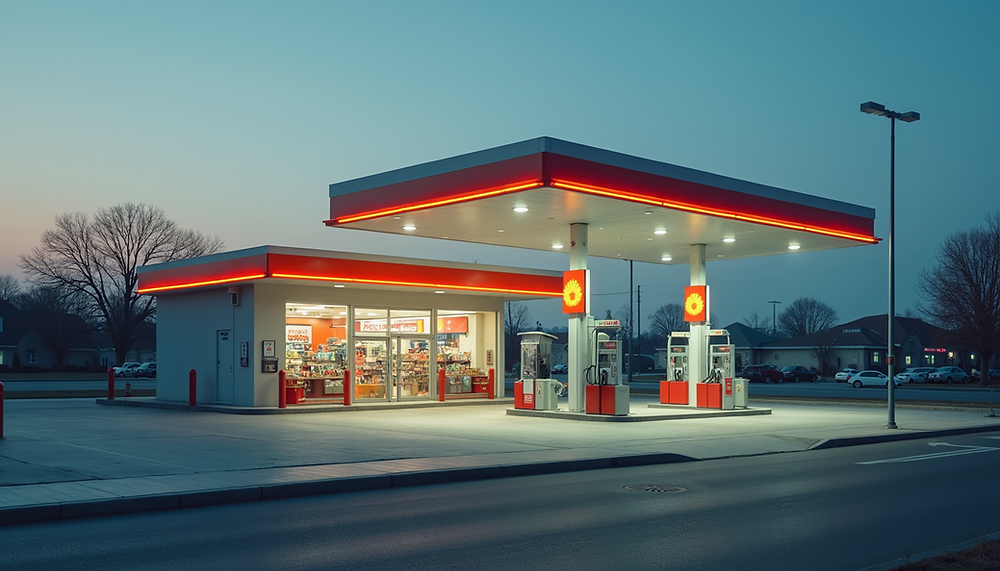
In the dynamic world of fuel retailing, gas stations often face various challenges and opportunities, particularly during rebranding or new construction. An in-depth understanding of how to calculate revenue from different sources such as diesel, gasoline, in-store sales, and quick-service restaurants (QSRs) is vital for success. This guide provides practical methodologies for revenue calculation, market leakage analysis, Monte Carlo simulations to evaluate economic changes, competitive analysis, and market gap analysis.
Identifying the main revenue streams for a gas station is essential. These typically include:
Each revenue stream plays a crucial role in a gas station's total profitability, and understanding their interconnections is key to effective financial management.
To accurately calculate revenue from fuel sales, you need to consider several factors:
The formula for calculating fuel revenue is:
```
Fuel Revenue = Volume of Fuel Sold x Price per Gallon
```
Rebranding economics depend on the competitive set at the specific site, which is what a custom fuel retail market report documents — competitor count and positions, traffic, access and inside-sales context.
If a gas station sells 10,000 gallons of gasoline at $3.00 per gallon, the revenue from gasoline sales would be:
```
Fuel Revenue = 10,000 gallons x $3.00/gallon = $30,000
```
This example showcases how even a modest volume can yield substantial revenue, emphasizing the importance of optimizing sales strategies.
In-store sales significantly contribute to a gas station's overall revenue. To calculate this, consider:
The formula for calculating in-store revenue is:
```
In-Store Revenue = Average Transaction Value x Number of Transactions
```
With an ATV of $20 and 200 daily transactions, your daily in-store revenue would be:
```
In-Store Revenue = $20 x 200 = $3,000
```
Over a month, this translates to:
```
Monthly In-Store Revenue = $3,000 x 30 = $60,000
```
This illustrates how vital effective merchandising and customer service can be for driving additional income.
Adding a quick-service restaurant can enhance profitability. To calculate QSR revenue:
The formula for calculating QSR revenue is:
```
QSR Revenue = Average Order Value x Daily Customer Count
```
Based on an AOV of $8 and 150 customers:
```
QSR Revenue = $8 x 150 = $2,200
```
Monthly, this totals:
```
Monthly QSR Revenue = $2,200 x 30 = $36,000
```
These figures illustrate how effective menu offerings and marketing can impact bottom-line revenue from food sales.
Market leakage analysis helps identify potential revenue lost to competitors. Understanding customer behavior is key.
Understanding market leakage enables gas station owners to develop targeted strategies to reclaim lost revenue.
Monte Carlo simulations allow forecasting of potential economic changes impacting revenue.
This analytical approach equips gas station owners to adapt to changing economic conditions proactively.
Conducting a competitive analysis is vital for positioning your gas station successfully.
By knowing the competitive landscape, gas station owners can create unique offerings that appeal to their target audience.
Market gap analysis reveals unmet needs within the market.
Addressing market gaps can attract more customers and boost revenue efficiently.
Rebranding or building a new gas station offers the chance to maximize revenue and improve market position. By understanding revenue calculations across diesel, gasoline, in-store, and QSR streams, carrying out market leakage and competitive analyses, utilizing Monte Carlo simulations, and identifying market gaps, gas station owners can make informed decisions to increase profitability.
With careful planning and strategic execution, a newly constructed or rebranded gas station can succeed in a competitive market, ensuring long-term success and sustainability.
Before capital is committed, a rebranding or ground-up program is normally tested by an independent fuel retail feasibility study that carries traffic, capture, margin and inside sales through to debt-service coverage.

President, Wert-Berater, Inc. — independent feasibility study consultants since 1998. 4,000+ engagements completed across all 50 states and internationally, evaluating $41.2 billion in project value for SBA, USDA, EB-5, conventional, and institutional financing decisions. Fiduciary duty runs to the lender and agency in every engagement.
+1 310-857-2443 ext. 800 · email · 1968 South Coast Hwy, Ste 2382, Laguna Beach, CA 92651 · 111 Town Square Pl Ste 1238 PMB 657834, Jersey City, NJ 07310 · 539 W. Commerce St #8486, Dallas, TX 75208 · 66 W Flagler Street, Suite 900, PMB 12704, Miami, FL 33130
Schedule a ConversationIndependent feasibility studies since 1998 — 4,000+ engagements, $41.2 billion in evaluated project value. Standard delivery in 10 to 15 business days. Fiduciary duty to the lender and agency.
Legal disclosure. Wert-Berater, Inc. offices are mailing addresses only. Following the COVID-19 pandemic the firm has elected to work remotely; its office locations receive mail and are not staffed for visitors or in-person meetings. Headquarters mailing address: 1968 South Coast Hwy, Ste 2382, Laguna Beach, CA 92651.
Wert-Berater, Inc. is an independent provider of feasibility studies and other related services. The firm does not provide financing or equity investment advice, and does not arrange, broker, or place debt or equity capital of any kind.
All appraisal assignments are performed by Bruce E. Jones, MAI, ASA-GC, BCA, CMEA, a member of the Appraisal Institute since 2006, a staff member of Wert-Berater, Inc. and owner of Special Purpose Realty Valuation.