
Optimize Your Project's Success: Comprehensive Business Planning and Feasibility Studies to Impress Investors and Lenders.
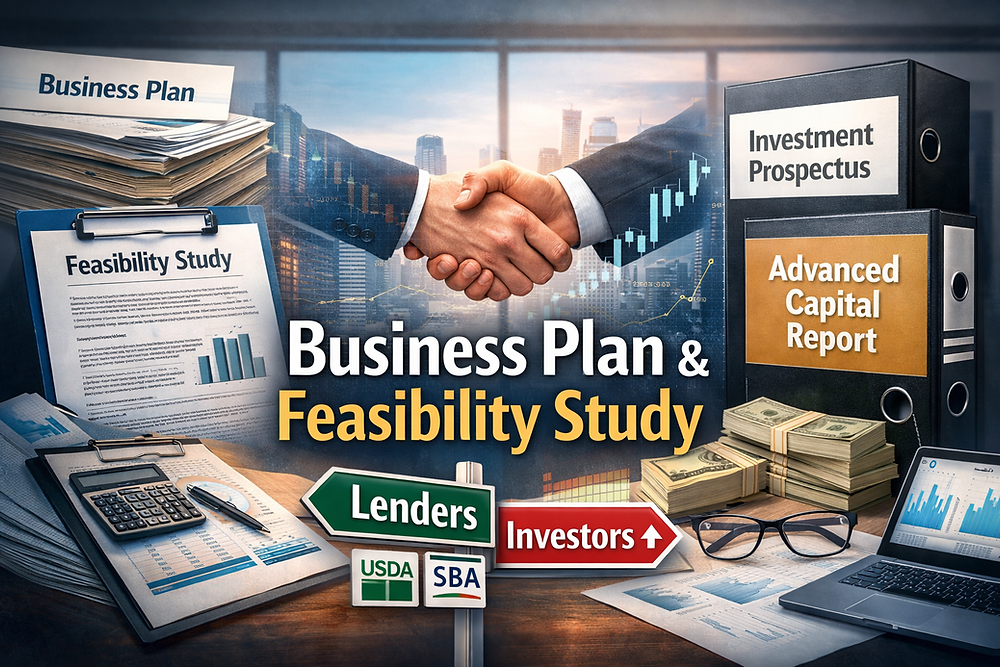
Optimize Your Project's Success: Comprehensive Business Planning and Feasibility Studies to Impress Investors and Lenders. Too many project sponsors approach banks, USDA lenders, SBA lenders, or equity investors with the wrong package. They may have a business plan, a set of projections, and a strong idea, but that does not mean the materials are underwriter-ready, regulation-aware, or investor-appropriate. That gap is where deals often slow down, lose credibility, or fail altogether.
Before you speak with lenders or investors , your business plan should be evaluated, pressure-tested, and optimized. Then, where required, a proper feasibility study should be completed.
The reason is simple: capital providers do not review projects casually. USDA and SBA lenders must underwrite within formal program rules and prudent lending standards, and sophisticated investors want focused capital materials that fit their decision process.
At Wert-Berater, Inc., this is exactly where disciplined preparation matters most. The firm presents itself as focused on bank-ready, investor-grade, regulation-compliant work used in financing and capital allocation decisions, and notes that its reports are relied upon by lenders, agencies, underwriters, and sophisticated investors.
A business plan is not just a marketing document. In finance-driven transactions, it becomes the sponsor’s operating narrative. It tells lenders and investors what the project is, why demand exists, how management will execute, what capital is needed, and how risk will be managed.
If that plan contains weak assumptions, unsupported market logic, unrealistic margins, or projections that do not align with industry norms, it can undermine the entire capital raise.
That is why evaluation must come before circulation. A plan should be reviewed for internal consistency, underwriting logic, market credibility, and ratio performance. Revenue assumptions should make sense against demand drivers. Expense lines should reflect operating reality. Capital structure should be coherent.
Debt service should appear sustainable under stress. In other words, the plan should not merely look polished. It should survive scrutiny. That is especially important because USDA lenders are instructed to analyze whether guaranteed loan terms and credit factors support repayment, and SBA loan origination follows formal SOP guidance for 7(a) and 504 lending.
For lenders, a feasibility study is not a decorative extra. In many cases, it is part of the decision framework. A lender is trying to answer whether a project is commercially viable, operationally realistic, financially sustainable, and creditworthy. A sponsor may believe in the project, but a bank needs independent analysis.
That matters even more in USDA and SBA-related financing environments. USDA’s guaranteed loan framework is governed by 7 CFR Part 5001, and the Rural Development B&I program states that the lender must conduct a credit evaluation consistent with prudent lending practices, address weaknesses, and analyze credit factors to determine repayment ability.
So, the issue is not whether the owner is enthusiastic. The issue is whether the project works under formal credit review.
A proper feasibility study helps answer questions such as:
Wert-Berater’s own service positioning reflects this lender-facing reality. The firm states that it provides independent feasibility studies built to withstand underwriting review, regulatory scrutiny, and capital risk, rather than reports written to justify preconceived outcomes.
One of the biggest mistakes borrowers make is assuming that an attractive concept alone can carry a financing request. It cannot. Underwriters do not operate on optimism. They operate within lending policy, risk standards, documentation requirements, and program rules.
For SBA lending, SBA’s official SOP 50 10 governs loan origination policies and procedures for the 7(a) and 504 programs. The currently posted version on SBA’s site is Version 8, effective June 1, 2025.
For USDA guaranteed lending, the governing regulation is 7 CFR Part 5001, and USDA’s B&I page states plainly that lenders must evaluate the borrower and project using prudent underwriting, address weaknesses, and determine that loan terms and credit factors ensure repayment.
That means your business plan and projections cannot be generic. They must be developed in a way that aligns with how regulated or program-based underwriting actually works.
Lenders do not read projections in a vacuum. They compare them to reality. One of the ways they do that is by looking at industry ratios and operating benchmarks. If a project shows margins, expense loads, turnover patterns, liquidity, or debt coverage that sit far outside the norms of its sector, the file becomes harder to defend.
That does not mean every project must match an average exactly. But it does mean that departures from sector norms need to be justified. If payroll is unusually low, why? If margins are unusually high, how? If ramp-up is faster than peers, what supports that? If debt service coverage is thin, what is the mitigation?
This is where many business plans fail. They are written like promotional decks instead of being structured for ratio-driven credit review. Wert-Berater specifically describes its analyses as including financial ratios, sustainability analysis, liquidity analysis, profitability metrics, and turnover review, which is the kind of discipline lenders expect to see in serious underwriting support materials.
The plan should not be written first and “fixed later.”
It should be built with the destination in mind.
If the target audience is a bank, USDA lender, or SBA lender, the business plan and projections should be prepared to fit that underwriting environment from the start. That means:
In practice, that means the business plan should be perfected and compliance-aware before a lender ever sees it. Then the feasibility study can reinforce, test, and independently validate the core assumptions behind the plan.
Now let’s switch audiences.
Equity investors do care about feasibility. They also want to understand market risk, capital structure, timing, and downside exposure. But that does not mean they want to receive a long, lender-style feasibility study as the first document in the conversation.
That is often the wrong tool for the job.
A full feasibility study is usually built for underwriting, documentation depth, and formal risk support. It may be essential for the bank. It may also be valuable in later diligence with investors. But as a first-touch equity document, it can be too long, too technical, too lender-oriented, and not focused enough on return mechanics, capital alignment, and investor decision-making.
Wert-Berater’s own Investment Prospectus & Advanced Capital Feasibility service is described as intentionally positioned between informal pitch materials and full lender or agency feasibility studies.
The firm says this service is designed for equity raises, joint ventures, institutional capital discussions, and early investor screening, and that many engagements later progress to full lender or agency feasibility once capital interest is established.
That is the key distinction.
If you are speaking to equity investors, the sequence should be more strategic.
A pitch deck is the opening conversation tool. It frames the opportunity, market thesis, team, capital need, and headline returns.
After that, a more advanced investor-facing document should carry the process forward.
For this purpose, the better fit is not usually a full lender-style feasibility report. It is an Investment Prospectus & Advanced Capital Feasibility report that translates the project into investor language: structure, sensitivity, return logic, governance, risks, and exit pathways.
Wert-Berater describes this service as combining financial feasibility, sensitivity testing, operational and management assessment, capital structuring, and risk analysis into a coherent investor-ready document.
The full feasibility study still matters. Investors may ask to review it during diligence, and the bank may require it. But it should not usually be the lead document for equity conversations because it is often longer than needed and less focused on how equity capital actually evaluates opportunity.
For projects that may involve both lender review and equity capital, the recommended sequence is:
1. Business plan perfected and compliant: Your business plan should first be evaluated, optimized, ratio-aware, and aligned with the likely underwriting or capital review framework.
2. Investment Prospectus & Advanced Capital Feasibility report: For equity investors, use an investor-ready capital document built for serious capital engagement and further diligence, not a bulky lender-first report. Wert-Berater’s service page presents this document as a bridge between pitch materials and full lender feasibility.
3. Full feasibility study: Complete the full feasibility study for lender requirements, formal diligence, and bank or agency underwriting support.
That sequence keeps the process efficient. It also respects the reality that debt and equity do not read the same way, do not prioritize the same points at the same time, and should not always receive the same document first.
Before speaking with investors or lenders, your project should be more than exciting. It should be prepared.
That means the business plan should be evaluated and optimized first. It means feasibility should be completed where lender review requires it. It means USDA and SBA-related underwriting realities must be respected, because those environments are governed by formal guidance and prudent credit review. And it means your materials should be matched to the audience: lender-grade feasibility for banks and agencies, and a focused pitch deck plus investor-grade capital documentation for equity discussions.
Wert-Berater’s positioning is built around exactly that distinction: bank-ready feasibility work for financing-critical assignments, and investment prospectus and capital feasibility services for equity, joint venture, and institutional capital discussions.
The firm states that it has operated since 1998 and has completed thousands of studies used in financing and capital allocation decisions.
Wert-Berater, Inc.
1968 South Coast Highway
Suite 2382
Laguna Beach, CA 92651Phone: +1 310-857-2443 ext. 800
Website: Wert-Berater official site .
Investment Prospectus & Advanced Capital Feasibility: official service page .
About / firm background: firm experience and About page.
President, Wert-Berater, Inc. — independent feasibility study consultants since 1998. 4,000+ engagements completed across all 50 states and internationally, evaluating $41.2 billion in project value for SBA, USDA, EB-5, conventional, and institutional financing decisions. Fiduciary duty runs to the lender and agency in every engagement.
+1 310-857-2443 ext. 800 · email · 1968 South Coast Hwy, Ste 2382, Laguna Beach, CA 92651 · 111 Town Square Pl Ste 1238 PMB 657834, Jersey City, NJ 07310 · 539 W. Commerce St #8486, Dallas, TX 75208 · 66 W Flagler Street, Suite 900, PMB 12704, Miami, FL 33130
Schedule a ConversationIndependent feasibility studies since 1998 — 4,000+ engagements, $41.2 billion in evaluated project value. Standard delivery in 10 to 15 business days. Fiduciary duty to the lender and agency.
Legal disclosure. Wert-Berater, Inc. offices are mailing addresses only. Following the COVID-19 pandemic the firm has elected to work remotely; its office locations receive mail and are not staffed for visitors or in-person meetings. Headquarters mailing address: 1968 South Coast Hwy, Ste 2382, Laguna Beach, CA 92651.
Wert-Berater, Inc. is an independent provider of feasibility studies and other related services. The firm does not provide financing or equity investment advice, and does not arrange, broker, or place debt or equity capital of any kind.
All appraisal assignments are performed by Bruce E. Jones, MAI, ASA-GC, BCA, CMEA, a member of the Appraisal Institute since 2006, a staff member of Wert-Berater, Inc. and owner of Special Purpose Realty Valuation.