
Opportunity Zones can create compelling investment opportunities for developers, real estate investors, and businesses willing to invest in designated economically distressed communities. By combining eligible investments with a sound development strategy, investors may benefit from preferential federal tax treatment while financing new construction, rehabilitating existing properties, expanding businesses, and supporting local economic growth.
However, a designated Opportunity Zone is not automatically a good investment. The location must support sufficient demand, the development must be economically viable, and the financing structure must withstand realistic operating and market conditions.
For developers, investors, lenders, and public-sector decision-makers, the central question is not simply whether a property is located in an Opportunity Zone. It is whether the proposed project can create sustainable economic value, qualify for the applicable tax benefits, attract capital, and perform over its investment horizon.
Wert-Berater provides independent market intelligence, feasibility analysis, financial modeling, underwriting, and investment due diligence to help decision-makers evaluate projects before committing significant capital.
1. What Is an Opportunity Zone?
An Opportunity Zone (OZ) is a designated U.S. census tract where eligible investments may qualify for preferential federal tax treatment under the federal Opportunity Zone program.
The program was established by the Tax Cuts and Jobs Act of 2017 to encourage long-term private investment in economically distressed communities. The original framework was designed to attract capital into areas that may otherwise experience difficulty securing investment for new development, business expansion, infrastructure-related projects, and property rehabilitation.
Investors generally access the program through a Qualified Opportunity Fund (QOF), an investment vehicle organized as a partnership or corporation to invest in qualifying Opportunity Zone property.
The program can connect private investment with projects that create housing, commercial space, industrial facilities, jobs, and other economic activity.
Why Opportunity Zones Matter to Developers
Opportunity Zones may provide developers with access to investors seeking qualifying projects that combine potential financial returns with tax advantages.
These investments can support:
- Multifamily apartments, workforce housing, and mixed-use developments.
- Industrial buildings, manufacturing facilities, and distribution centers.
- Hotels, hospitality facilities, and tourism-related businesses.
- Retail centers, restaurants, and neighborhood commercial development.
- Office, medical office, and specialized commercial properties.
- Adaptive reuse, redevelopment, and substantial property rehabilitation.
- Operating businesses that meet applicable Opportunity Zone business requirements.
- Rural development and qualifying business expansion.
The tax designation is only one component of a successful development strategy. Developers must still evaluate market demand, construction costs, achievable rents or sales prices, operating expenses, financing terms, and the project's exit strategy.
Official guidance is available from the Internal Revenue Service (IRS).
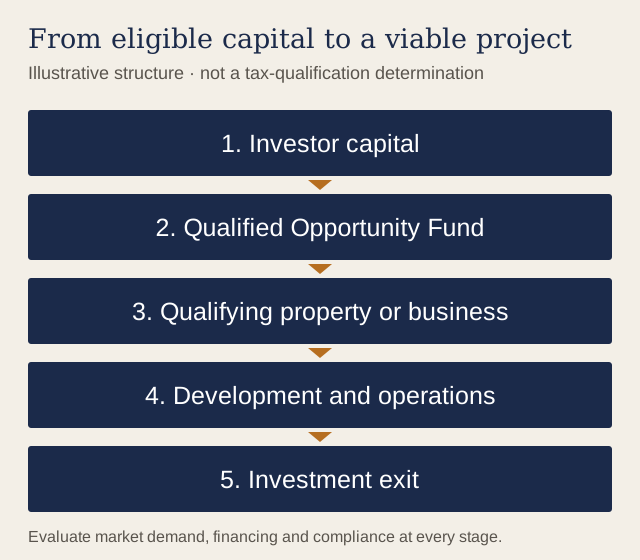
2. How Do Opportunity Zones Work?
The original Opportunity Zone framework generally involves four principal participants: the investor, the Qualified Opportunity Fund, the project sponsor or developer, and the underlying business or property.
Step 1: Identify an eligible Opportunity Zone
The developer identifies a site located within a designated census tract and verifies the property's eligibility under the applicable rules.
An address near an Opportunity Zone is not necessarily inside one. Developers should verify the precise census tract and the relevant designation period rather than relying on a marketing brochure or a generalized map.
Step 2: Establish the development concept
The developer determines what the property should become, considering local demand, competing supply, zoning, infrastructure, construction costs, and financial performance.
Potential concepts include a new apartment community, industrial facility, hotel, neighborhood shopping center, or adaptive reuse project.
At this stage, an independent feasibility study can identify whether the proposed concept is supported by market conditions and whether alternative uses would produce better results.
Step 3: Structure the investment
An eligible investor generally invests qualifying capital gains in exchange for an equity interest in a Qualified Opportunity Fund within the applicable investment period.
The fund then invests in qualifying Opportunity Zone property, such as eligible business property, stock, or partnership interests.
The structure may involve a fund investing in a project-level entity that owns the property or operates the business. Legal, tax, and operating structures depend on the project and applicable requirements.
Step 4: Develop and operate the project
The sponsor acquires or controls the site, secures entitlements, obtains financing, completes construction or rehabilitation, and operates the property or business.
The investment must satisfy the applicable qualification, asset, business, timing, and reporting requirements. A property does not qualify simply because it is located within a designated tract.
Step 5: Manage the investment and exit
The investor monitors construction, lease-up, occupancy, operating performance, debt service, capital expenditures, and exit opportunities.
The investment's tax treatment depends on its eligibility, acquisition and investment dates, holding period, and applicable law.
Important: Opportunity Zone investments are not guaranteed to produce a profit, secure financing, or qualify for every anticipated tax benefit.
Fund and business tests are different
A QOF generally must satisfy the 90% qualifying-asset standard. A qualifying underlying business has separate requirements, including the 70% tangible-property standard, at least 50% qualifying active-business gross income, and limits on nonqualified financial property. Original-use or substantial-improvement rules, excluded businesses, applicable safe harbors and testing dates require professional review. These percentages are not interchangeable.
Under current IRS guidance, funds use Form 8996 for certification and annual reporting, while investors use Form 8997 for their annual investment reporting and Form 8949 for applicable elections. Confirm current instructions and any subsequently effective reporting changes. See IRS fund certification and maintenance and Notice 2026-40, section 2.
3. What Are the Tax Benefits of Opportunity Zone Investments?
The original Opportunity Zone program provided three principal federal tax advantages. The applicable treatment now depends in part on when the investment was made and which statutory regime governs it.
Benefit 1: Deferral of eligible capital gains
Under the original framework, investors could elect to defer eligible capital gains by investing the qualifying gain in a Qualified Opportunity Fund within the applicable 180-day period.
For investments governed by the original rules, the deferred gain generally becomes taxable upon an earlier inclusion event or December 31, 2026.
Consequently, an investor evaluating an investment in 2026 must distinguish between the tax treatment of a newly realized gain and the continuing tax treatment of an existing Opportunity Zone investment.
Benefit 2: Potential reduction in deferred gain
Under the original rules, qualifying investors could increase their tax basis in the fund investment based on the holding period:
- Five years: A 10% basis increase attributable to the deferred gain.
- Seven years: An additional 5% basis increase, for a potential total of 15%.
These benefits depended on satisfying the applicable holding-period requirements. Because the original deferred-gain recognition date is December 31, 2026, investors making new investments in 2026 generally cannot achieve the original five- or seven-year holding periods before that recognition date.
This timing distinction is important when evaluating older promotional materials that describe the original benefits without considering the current calendar.
Benefit 3: Potential exclusion of appreciation on a qualifying investment
Under the original framework, investors who held a qualifying Opportunity Zone investment for at least ten years could elect a basis adjustment to fair market value upon a qualifying sale or exchange. This can eliminate federal capital gains tax on eligible appreciation in the qualifying fund investment, subject to applicable limitations and rules.
This benefit is distinct from the deferral of the original gain invested in the fund.
Illustrative example
Assume an investor has $1 million in eligible capital gains and invests that amount in a qualifying Opportunity Zone Fund.
Suppose the investment eventually increases in value to $1.8 million.
Under a hypothetical qualifying structure governed by the original ten-year appreciation rules, the $800,000 in appreciation could potentially qualify for the applicable basis adjustment. The original $1 million of deferred gain, however, is subject to its separate recognition rules.
This example illustrates the distinction between the original deferred gain and subsequent investment appreciation. It does not establish that a particular investor or investment qualifies for the treatment described.
Tax benefits do not replace investment analysis
A project with weak demand, excessive construction costs, or insufficient operating income can destroy more economic value than the tax benefits create.
Investors should evaluate both the investment's underlying economics and its tax-adjusted returns. Tax counsel and qualified tax professionals should verify eligibility, timing, basis adjustments, reporting obligations, and exit treatment before capital is committed.
Primary reference: IRS — Investing in a Qualified Opportunity Fund.
4. What Changed in 2025–2026?
The Opportunity Zone program changed under federal legislation enacted July 4, 2025. The amendments establish a continuing framework for future Opportunity Zone designations and change certain rules applicable to investments beginning in 2027.
For developers and investors, the distinction between the original program and the newer framework is essential.
Existing and new investments must be analyzed separately
The original Opportunity Zone rules continue to matter for qualifying property and investments within the transition provisions. The newer framework applies according to the statutory effective dates and related requirements.
Among the developments relevant to project planning:
- The updated framework establishes recurring Opportunity Zone designation periods beginning in 2027.
- The rules for future qualifying property and investments differ from the original program in specified respects.
- Qualifying rural Opportunity Zone property may benefit from a reduced substantial-improvement threshold.
- Transitional guidance and forthcoming regulations affect how the amended provisions should be applied.
The IRS has published guidance on these changes, including its January 2026 explanation of enhanced incentives for rural Opportunity Zone investments and its 2026 transitional guidance.
Why this matters to developers
A developer planning a project in 2026 should not assume that a new investment receives the same treatment as an investment made under the original program.
The project team should verify:
- The property's applicable Opportunity Zone designation.
- The relevant acquisition and investment dates.
- The applicable statutory regime and transitional provisions.
- Whether the project meets the required property or business tests.
- The substantial-improvement rules applicable to the property, including any qualifying rural provisions.
- The holding period, reporting, and exit requirements.
For rural redevelopment projects in particular, the potential reduction in the substantial-improvement threshold may materially affect the acquisition strategy and rehabilitation budget. Eligibility must be established under the applicable rules; a rural location alone is insufficient.
Before marketing an investment as tax-advantaged, obtain project-specific tax and legal review.
Separate the investment date from the gain date
Investments made through December 31, 2026: the original deferred gain is generally included at an earlier inclusion event or on December 31, 2026. Recognition of that gain does not by itself end potential eligibility for the separate ten-year appreciation election. The deemed-included gain cannot simply be re-deferred into the new regime.
Qualifying investments made on or after January 1, 2027: Notice 2026-40 describes deferral until the earliest applicable inclusion event or five years after investment, with a 10% basis increase after five years, or 30% for an investment in a qualified rural opportunity fund. A rural property is not, by itself, proof that a fund qualifies. Eligible gains realized in 2026 may fall under these rules if timely invested in 2027; the relevant investment period still applies.
New designations: tracts certified during 2026 have a designation period from January 1, 2027 through December 31, 2036. An old designation alone does not establish that property acquired after 2026 qualifies. Transitional exceptions, including specified working-capital arrangements, require separate analysis.
Appreciation and exit: for qualifying amounts invested after December 31, 2026 and held at least ten years, the amended election measures fair market value at the earlier of sale or exchange, or the thirtieth anniversary of investment. Do not assume all appreciation after year 30 is excluded. The original framework has a different exit-election timeline; obtain advice before a disposition.
Rural rehabilitation: effective July 4, 2025, the substantial-improvement threshold for property in an eligible zone comprised entirely of a rural area was reduced from 100% to 50%. Confirm the tract and the applicable basis calculation under Notice 2025-50; this is not a blanket rule for every rural parcel.
Sources: Notice 2026-40, sections 2–6 and IRS Tax Tip 2026-04. The notice provides transitional guidance and announces forthcoming proposed regulations with anticipated applicability described in section 6; it is not a statement that all implementing regulations are final.
5. What Types of Projects Can Be Developed in Opportunity Zones?
Opportunity Zones can accommodate a broad range of development and operating-business strategies. The best opportunity depends on local demand, site characteristics, development costs, and the availability of suitable capital.
Multifamily and workforce housing
Multifamily housing may be attractive where employment growth, household formation, affordability constraints, or population growth support additional rental supply.
A feasibility study should evaluate achievable rents by unit type, competitive supply, concessions, vacancy, household incomes, employment access, operating expenses, construction costs, and the financing structure.
Projects may include market-rate apartments, workforce housing, mixed-income developments, and adaptive reuse of existing buildings. Additional affordable-housing incentives may be available for some projects, but those incentives have separate eligibility and compliance requirements.
Industrial and manufacturing development
Opportunity Zones may offer sites for new manufacturing facilities, industrial buildings, logistics facilities, and business expansion.
The strongest locations typically have demonstrable access to transportation, labor, utilities, suppliers, customers, and necessary infrastructure.
A manufacturing feasibility study should evaluate the proposed product market, competitive capacity, labor availability, utility costs, production economics, capital equipment, and demand under alternative operating scenarios.
Retail and neighborhood commercial development
Neighborhood retail, restaurants, service businesses, and commercial centers may be viable where the surrounding population and consumer spending support the proposed concept.
Developers should analyze trade-area demographics, traffic patterns, competing businesses, purchasing power, visibility, access, and the tenant mix.
Hospitality and tourism
Hotels, extended-stay properties, and other hospitality businesses may be suitable where tourism, business travel, regional employment, or transportation infrastructure generate sufficient demand.
The analysis should include seasonal occupancy, average daily rates, revenue per available room, labor costs, management expenses, and debt-service requirements.
Mixed-use development
Mixed-use projects can combine residential units, retail, office, hospitality, and other compatible uses.
The principal benefit is diversification of potential income sources. However, mixed-use developments also introduce more complex construction sequencing, leasing requirements, operating arrangements, and capital needs.
Adaptive reuse and redevelopment
Converting an obsolete office building, warehouse, industrial facility, or other existing structure into a productive use can create investment opportunities.
The feasibility analysis should assess structural conditions, environmental liabilities, zoning, rehabilitation costs, code compliance, utility capacity, and achievable post-renovation income.
Operating businesses and business expansion
Opportunity Zone investments are not limited to real estate. Eligible businesses may include manufacturing, distribution, technology, healthcare, and other operating enterprises that satisfy the applicable requirements.
Business investments require analysis of customers, revenue, margins, labor, equipment, working capital, management, and growth potential—not merely an assessment of the underlying property.
6. How Can Developers Capitalize on Opportunity Zones?
Developers can use the program to pursue projects that align the tax objectives of investors with the economic and operating requirements of a viable development.
Strategy 1: Acquire underutilized property
Identify properties with redevelopment potential, existing infrastructure, or a location advantage that is not fully reflected in current pricing.
Before acquiring a property, assess alternative uses, entitlement requirements, rehabilitation costs, market demand, and the likelihood of satisfying applicable Opportunity Zone property requirements.
Strategy 2: Develop new construction
New construction may be attractive where a market has a documented shortage of suitable housing, industrial capacity, retail space, or other facilities.
The development plan should establish the appropriate size, product mix, construction schedule, pricing strategy, and absorption assumptions.
Strategy 3: Reposition existing assets
An underperforming property may be repositioned through renovations, changes in use, tenant improvements, operational improvements, or a different leasing strategy.
Developers should compare the expected return from repositioning with the cost and risk of new construction or an alternative use.
Strategy 4: Attract tax-sensitive equity investors
Some investors may prefer eligible Opportunity Zone investments because of their federal tax treatment and long-term investment characteristics.
A sponsor should prepare a defensible investment case that explains the project, capital requirements, development timetable, expected cash flows, risks, exit strategy, and applicable qualification requirements.
The presence of a tax benefit does not guarantee that investors will accept the proposed valuation or expected return.
Strategy 5: Combine compatible incentives
Depending on the project and jurisdiction, additional programs may include:
- Low-Income Housing Tax Credits for eligible affordable-housing developments.
- Historic rehabilitation tax credits for qualifying properties.
- New Markets Tax Credits for eligible business and real estate investments.
- State and local tax incentives, grants, or economic development programs.
- Brownfield remediation assistance where the property qualifies.
- Industrial revenue bonds, infrastructure assistance, or other project-specific financing.
Each program has separate rules, costs, and compliance obligations. Some incentives can be combined, while others may create restrictions, timing conflicts, or limitations on the same expenditures. A tax-credit or incentive specialist should evaluate compatibility before the capital stack is finalized.
7. How Are Opportunity Zone Projects Financed?
Opportunity Zone development generally requires a capital structure that balances investor equity, debt, project costs, and operating cash flow.
Common financing sources
1. Qualified Opportunity Fund equity
Equity may come from individuals, family offices, investment partnerships, real estate funds, or other eligible investors.
Investors generally expect compensation for development risk, illiquidity, execution uncertainty, and the possibility that the project will not meet its projected returns.
2. Developer equity
The sponsor may contribute cash, land, or other eligible capital. A land contribution or other sponsor contribution does not automatically receive QOF tax treatment; qualifying and nonqualifying interests must be distinguished. Sponsor equity can demonstrate commitment but should be evaluated in the context of total project cost, liquidity, and the sponsor's other obligations.
3. Construction financing
A bank or other lender may provide a construction loan based on the project's costs, sponsor strength, collateral, equity contribution, and repayment prospects.
The lender will typically assess construction contingencies, interest reserves, lease-up risk, completion guarantees, and the proposed permanent financing or sale.
4. Permanent financing
Once a project is completed and stabilized, permanent debt may refinance construction financing. Depending on the asset and borrower, potential sources include commercial banks, life insurance companies, agency lenders, debt funds, and other commercial real estate lenders.
5. Government and tax-credit programs
Eligible projects may obtain additional financing or incentives through affordable-housing programs, state and local economic development programs, or other qualifying initiatives.
These funds should not be assumed available until eligibility, allocation, timing, and funding commitments are confirmed.
Illustrative capital stack
Consider a hypothetical $20 million development:
| Capital source | Amount | Share |
|---|---|---|
| Qualified Opportunity Fund equity | $6,000,000 | 30% |
| Developer and co-investor equity | $2,000,000 | 10% |
| Construction loan | $12,000,000 | 60% |
| Total project capitalization | $20,000,000 | 100% |
This is an illustrative financing structure, not a recommended leverage ratio or a statement of typical lender terms. Actual funding depends on the asset type, project economics, tax structure, lender underwriting, and investor requirements.
What lenders and equity investors need to see
A financeable Opportunity Zone project should have a coherent investment thesis supported by evidence.
Typical requirements include:
- Independent market and demand analysis.
- A review of competing supply and achievable pricing.
- Development costs supported by appropriate estimates.
- A realistic construction and lease-up schedule.
- Multi-year cash-flow projections.
- Debt-service coverage ratio (DSCR) and debt yield analysis, where applicable.
- Sensitivity analysis covering rents or prices, vacancy, costs, interest rates, and absorption.
- Sponsor experience, financial capacity, and operating strategy.
- A credible exit or refinancing strategy.
- Evidence supporting the applicable Opportunity Zone qualification and tax treatment.
A tax incentive may improve the investor's after-tax return, but lenders still need to determine whether the project can repay its debt.
8. How Feasibility Studies Help Developers and Investors
An independent feasibility study helps determine whether a proposed development is economically justified before substantial capital is committed.
For Opportunity Zone projects, it should address two related but distinct questions:
- Investment feasibility: Is the project supported by market demand, reasonable costs, achievable revenue, and acceptable risk?
- Program and financing compatibility: Can the proposed investment structure satisfy the applicable Opportunity Zone rules and the requirements of prospective lenders and other capital providers?
A feasibility study informs these decisions but does not replace legal, tax, engineering, environmental, or other specialized professional advice.
Market feasibility
Market analysis evaluates whether the proposed use is supported by the surrounding market.
Depending on the project, this may include population and household trends, employment, income, consumer spending, competitive supply, rental rates, sales prices, absorption, and demand forecasts.
For manufacturing projects, the analysis may also include industry demand, transportation, utilities, workforce availability, suppliers, production capacity, and customer markets.
Site and development feasibility
A site can qualify geographically but still be unsuitable for the proposed project.
The assessment should examine zoning, land use, access, utilities, environmental conditions, physical constraints, construction requirements, infrastructure, and alternative uses.
Developers should also identify entitlement risks and determine whether the proposed design and scale are consistent with market demand.
Financial feasibility
The financial model converts market and development assumptions into projected investment performance.
A typical model includes:
- Land acquisition and closing costs.
- Hard and soft construction costs.
- Financing costs and interest reserves.
- Contingencies and working capital.
- Rental, sales, or business operating revenue.
- Vacancy, concessions, and collection losses.
- Operating expenses and capital expenditures.
- Debt service and financing covenants.
- Investor cash flows and exit assumptions.
- Sensitivity and downside scenarios.
Depending on the project, appropriate metrics may include DSCR, debt yield, loan-to-cost, loan-to-value, net operating income, internal rate of return (IRR), equity multiple, and break-even occupancy.
Investment and scenario analysis
The study should test what happens if the project does not perform as expected.
For example, a multifamily project could be modeled under lower rents, higher vacancy, increased construction costs, and slower lease-up. A manufacturing project could be tested under lower sales volumes, higher input costs, or delayed production.
This allows developers and investors to identify the assumptions that have the greatest effect on returns and financing capacity.
Comparing alternative development concepts
A feasibility study can also compare different uses of the same site.
For example, an underutilized industrial property might be evaluated for continued industrial use, warehouse redevelopment, manufacturing expansion, or adaptive reuse.
The preferred alternative should be supported by evidence regarding market demand, development costs, achievable income, financing, and risk.
Ongoing performance monitoring
Feasibility is not a one-time issue. After investment, the sponsor should compare actual performance with the approved underwriting assumptions.
Regular monitoring can identify deteriorating occupancy, revenue shortfalls, rising expenses, construction overruns, delayed lease-up, or weakening debt coverage.
Wert-Berater's asset and portfolio performance monitoring service is relevant to investors and capital providers seeking continued visibility into asset performance after the original investment decision.
9. Five Illustrative Opportunity Zone Case Studies
The following five case studies are hypothetical examples created to demonstrate how Opportunity Zone feasibility analysis can support investment decisions. They are not actual Wert-Berater engagements, verified transactions, or representations of available tax benefits. Project costs, revenues, and financing amounts are illustrative only.
Case Study 1: Multifamily and Workforce Housing Development
Illustrative and hypothetical — not an actual Wert-Berater engagement or verified investment.
Project concept: A 120-unit apartment development in an eligible urban Opportunity Zone.
Investment challenge: The developer believes the surrounding area has unmet rental demand, but nearby properties compete for the same tenants. Construction costs and interest expense create uncertainty about achievable returns.
Feasibility analysis:
- Evaluate household growth, employment, incomes, and renter demand.
- Identify competitive properties and compare rents by unit type.
- Analyze unit mix, amenities, parking, and achievable rent premiums.
- Estimate construction costs, operating expenses, vacancy, and lease-up.
- Model construction financing, permanent debt, and investor cash flows.
- Evaluate affordable-housing or other incentive programs where appropriate.
Illustrative financing: A combination of Opportunity Fund equity, sponsor equity, and construction debt, with potential additional funding if a separate affordable-housing program is available and compatible.
Decision supported: Whether to proceed with the proposed unit count, revise the unit mix, phase the development, or reconsider the site.
Key lesson: A strong tax strategy cannot compensate for rents that fail to support the cost of development.
Case Study 2: Manufacturing Facility Expansion
Illustrative and hypothetical — not an actual Wert-Berater engagement or verified investment.
Project concept: Expansion of an existing manufacturing operation through a new 100,000-square-foot production facility.
Investment challenge: The business has identified potential customer demand but needs to determine whether the expansion will generate enough incremental cash flow to support the required investment.
Feasibility analysis:
- Evaluate the addressable market and projected customer demand.
- Review production capacity, utilization, labor availability, and equipment requirements.
- Analyze transportation, utility capacity, supplier access, and site suitability.
- Estimate construction costs, equipment expenditure, working capital, and staffing.
- Model revenue, gross margins, operating costs, and debt-service coverage.
- Test lower production volumes, cost inflation, and delayed customer contracts.
Illustrative financing: Sponsor equity and a Qualified Opportunity Fund investment, combined with commercial or industrial financing. Equipment financing or other incentives may be considered where available and appropriate.
Decision supported: Whether the proposed expansion is justified, whether a smaller first phase would reduce risk, and what minimum sales or utilization levels are necessary for financial viability.
Key lesson: Industrial Opportunity Zone investments should be supported by evidence of product demand and operating economics, not solely by real estate appreciation assumptions.
Case Study 3: Adaptive Reuse of an Existing Commercial Building
Illustrative and hypothetical — not an actual Wert-Berater engagement or verified investment.
Project concept: Conversion of an obsolete commercial building into a mixed-use property with residential units and ground-floor retail.
Investment challenge: The building has a potentially attractive location, but its structural condition, renovation requirements, and leasing prospects are uncertain.
Feasibility analysis:
- Review building condition and identify major rehabilitation requirements.
- Evaluate zoning, permitted uses, accessibility, and code compliance.
- Assess residential and retail demand separately.
- Estimate construction costs, tenant improvements, and contingency requirements.
- Compare adaptive reuse with demolition and new construction.
- Model phased occupancy, operating expenses, financing, and exit value.
Illustrative financing: Opportunity Fund equity, sponsor equity, construction or rehabilitation financing, and potentially compatible historic or local redevelopment incentives if the property qualifies.
Decision supported: Whether adaptive reuse produces a better risk-adjusted outcome than alternative development concepts.
Key lesson: Reuse projects can create value, but hidden building costs and entitlement delays can undermine the original investment thesis.
Case Study 4: Neighborhood Retail and Service Center
Illustrative and hypothetical — not an actual Wert-Berater engagement or verified investment.
Project concept: A 45,000-square-foot neighborhood retail center serving residents and businesses in an eligible Opportunity Zone.
Investment challenge: The site benefits from traffic exposure, but the developer must determine whether the trade area can support the proposed tenant mix and occupancy.
Feasibility analysis:
- Map the trade area and evaluate population, income, traffic, and access.
- Analyze consumer spending and competing retail locations.
- Identify potential tenants and estimate achievable rents.
- Evaluate parking, visibility, circulation, signage, and site constraints.
- Model tenant improvements, leasing commissions, vacancy, and operating expenses.
- Test slower leasing, tenant defaults, and lower rental rates.
Illustrative financing: Opportunity Fund equity, developer equity, and commercial real estate debt, subject to lender underwriting and the project's projected cash flow.
Decision supported: Whether to develop the full center, reduce its size, change the tenant mix, or secure additional leasing commitments before construction.
Key lesson: Retail feasibility depends on the spending capacity of the trade area and the ability to attract viable tenants.
Case Study 5: Rural Industrial and Business Development
Illustrative and hypothetical — not an actual Wert-Berater engagement or verified investment.
Project concept: A 60,000-square-foot rural industrial facility serving regional manufacturers and distribution businesses.
Investment challenge: Land costs may be relatively low, and qualifying rural Opportunity Zone rules may offer an advantage for certain substantial-improvement projects. However, the market may have limited labor availability, utility constraints, or insufficient tenant demand.
Feasibility analysis:
- Verify the tract's applicable designation and the project's eligibility.
- Review regional employment, industrial demand, and competing facilities.
- Assess highway access, utility capacity, broadband, and workforce availability.
- Evaluate tenant demand, achievable rents, and potential preleasing.
- Estimate site preparation, construction, and operating costs.
- Model alternative occupancy levels, leasing periods, and financing structures.
- Obtain tax advice on the applicable rural substantial-improvement provisions.
Illustrative financing: Qualified Opportunity Fund equity, sponsor capital, commercial debt, and potentially compatible state or local economic development assistance.
Decision supported: Whether to proceed with a speculative development, secure tenants first, or phase the project to match verified demand.
Key lesson: Rural tax advantages can improve a project's potential economics, but infrastructure, workforce, and tenant demand remain decisive.
10. Common Risks and Mistakes to Avoid
Opportunity Zone projects can fail for many of the same reasons as other real estate and business investments. The designation does not eliminate those risks.
Assuming every property qualifies. Confirm the property's census tract, designation period, and applicable program requirements.
Overestimating tax benefits. Calculate the treatment under the specific rules applicable to the investor, fund, property, and investment date.
Underestimating development costs. Obtain appropriate cost estimates and test contingencies, financing expenses, and schedule delays.
Relying on unsupported demand forecasts. Use market evidence, competitive analysis, and realistic absorption assumptions.
Using excessive leverage. Evaluate debt service, refinancing risk, interest-rate exposure, and downside scenarios.
Ignoring operating requirements. Eligible funds and businesses have ongoing qualification, asset, and reporting requirements.
Failing to plan the exit. Model potential sale, refinancing, and long-term hold scenarios, including the tax consequences of each.
Confusing feasibility with tax compliance. A feasibility study evaluates market and financial viability; it does not certify that the investment qualifies for Opportunity Zone tax treatment.
11. Opportunity Zone Development Checklist
Before acquiring a property or committing development capital, investors and developers should address the following items.
- Confirm the site's Opportunity Zone designation and applicable rules.
- Obtain tax and legal advice on the investment structure and timing.
- Define the proposed use and evaluate alternative concepts.
- Verify market demand and competing supply.
- Evaluate zoning, infrastructure, environmental conditions, and site constraints.
- Prepare a development budget with appropriate contingencies.
- Build a multi-year financial model and test downside scenarios.
- Evaluate debt capacity, equity requirements, and potential financing sources.
- Assess sponsor capability, construction execution, and operating management.
- Establish reporting, compliance, monitoring, and exit procedures.
Completing this work before committing capital can help prevent avoidable acquisition mistakes and improve the quality of investment and financing decisions.
12. How Wert-Berater Can Help
Wert-Berater provides independent market intelligence, feasibility analysis, underwriting, financial modeling, and investment due diligence to support real estate and business decisions.
Since 1998, the firm has prepared feasibility studies and related analytical work for projects involving lenders, developers, investors, and other capital decision-makers.
Opportunity Zone projects can benefit from independent analysis at several stages of the investment lifecycle.
Market intelligence and site selection: Determine whether a location and proposed use are supported by demand, competitive conditions, demographics, employment, and other relevant market factors.
Development feasibility: Evaluate alternative development concepts, site constraints, project scale, achievable revenue, and preliminary economics.
Financial feasibility and underwriting: Develop multi-year financial projections, assess debt-service capacity, evaluate investment returns, and test downside scenarios.
Investment due diligence: Provide independent analytical support for acquisition decisions, capital allocation, and investment committee review.
Performance monitoring: Compare actual project performance with underwriting assumptions and identify material variances after development or acquisition.
The scope of each engagement depends on the property, business, financing structure, decision being evaluated, and the requirements of the intended users.
An independent feasibility study does not guarantee financing, investment returns, tax qualification, or regulatory approval. Its purpose is to provide decision-makers with defensible evidence, transparent assumptions, and a clearer understanding of the risks.
To learn more about Wert-Berater's capabilities, visit the feasibility study and advisory resources or explore the firm's services.
Considering an Opportunity Zone development? Evaluate the market, development costs, financing structure, and investment economics before committing capital. An independent feasibility study can help identify whether a project warrants further investment, requires modification, or should be reconsidered.
13. Frequently Asked Questions About Opportunity Zones
What is an Opportunity Zone in simple terms?
An Opportunity Zone is a designated census tract where eligible investments may receive preferential federal tax treatment. Investors generally use Qualified Opportunity Funds to invest in qualifying property or businesses.
How do Opportunity Zones make money?
Investors may earn rental income, operating-business income, distributions, or proceeds from selling an investment. Their returns depend on the underlying project's performance, investment costs, financing, and exit value. Tax benefits may improve after-tax results but do not guarantee a profit.
What are the tax benefits of Opportunity Zones?
Under the original framework, benefits included deferral of eligible capital gains, potential basis increases based on qualifying holding periods, and a potential basis adjustment for appreciation after a qualifying ten-year holding period. The applicable rules depend on investment timing and subsequent legislative changes.
Can developers build new construction in Opportunity Zones?
Yes, qualifying new construction can be an eligible investment strategy. The developer must verify the property's eligibility and satisfy the applicable rules for the fund, property, or operating business.
Can an existing building be renovated?
Potentially. Existing property must satisfy the applicable qualification and substantial-improvement rules where required. Certain qualifying rural properties may benefit from a lower substantial-improvement threshold under the updated law.
What types of businesses can qualify?
Eligible businesses can include real estate-related operating businesses and a range of other enterprises, subject to the statutory requirements and restrictions. A business does not qualify solely because it operates within an Opportunity Zone.
Can Opportunity Zone projects obtain bank financing?
Yes. A qualifying project may obtain construction loans, permanent financing, or other commercial debt. The lender will evaluate repayment capacity, collateral, sponsor strength, project risk, and its own underwriting requirements.
Can Opportunity Zones be combined with other tax incentives?
Potentially. Certain projects may also qualify for affordable-housing, historic rehabilitation, New Markets Tax Credit, or state and local incentives. Each program has separate requirements, and the compatibility of incentives must be evaluated before the financing structure is finalized.
Why should a developer obtain a feasibility study?
A feasibility study evaluates market demand, competitive supply, development costs, projected revenue, operating expenses, financing capacity, and investment risk. It helps developers compare alternatives and provides lenders and investors with independent evidence for their decisions.
Do Opportunity Zones guarantee tax savings or investment returns?
No. Investors must meet the applicable requirements to obtain tax benefits, and projects remain subject to development, operating, market, financing, and liquidity risks.
Where can I verify Opportunity Zone locations?
Start with the IRS Opportunity Zones resource page and confirm the applicable census tract and designation period. Consult qualified tax counsel for project-specific eligibility.
About Wert-Berater
Wert-Berater is an independent market intelligence and feasibility advisory firm serving investors, lenders, developers, owners, and other capital decision-makers. Its services include market analysis, feasibility studies, underwriting, financial modeling, investment due diligence, and asset and portfolio performance monitoring.
Learn more at www.wert-berater.com.
*Disclaimer: This article is for general informational purposes only and is not legal, tax, accounting, lending, or investment advice. Opportunity Zone statutes, regulations, designations, and transitional provisions may change. Investors and project sponsors should obtain professional advice regarding the requirements applicable to their specific investments.*
Evaluating an Opportunity Zone Development?
Before committing capital, evaluate market demand, development costs, financing capacity, investment returns, and project-specific risks. Wert-Berater provides independent feasibility analysis, market intelligence, underwriting, financial modeling, and investment due diligence to support informed capital decisions.
Please do not include confidential financial, investor or borrower information in a general inquiry.
Sources and important limitations
Primary-source check: October 15, 2026. This is an editorial source check, not a legal opinion, tax certification or professional tax review.
- IRS — Opportunity Zones: program resources and designation guidance
- IRS — Invest in a Qualified Opportunity Fund: original framework and investor reporting
- IRS — Certify and maintain a Qualified Opportunity Fund
- IRS Tax Tip 2026-04 — Rural substantial-improvement rules
- IRS Notice 2026-40 — Statutory amendments and transitional guidance
This article is for general informational purposes only and is not legal, tax, accounting, lending, or investment advice. Opportunity Zone statutes, regulations, designations, and transitional provisions may change. Investors and project sponsors should obtain professional advice regarding the requirements applicable to their specific investments.
Neither this article nor its hypothetical case studies guarantee tax qualification, investment returns, financing or regulatory approval. Project-specific eligibility, state tax conformity, exit elections, incentive combinations and transitional exceptions require qualified professional review before use in a transaction.