
Tax Increment Financing (TIF) is a public financing mechanism that can help fund infrastructure, redevelopment, and economic development projects by dedicating some or all of the future increase in designated tax revenues to eligible project costs or debt repayment.
For real estate developers, investors, lenders, and public-sector decision-makers, TIF can help bridge the financial gap between what a project costs to develop and what the private market can support. It may make otherwise difficult projects more feasible by helping finance public infrastructure, site preparation, environmental remediation, street improvements, utilities, and other eligible expenditures.
TIF is particularly relevant to projects that may generate substantial new property value but require significant upfront investment before that value can be realized. Examples include downtown redevelopment, multifamily housing, industrial facilities, mixed-use developments, brownfield remediation, and infrastructure-intensive commercial projects.
However, TIF is not free money, and an increase in property value does not automatically create an available funding source. Projects must satisfy applicable legal requirements, obtain public approvals, demonstrate credible economic benefits, and establish a financing structure supported by realistic revenue projections.
For developers, the central question is whether TIF can make a proposed project financially feasible while providing sufficient public benefit to justify the use of future tax revenues.
Wert-Berater provides independent market intelligence, feasibility analysis, financial modeling, underwriting, and investment due diligence to help developers, lenders, investors, and public-sector decision-makers evaluate these opportunities.
1. What Is Tax Increment Financing?
Tax Increment Financing is a public financing tool used by eligible local governments to support designated development or redevelopment areas.
The basic concept is straightforward: a public agency identifies an area where investment is expected to increase property values or generate other eligible tax revenues. A base level of tax revenue is established under the applicable law. As development occurs and the tax base increases, a designated portion of the incremental revenue may be allocated to eligible project costs or used to repay financing obligations.
The intended result is to use a portion of the additional revenue associated with future development to help finance improvements that support that development.
The Federal Highway Administration describes TIF as a value-capture mechanism that can finance infrastructure using future increases in real estate tax revenues. Specific rules differ by state and locality.
Official reference: Federal Highway Administration — Tax Increment Financing.
What is a TIF district?
A TIF district is a geographically defined area established under applicable state and local law.
Depending on the jurisdiction, the district may contain underutilized commercial property, vacant land, deteriorated infrastructure, industrial sites, downtown properties, or other areas eligible for redevelopment.
The government generally establishes the applicable tax base and identifies the plan, improvements, or redevelopment objectives that will guide the use of the incremental revenue.
A TIF district does not necessarily mean that every property within its boundaries receives a subsidy. Funding is generally subject to an approved plan, eligible expenditures, available revenues, and the relevant agreements.
Why do governments use TIF?
Governments may use TIF when the upfront cost of improvements is a barrier to development that could produce broader public benefits.
Examples include:
- Extending water, sewer, and other utility infrastructure.
- Reconstructing streets and improving public access.
- Preparing difficult or contaminated development sites.
- Supporting redevelopment of obsolete commercial or industrial property.
- Improving public spaces and transportation infrastructure.
- Helping finance qualifying housing or mixed-use redevelopment.
- Supporting commercial and industrial investment where authorized.
The objective is to encourage development that might not occur, or might occur on a smaller scale or later timetable, without the public financing mechanism.
That justification must be evaluated rather than assumed.
FHWA explains TIF as a value-capture mechanism; its overview is not a federal TIF grant or a project approval. As one state-specific example, the Texas Comptroller's Chapter 311 guidance states that each participating taxing unit determines the percentage of its increment, if any, that it commits. Texas calls these districts Tax Increment Reinvestment Zones (TIRZs). Do not apply that state's terminology or requirements to every jurisdiction.
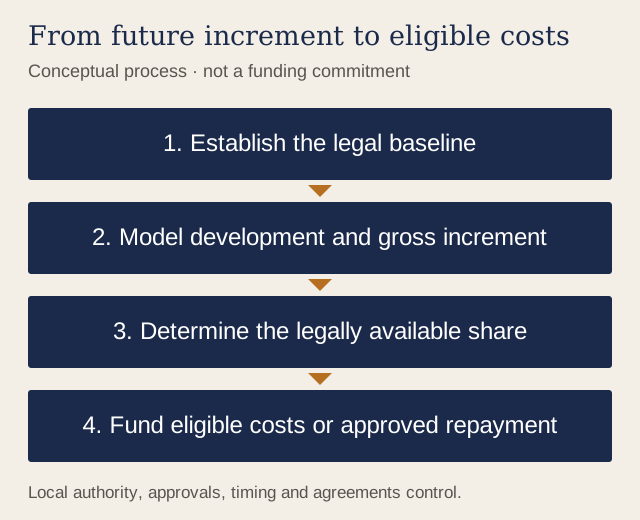
2. How Does TIF Work?
The typical TIF structure involves a public agency, a designated district, an approved development or redevelopment plan, a source of future incremental tax revenue, and an eligible use of the funds.
Step 1: Establish the baseline tax revenue
Suppose a designated district initially generates $500,000 annually in eligible property tax revenue.
This amount represents the simplified baseline for the illustration. Actual baseline calculations, tax rates, assessment rules, and participating taxing jurisdictions depend on local law.
Step 2: Plan the improvements
The government identifies improvements intended to support development.
These may include public roads, utilities, site preparation, environmental remediation, or other eligible costs.
The plan should identify the anticipated development, projected costs, funding requirements, expected tax revenue, and applicable approval process.
Step 3: Development increases assessed value
Assume that private investment and new construction increase the district's annual property tax revenue from $500,000 to $1 million.
The resulting increase is $500,000 annually.
This is the simplified annual tax increment.
Step 4: Allocate the eligible increment
The government determines what portion of the increment is available for TIF purposes.
The amount may be affected by the participation of different taxing jurisdictions, statutory restrictions, administrative costs, collection performance, and the terms of the approved financing.
Not every dollar of additional tax revenue necessarily becomes available to the TIF project.
Step 5: Finance eligible improvements
Depending on the jurisdiction and approved structure, the increment may be used to:
- Repay bonds or other authorized obligations.
- Reimburse a developer for approved eligible costs.
- Fund improvements on a pay-as-you-go basis.
- Support another permitted financing arrangement.
Step 6: Monitor the project and revenue stream
The government or designated agency monitors the project's compliance, the availability of incremental revenue, the repayment obligations, and the performance of the district.
The financing must be structured to account for the possibility that development, assessed values, or tax collections may be lower than projected.
Illustrative TIF calculation
Consider a redevelopment district with the following hypothetical annual tax revenues.
| Item | Annual amount |
|---|---|
| Baseline eligible property tax revenue | $500,000 |
| Projected post-development revenue | $1,000,000 |
| Gross annual tax increment | $500,000 |
| Illustrative participating share | 80% |
| Potential annual TIF allocation | $400,000 |
In this example, the potential annual TIF allocation is $400,000, calculated as the $500,000 increment multiplied by an assumed 80% participating share.
The 80% figure is an illustrative assumption, not a typical rate or an entitlement. Actual allocations depend on the applicable law and agreements.
This simplified calculation does not account for assessment changes, collections, timing, other participating taxing bodies, administrative costs, or financing expenses.
Important: The annual tax increment is not the same as the amount of money a developer can borrow. The amount of financing supported by the increment depends on the timing, duration, reliability, and legal availability of the revenue, along with interest rates, coverage requirements, and transaction costs.
3. How Is a TIF District Established?
TIF is governed primarily by state and local law. The authority to create a district, eligibility standards, public approval procedures, financing structures, and permissible uses vary by jurisdiction.
A typical process includes the following steps.
Identify an eligible area
The municipality or authorized public agency determines whether the area meets the applicable statutory criteria.
Some jurisdictions require findings involving blight, underutilization, redevelopment need, economic distress, or other specified conditions. Other jurisdictions use different criteria.
Developers should not assume that every vacant site or underperforming property qualifies.
Prepare a redevelopment plan
The public agency establishes the proposed boundaries, objectives, improvements, projected costs, funding strategy, and anticipated development impacts.
Depending on the jurisdiction, the plan may require engineering, planning, market, financial, and fiscal-impact analysis.
Evaluate the need for public assistance
Many TIF programs require findings supporting the use of the financing mechanism. These may include a determination that the project would not proceed in substantially the same form without assistance.
The terminology and required evidence vary by state.
An independent feasibility study can help evaluate the project's financial gap, market demand, costs, and sensitivity to alternative funding assumptions.
Obtain public approvals
The process may involve public hearings, legislative action, planning reviews, participation agreements, or approvals from multiple taxing jurisdictions.
The applicable requirements must be confirmed locally.
Establish the financing and reporting arrangements
Once authorized, the financing structure must identify the eligible costs, repayment source, timing, reporting obligations, and responsibilities of the participating parties.
A TIF district can exist without every proposed development receiving funding. Project-specific eligibility and funding approvals remain important.
4. What Costs Can TIF Finance?
Eligible costs depend on state law, local policy, the adopted plan, and the terms of the financing arrangement.
Potential categories may include the following.
Public infrastructure
Infrastructure is a common application of TIF.
Examples include streets, sidewalks, water and sewer extensions, drainage, utilities, public access improvements, and other authorized infrastructure.
These investments may help unlock privately owned sites that would otherwise be too costly or difficult to develop.
Site preparation and environmental remediation
Some programs permit eligible land preparation, demolition, environmental remediation, and related costs.
For brownfield redevelopment, the feasibility analysis should assess environmental conditions, remediation costs, liability allocation, regulatory approvals, and contingency requirements.
Public improvements supporting private development
Certain programs permit public financing or reimbursement for qualifying improvements associated with private development.
Examples may include public parking, streetscape improvements, access roads, and other improvements allowed under the governing statute and approved plan.
Redevelopment of existing properties
Where permitted, TIF may support eligible rehabilitation, reconstruction, land assembly, and other redevelopment costs.
The distinction between eligible and ineligible expenditures must be established before the project budget is finalized.
Professional and financing costs
Some jurisdictions permit specified planning, engineering, legal, financial, administrative, and financing expenses.
These costs should be documented and tested against the applicable program requirements.
What TIF does not automatically pay for
A project should not assume that all land, construction, equipment, marketing, tenant improvements, operating expenses, or developer costs are eligible.
Each proposed expenditure should be reviewed against the governing law, adopted plan, and financing agreement.
5. What Types of Projects Can Benefit from TIF?
TIF may be relevant to a broad range of development and redevelopment projects when the local program permits the proposed use and the project produces a supportable incremental revenue stream.
Multifamily and mixed-use development
Multifamily housing may require substantial upfront expenditure for roads, utilities, drainage, parking, and other site infrastructure.
A TIF structure may help address eligible public improvement costs that otherwise create a financing gap.
The analysis should evaluate achievable rents, household demand, competitive supply, construction costs, lease-up, operating expenses, debt service, and the incremental property tax revenue expected from the development.
Affordable housing may require additional analysis of affordability restrictions, subsidy sources, operating assumptions, and program compatibility.
Downtown redevelopment
Older downtown districts can contain underutilized buildings, obsolete infrastructure, vacant storefronts, and sites requiring substantial investment.
TIF may help support eligible public improvements and redevelopment programs that encourage new commercial activity, residential development, and adaptive reuse.
The analysis should assess market demand, pedestrian activity, parking, tenant demand, competing locations, public investment requirements, and the fiscal implications of the proposed plan.
Industrial and manufacturing development
Industrial projects may require expensive utility extensions, road improvements, drainage, rail access, or specialized infrastructure.
TIF may be considered where the applicable program authorizes the proposed improvements and the development supports credible future revenue.
Feasibility analysis should include industrial demand, tenant or owner requirements, transportation access, labor availability, utility capacity, construction costs, and business operating economics.
Retail and commercial development
Retail projects may generate additional assessed value and, in some jurisdictions, other forms of eligible incremental revenue.
A TIF proposal should be supported by trade-area analysis, consumer spending, traffic and access, competing supply, tenant demand, and projected occupancy.
A large commercial project is not automatically beneficial simply because it generates tax revenue. Its public costs, infrastructure demands, potential displacement, and net fiscal effects should also be evaluated.
Brownfield and adaptive reuse projects
Contaminated sites and obsolete buildings can require substantial upfront investment before they generate productive income.
TIF may help support eligible remediation or redevelopment costs, depending on the program.
The feasibility study should compare rehabilitation, demolition and reconstruction, alternative uses, remediation scenarios, and the timing of potential revenue generation.
Transportation-oriented development
Projects near transit, major roads, or transportation hubs may require infrastructure investments that support new development.
Where permitted, TIF can help finance qualifying infrastructure that supports redevelopment and increased property values.
The project team should assess accessibility, ridership or traffic assumptions where relevant, surrounding land uses, development potential, and the fiscal and financial consequences of the improvements.
6. How Can Developers Obtain TIF Financing?
Developers generally need to engage the relevant public agency early, demonstrate the need for the requested assistance, and present a project that is financially and economically credible.
Step 1: Identify the responsible public agency
Determine whether the municipality, county, redevelopment authority, or another authorized entity administers the applicable program.
Review the local redevelopment plan, TIF district boundaries, application requirements, available funding, and approval calendar.
Step 2: Establish project eligibility
Confirm that the site and proposed improvements qualify under the applicable statute and local plan.
Identify any requirements concerning redevelopment need, public benefit, project timing, eligible expenditures, or other statutory findings.
Step 3: Prepare the development concept and budget
Develop a realistic scope, schedule, cost estimate, and operating or leasing strategy.
Separate potentially eligible costs from costs that must be funded through other sources.
Step 4: Demonstrate the financing gap
A developer should establish why the project cannot reasonably proceed under the proposed market assumptions without the requested assistance, where such a demonstration is required.
The analysis may compare:
- Total project costs.
- Achievable market revenue.
- Available private financing.
- Required equity returns.
- Debt-service capacity.
- Eligible public improvement costs.
- The minimum amount of assistance necessary for feasibility.
A financing gap should be supported by a transparent model, not simply asserted.
Step 5: Quantify the anticipated public benefit
Depending on local requirements, the public agency may examine anticipated investment, employment, redevelopment outcomes, infrastructure improvements, additional tax revenue, housing production, or other policy objectives.
The developer should distinguish gross economic activity from net public benefit and consider the costs and risks assumed by the public sector.
Step 6: Negotiate the structure
Possible arrangements include reimbursement of eligible costs, pay-as-you-go financing, bond-supported financing, or other authorized mechanisms.
The appropriate structure depends on the jurisdiction, the timing of eligible expenditures, the reliability of future revenue, and the allocation of risk.
Step 7: Secure approvals and comply with the agreement
The developer must satisfy applicable approval conditions, documentation requirements, construction obligations, reporting duties, and any performance standards.
TIF should be treated as a potential funding source until the relevant commitments and conditions have been established.
7. How Are TIF Projects Financed?
TIF is often one component of a broader capital stack rather than the sole source of project funding.
Common financing sources
Private equity. Sponsor capital, investment partnerships, family offices, and institutional investors may fund acquisition, development, and other project costs.
Construction loans. Commercial lenders may finance eligible development costs based on the project's economics, collateral, equity contribution, and repayment prospects.
Permanent debt. Stabilized properties may qualify for permanent financing from banks, insurance companies, agency lenders, or other capital providers.
TIF-supported bonds or obligations. Where authorized, future incremental revenue may support repayment of public financing used for eligible improvements.
Developer reimbursement. In a pay-as-you-go arrangement, a developer may fund eligible improvements upfront and receive reimbursement from incremental revenues as they become available, subject to the governing agreement.
Other public incentives. Grants, infrastructure programs, tax credits, or other economic development tools may be available where legally compatible and approved.
Illustrative capital stack
Consider a hypothetical $30 million mixed-use development.
| Capital source | Amount | Share |
|---|---|---|
| Developer and investor equity | $6,000,000 | 20% |
| Construction loan | $18,000,000 | 60% |
| TIF-supported funding | $6,000,000 | 20% |
| Total project capitalization | $30,000,000 | 100% |
This example illustrates how TIF-supported funding might complement private capital. It is not a statement of typical financing terms, a funding commitment, or an assumption that the entire $6 million would be available for unrestricted construction costs.
The actual financing structure depends on eligible costs, the applicable legal authority, projected increment, debt terms, private lender requirements, and public approvals.
How much TIF financing can a project support?
The answer depends on the amount and timing of eligible incremental revenue, the share legally available to the project, financing costs, and repayment requirements.
A financial model should estimate the annual increment under multiple scenarios, calculate the cash flow available for repayment, and test the effect of delayed construction, lower property values, reduced tax collections, and higher interest rates.
The present value of projected incremental revenue may provide an analytical starting point, but it is not automatically equal to the amount of authorized or financeable TIF funding.
8. How Feasibility Studies Help Evaluate TIF Projects
TIF decisions involve both private investment economics and public fiscal considerations.
A project can appear attractive to a developer but create an unacceptable risk for the public agency. Conversely, a project may offer public benefits but remain financially infeasible without changes to its design, costs, phasing, or financing.
An independent feasibility study helps decision-makers evaluate both sides.
Market feasibility
Market analysis evaluates whether the proposed use is supported by actual demand.
Depending on the project, the analysis may cover:
- Population and household trends.
- Employment and income.
- Competitive properties and future supply.
- Rental rates and sales prices.
- Absorption and occupancy.
- Retail trade areas and consumer spending.
- Industrial tenant demand.
- Infrastructure and location advantages.
The results inform the scale, design, phasing, and revenue assumptions of the proposed development.
Development and site feasibility
A site may require substantial public investment but still be unsuitable for its proposed use.
The analysis should consider zoning, permitted uses, environmental conditions, utilities, access, physical constraints, construction requirements, infrastructure capacity, and entitlement risk.
For redevelopment sites, alternative concepts may be evaluated to determine whether a less expensive or more productive use would generate a better result.
Financial feasibility and the financing gap
A financial model should quantify the project's total costs, revenues, operating expenses, financing requirements, and investment returns.
Typical components include:
- Land acquisition and closing costs.
- Hard and soft construction costs.
- Eligible and ineligible public improvements.
- Environmental remediation and site preparation.
- Financing costs, interest reserves, and contingencies.
- Rental, sales, or operating-business revenue.
- Vacancy, concessions, and operating expenses.
- Debt service and refinancing assumptions.
- Investor returns and exit value.
The study can then test whether the project is feasible without TIF, whether TIF addresses a genuine funding gap, and whether a smaller or phased project could reduce the required public contribution.
Incremental tax revenue analysis
The study should model the tax revenue expected under the proposed development scenario and compare it with a credible baseline.
The analysis should account for applicable assessment rules, projected assessed values, relevant tax rates, development timing, collection assumptions, and the share of revenue available to the TIF program.
Where appropriate, it should compare the proposed project with a reasonable no-project or alternative-development scenario.
This is important because a projection of total future property tax revenue is not the same as the incremental revenue legally available to support TIF.
Public fiscal and economic impact
Public agencies may need to evaluate the consequences for municipal services, infrastructure, schools, overlapping taxing jurisdictions, employment, housing, and other local objectives.
A robust analysis distinguishes:
- Gross project investment from net economic benefit.
- New activity from activity that would have occurred anyway.
- Temporary construction employment from ongoing employment.
- Incremental tax revenue from total tax revenue.
- Public infrastructure costs from private development costs.
- Projected benefits from risks and contingent obligations.
Sensitivity and risk analysis
A TIF model should test lower property values, reduced tax collections, construction delays, cost overruns, slower absorption, and changes in financing costs.
For example, if a proposed development produces less incremental revenue than expected, the amount available to repay TIF-supported obligations may decline. The study should identify who bears that risk under the proposed financing structure.
Independent underwriting and decision support
The purpose of the study is to provide a defensible basis for decisions about project scale, financing, public assistance, and investment risk.
A feasibility study does not guarantee TIF approval or funding. It supports the decision-making process with documented assumptions, market evidence, financial calculations, and alternative scenarios.
9. Five Illustrative TIF Case Studies
The following examples are hypothetical illustrations of how TIF feasibility analysis can inform development decisions. They are not actual Wert-Berater engagements, verified transactions, or representations of available funding.
Case Study 1: Multifamily and Mixed-Use Development
Illustrative and hypothetical — not an actual Wert-Berater engagement, verified transaction or available funding commitment.
Project concept: A 200-unit apartment development with ground-floor retail in an underutilized urban district.
Challenge: The site requires substantial utility and streetscape improvements. The developer's initial model indicates that the project cannot support the full cost of these improvements while meeting lender requirements.
Feasibility analysis:
- Evaluate rental demand and competitive apartment supply.
- Test achievable rents, occupancy, concessions, and operating expenses.
- Estimate construction and infrastructure costs.
- Compare alternative unit mixes and development phases.
- Model property tax revenue under different assessed-value scenarios.
- Estimate the potential eligible increment and evaluate its timing.
- Test debt-service coverage and investor returns with and without TIF.
Potential financing: Developer equity, construction debt, and a qualifying TIF-supported infrastructure or reimbursement arrangement, subject to local approval.
Decision supported: Whether to proceed with the proposed scale, reduce infrastructure costs, phase the project, or seek an alternative funding structure.
Key lesson: TIF may help address eligible infrastructure costs, but apartment demand and project-level financial feasibility remain essential.
Case Study 2: Manufacturing and Industrial Expansion
Illustrative and hypothetical — not an actual Wert-Berater engagement, verified transaction or available funding commitment.
Project concept: A new industrial facility intended to accommodate a manufacturer's regional expansion.
Challenge: The site requires road improvements, drainage, and utility extensions before construction can begin.
Feasibility analysis:
- Evaluate regional industrial demand and competing facilities.
- Confirm utility capacity, workforce availability, and transportation access.
- Analyze customer demand and operating-business economics.
- Estimate infrastructure and building costs.
- Review the proposed construction schedule and tenant or owner commitments.
- Model expected property values and incremental tax revenues.
- Test whether projected increment could support the proposed public improvements.
Potential financing: Private equity, industrial construction debt, and eligible TIF-supported infrastructure funding, potentially alongside other approved economic development programs.
Decision supported: Whether to proceed at the proposed location, phase the expansion, or consider a site with lower infrastructure costs.
Key lesson: Industrial TIF projects should be supported by both real estate analysis and credible evidence of business demand.
Case Study 3: Downtown Adaptive Reuse
Illustrative and hypothetical — not an actual Wert-Berater engagement, verified transaction or available funding commitment.
Project concept: Conversion of an obsolete commercial building into residential apartments with neighborhood retail.
Challenge: The building requires extensive rehabilitation, while the downtown market has uncertain tenant demand and the property may have hidden construction costs.
Feasibility analysis:
- Assess structural conditions and rehabilitation requirements.
- Review zoning, accessibility, and code compliance.
- Evaluate residential and retail demand separately.
- Compare adaptive reuse with demolition and new construction.
- Estimate eligible public improvements and other funding needs.
- Model lease-up, operating costs, property values, and incremental revenue.
Potential financing: Developer equity, rehabilitation or construction debt, and eligible TIF support for approved public or redevelopment costs.
Decision supported: Whether adaptive reuse produces a better outcome than alternative uses and whether the public improvements justify the proposed financing.
Key lesson: TIF can be relevant to difficult redevelopment sites, but uncertain rehabilitation costs must be addressed before the financing plan is finalized.
Case Study 4: Brownfield Redevelopment
Illustrative and hypothetical — not an actual Wert-Berater engagement, verified transaction or available funding commitment.
Project concept: Redevelopment of a former industrial site into a commercial and light-industrial business park.
Challenge: Environmental remediation, site preparation, and utility work make the site more expensive to develop than competing properties.
Feasibility analysis:
- Review available environmental information and remediation requirements.
- Estimate site preparation, utility, and infrastructure costs.
- Evaluate competing industrial and commercial locations.
- Determine likely tenant demand and achievable rents.
- Identify potentially eligible costs under the applicable TIF program.
- Model development phasing, incremental tax revenue, and financing repayment.
- Compare the project with alternative remediation and redevelopment strategies.
Potential financing: Sponsor equity, private construction financing, eligible TIF funding, and compatible environmental or economic development assistance where available.
Decision supported: Whether the site can be redeveloped economically, which costs may qualify for assistance, and how environmental and revenue risks should be allocated.
Key lesson: TIF may help bridge eligible redevelopment costs, but environmental liabilities and uncertain market demand cannot be ignored.
Case Study 5: Public Infrastructure Supporting Commercial Development
Illustrative and hypothetical — not an actual Wert-Berater engagement, verified transaction or available funding commitment.
Project concept: A commercial and employment district requiring new roads, drainage, water, sewer, and access improvements.
Challenge: The infrastructure must be constructed before private development can proceed, but the municipality does not wish to fund the entire cost from current revenues.
Feasibility analysis:
- Identify the development capacity supported by the infrastructure.
- Evaluate potential industrial, commercial, and residential demand.
- Estimate the cost and timing of each infrastructure component.
- Project future assessed values under alternative buildout scenarios.
- Calculate the potentially available tax increment.
- Evaluate the amount and timing of funding that could be supported.
- Test delayed absorption, lower assessed values, and higher construction costs.
Potential financing: Authorized TIF-supported obligations or pay-as-you-go reimbursement, combined with private development capital and other eligible infrastructure funding.
Decision supported: Whether to construct all infrastructure at once, phase improvements, or require additional private commitments before proceeding.
Key lesson: Infrastructure timing should be coordinated with credible development demand so that public expenditures do not depend on unsupported assumptions about future growth.
10. TIF Risks and Common Mistakes
TIF can help unlock development, but poorly structured arrangements can create fiscal exposure and project delays.
Overestimating future tax revenue
Incremental revenue may be lower than projected because of slower construction, lower assessed values, changes in tax rates, collection issues, or weaker market conditions.
Models should test downside scenarios rather than rely on a single optimistic forecast.
Assuming TIF approval is guaranteed
A developer may identify a potential funding source but still need to satisfy eligibility criteria, demonstrate public benefits, complete an application, and obtain the required approvals.
Funding should not be treated as committed before the applicable conditions are met.
Confusing project value with available increment
The total value of a new development does not determine the amount of TIF funding available. The applicable baseline, tax rates, participating jurisdictions, allocation percentages, and statutory restrictions must be considered.
Underestimating costs and timing
Construction delays, environmental conditions, infrastructure overruns, and approval delays can increase costs while postponing the tax revenue expected to repay the financing.
Ignoring the public-sector perspective
A project can generate additional property taxes but also create service costs, infrastructure obligations, and other fiscal impacts.
The analysis should consider net public benefits and the distribution of costs and benefits among affected parties.
Using TIF to support a fundamentally weak project
If demand is insufficient or construction costs are excessive, public financing may merely shift risk without creating a sustainable investment.
The appropriate response may be to revise the project, reduce its scale, change its use, or decline to proceed.
Failing to coordinate funding sources
TIF may interact with other public incentives, tax credits, grants, or financing arrangements. Eligibility and compatibility must be checked rather than assumed.
11. TIF Development Feasibility Checklist
Before submitting a TIF proposal or committing development capital, consider the following.
- Identify the responsible public agency and governing TIF legislation.
- Confirm that the site and proposed use meet applicable eligibility requirements.
- Review district boundaries, plans, approval requirements, and deadlines.
- Define the project concept and compare alternative development scenarios.
- Verify market demand, competitive supply, and achievable revenue.
- Prepare a realistic development budget and construction schedule.
- Separate potentially eligible costs from ineligible project expenses.
- Establish a credible baseline for incremental tax revenue.
- Model the amount and timing of potentially available increment.
- Test the financing structure under downside scenarios.
- Evaluate the project's debt-service capacity and equity returns.
- Assess public costs, expected benefits, and potential fiscal risks.
- Identify other funding sources and confirm compatibility.
- Establish compliance, reporting, monitoring, and exit procedures.
12. How Wert-Berater Can Help
Wert-Berater provides independent market intelligence, feasibility analysis, underwriting, financial modeling, and investment due diligence for investors, lenders, developers, owners, and other capital decision-makers.
Since 1998, the firm has supported development and investment decisions through analytical work designed to evaluate market conditions, financial performance, and project risk.
For TIF-supported developments, independent analysis can assist at several stages.
Market intelligence and demand analysis: Evaluate whether the proposed project is supported by demographic, economic, competitive, and property-market conditions.
Development feasibility: Assess alternative uses, development scale, site constraints, construction requirements, and achievable revenue.
Financial modeling and underwriting: Evaluate development costs, operating cash flows, debt-service capacity, investment returns, and sensitivity to changing assumptions.
TIF financing analysis: Support the evaluation of project costs, financing gaps, projected incremental revenue, and alternative financing scenarios. Legal eligibility and final public financing decisions remain with the appropriate authorities and professional advisers.
Investment due diligence: Provide independent analytical support to developers, investors, lenders, and public-sector decision-makers evaluating a proposed project.
Asset and portfolio performance monitoring: Compare actual performance with underwriting assumptions and identify material deviations after acquisition, development, or stabilization.
Learn more about Wert-Berater's feasibility study services, review the firm's experience, or explore asset and portfolio performance monitoring.
Evaluating a TIF-supported development?
Before committing capital or requesting public assistance, evaluate market demand, project costs, incremental revenue assumptions, financing capacity, and downside risk.
An independent feasibility study can help determine whether the proposed development is economically justified, whether the financing gap is supported by evidence, and which alternative strategies may improve the project's prospects.
13. Frequently Asked Questions About Tax Increment Financing
What is TIF in simple terms?
Tax Increment Financing is a public financing mechanism that uses some or all of designated future increases in tax revenue to help finance eligible improvements or repay authorized obligations.
How does TIF generate money?
A qualifying district has a baseline tax revenue amount. As property values or other eligible tax bases increase, the resulting increment may be allocated to authorized project costs or financing obligations, depending on applicable law and agreements.
Is TIF a tax credit?
Not in the usual sense. TIF is generally a public financing mechanism that allocates designated future tax revenue increases. It is not automatically a federal income tax credit or a direct grant to a developer.
Does a developer receive TIF money directly?
Potentially, depending on the approved structure. A developer may receive reimbursement for eligible costs, or the public agency may use the increment to repay bonds or finance improvements. The arrangement depends on local law and the project agreement.
What types of projects can use TIF?
Potential uses include infrastructure, redevelopment, multifamily housing, mixed-use projects, industrial facilities, downtown revitalization, and brownfield redevelopment, where authorized by the relevant program.
How much TIF financing can a project receive?
There is no universal amount. Funding depends on eligible costs, projected tax increment, legal restrictions, public approvals, financing terms, and the project's ability to support the proposed structure.
Does TIF increase property taxes?
TIF does not necessarily impose an additional tax rate. It generally allocates designated incremental revenue under the applicable legal framework. The treatment of tax revenue, assessments, and participating jurisdictions varies by state and locality.
Can TIF be combined with other incentives?
Potentially. Some projects combine TIF with private debt and equity, grants, tax credits, or other economic development programs. Each source must be evaluated for eligibility, compatibility, and timing.
Why is a feasibility study important for TIF?
A feasibility study evaluates market demand, project costs, expected revenue, financing requirements, potential incremental tax revenue, and downside risks. It helps decision-makers determine whether the project is economically supportable and whether public assistance is justified.
Does TIF guarantee that a project will be financed?
No. TIF approval and funding are subject to the relevant legal, financial, and public approval requirements. Developers still need a viable project and an acceptable financing structure.
Where can I find official TIF guidance?
The Federal Highway Administration's TIF overview explains the general mechanism. Developers should also consult the relevant state statutes, local redevelopment plans, and the administering public agency.
About Wert-Berater
Wert-Berater is an independent market intelligence and feasibility advisory firm serving investors, lenders, developers, owners, and other capital decision-makers.
Its services include market analysis, feasibility studies, underwriting, financial modeling, investment due diligence, and asset and portfolio performance monitoring.
Visit www.wert-berater.com to learn more.
*Disclaimer: This article is for general informational purposes only and is not legal, tax, accounting, lending, or investment advice. TIF laws, eligible costs, approval requirements, and financing structures vary by jurisdiction and may change. Project sponsors should obtain professional advice regarding the requirements applicable to their proposed development.*
Discuss a TIF feasibility engagement
Evaluate demand, development costs, the financing gap, potentially available increment and downside scenarios before committing capital or seeking public assistance.
Please do not send confidential financial, investor or borrower information through a general inquiry.
Related research and services
Official sources and important limitations
Primary sources checked October 15, 2026. This is an editorial source check, not a legal opinion or approval of a particular district, project or financing.
- Federal Highway Administration — Tax Increment Financing: general mechanism, bonds, pay-as-you-go reimbursement and state-law variation
- Texas Comptroller — Chapter 311: one jurisdiction's TIRZ framework and taxing-unit participation
This article is for general informational purposes only and is not legal, tax, accounting, lending, municipal advisory, or investment advice. TIF authority, eligible costs, participating revenues, approval requirements, and financing terms vary by state and locality. Developers and public agencies should consult the governing law, adopted plans, project agreements, and appropriately qualified advisers before relying on a financing structure.
Neither a feasibility study nor these hypothetical examples guarantee TIF approval, financing, tax revenue or investment returns. The annual allocation example and capital-stack example are separate illustrations: the $400,000 annual allocation does not establish support for the $6 million TIF component in the capital stack.
Engineering, structural and environmental conclusions require the relevant qualified specialists; analytical work can evaluate their findings rather than substitute for their inspections. This article does not offer municipal securities underwriting or placement. Legal eligibility, bond issuance and regulated municipal advisory services require appropriately qualified advisers.